




India-UK Free Trade Agreement
| General Studies Paper II: International Treaties and Agreements, Impact of Countries’ Policies and Politics on India’s Interests |
Why in News?
The landmark India-UK Free Trade Agreement will officially take effect on July 15, significantly boosting bilateral economic cooperation.
What is the India–UK Free Trade Agreement?
- About: The India–UK Free Trade Agreement (FTA), officially the India-UK Comprehensive Economic and Trade Agreement (CETA), is India’s most significant bilateral trade pact with a major European economy after Brexit.
- Timeline: Formal negotiations for the Free Trade Agreement (FTA) commenced in January 2022 under former UK PM Boris Johnson.
- After 15 rounds of rigorous talks, the sweeping trade pact was concluded on May 6, 2025.
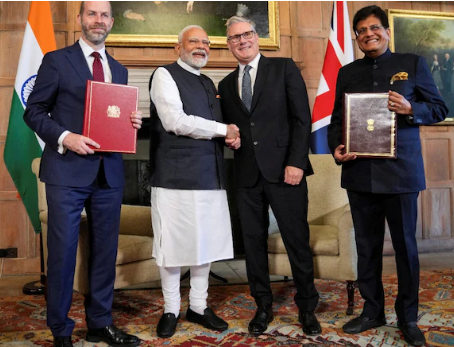
- The agreement was signed on 24 July 2025, during Indian Prime Minister Narendra Modi’s official visit to London.
- It will enter into force on 15 July 2026.
- Features:
- Zero-Duty Goods Access: The UK will eliminate tariffs on 99% of Indian exports to the UK, allowing entry into a largely duty-free market. This covers the entirety of bilateral trade value.
- It will significantly benefit labor-intensive industries by replacing prior import tariffs ranging from 8% to 20%.
- It will benefit textiles, apparel, leather, footwear, gems & jewellery, engineering goods, chemicals, furniture, machinery, and auto components sectors.
- Boost to Key MSMEs: Sectors with high employment—including textiles, leather footwear, marine products, gems and jewelry, sports goods, and toys— will receive maximum benefit from the eliminated tariffs.
- This duty-free access will empower women-led enterprises and MSME hubs across Indian cities like Agra, Kanpur, and Chennai.
- Services and Mobility: The agreement delivers highly ambitious commitments in services, particularly for IT/ITeS, financial services, and education.
- It will ease temporary mobility for contractual service suppliers and independent professionals, facilitating annual allowances for Indian professionals like yoga instructors, musicians, and chefs.
- Social Security Agreement: Both nations signed a Double Contribution Convention Agreement (Social Security Agreement).
- This provision protects migrating professionals by ensuring they are not double-taxed or forced to pay national insurance and social security contributions in both countries.
- It grants UK firms access to India’s non-sensitive government procurement market, increasing transparency and investment flows.
- Protection of Sensitive Sectors: India retained its policy sovereignty by fully safeguarding its sensitive sectors. Dairy, cereals, millets, pulses, and vegetables remain strictly protected to defend the livelihoods of Indian farmers.
- High-value items like gold jewelry, lab-grown diamonds, and critical polymers are similarly protected.
- Industrial and Auto Sector Access: The UK will eliminate import duties on Indian-made machinery, tools, and auto parts.
- Conversely, India will reduce import tariffs on automobiles (cut to 10% under a specific quota, down from over 100%) and will gradually reduce tariffs on UK Scotch whiskey.
- Tariffs on British whisky and gin will fall from 150% to 75% initially, reaching 40% within ten years.
- Pharmaceuticals and Healthcare: The FTA facilitates simpler regulatory pathways and faster approvals for Indian pharmaceutical products entering the UK.
- This will strengthen India’s role as a reliable global supplier, particularly for generic medicines procured by the National Health Service (NHS).
- Agriculture and Food Processing: Tariffs will be slashed on 99.7% of processed food lines, dropping from previous highs of up to 70% to zero.
- This will open the lucrative UK market to high-value niche Indian agricultural exports like tea, mangoes, grapes, and spices.
- Innovation and Technology: The pact features a first-of-its-kind Innovation Chapter designed to accelerate trade in innovative products.
- It outlines provisions for joint cooperative activities in emerging technologies, facilitating dynamic learning, joint ventures, and renewable energy infrastructure investments.
- Trade Projections and Milestones: Designed to shape bilateral economics up to 2040, the agreement establishes a target to double the USD 60 billion bilateral trade to USD 120 billion by 2030.
- UK assessments estimate gains of £4.8 billion in GDP, £2.2 billion in annual wages, and £25.5 billion additional bilateral trade in the long run.
- Import-duty savings are projected at £400 million immediately, rising to £900 million after ten years.
- The deal acts as India’s most comprehensive trade pact with a G-7 nation.
- Zero-Duty Goods Access: The UK will eliminate tariffs on 99% of Indian exports to the UK, allowing entry into a largely duty-free market. This covers the entirety of bilateral trade value.
Significance of the India–UK FTA
- Global Value Chain Integration: The FTA helps India move beyond low-cost manufacturing into high-value global value chains through easier access to British technology, advanced manufacturing inputs, and innovation ecosystems. It aligns with India’s export-led growth strategy.
- Customs Modernisation: The agreement introduces electronic documentation, advanced customs rulings, single-window clearances, and faster cargo processing, reducing transaction costs and logistics delays for exporters.
- Boost to MSME Internationalisation: Dedicated provisions support Micro, Small and Medium Enterprises (MSMEs) through simplified procedures, transparency measures, and easier market information access, enabling greater participation in international trade.
- Strengthening Rules-Based Trade: At a time of rising protectionism, the FTA reinforces a rules-based trading framework, offering greater predictability, dispute-settlement mechanisms, and legal certainty for businesses and investors.
- Innovation and Knowledge Partnership: Beyond tariffs, the pact promotes collaboration in digital trade, telecommunications, financial services, professional services, research, and innovation, creating long-term economic competitiveness.
Challenges of the India–UK FTA
- Complex Rules of Origin Compliance: Exporters must satisfy Regional Value Content (40–45%) and transformation requirements. Smaller firms may face compliance costs and documentation burdens to qualify for tariff benefits.
- Non-Tariff Barriers Remain: Even with tariff reductions, exporters must comply with stringent UK sanitary, phytosanitary, quality, environmental, and technical standards, which can limit actual market access.
- Pressure on Domestic Industries: Lower tariffs could increase competition for Indian producers in sectors exposed to premium British products, requiring productivity improvements and technological upgrading.
- Carbon and Sustainability Regulations: Future environmental measures and carbon-related regulations could raise compliance costs for Indian exporters, particularly in energy-intensive sectors such as metals and manufacturing.
- Unequal Competition in Agriculture: The agreement may lead to a sharp fall in prices of spices, tea, and other agricultural products.
- These sectors are already in a weak position due to WTO’s outdated subsidy calculations. It will be hard to compete with cheap imported goods.
IMPORTANT POINTS:
- A Free Trade Agreement (FTA) is a treaty between two or more countries aimed at reducing or eliminating trade barriers, such as tariffs, quotas, and regulatory hurdles.
- India currently has 16 signed Free Trade Agreements (FTAs) along with several limited Preferential Trade Agreements (PTAs).
- In recent years, India has secured 9 massive trade pacts in a span of just 6 years, covering 38 developed countries and encompassing nearly two-thirds of the global GDP.
- India’s recent and highly impactful FTAs/trade deals include:
- European Union (EU) FTA: Signed in January 2026, creating market access across 27 member states.
- United Kingdom (UK) Comprehensive Economic and Trade Agreement (CETA): Signed in July 2025.
- Oman Comprehensive Economic Partnership Agreement (CEPA): Concluded/signed in December 2025.
- New Zealand FTA: Announced in December 2025, providing strong access for agroforestry, farmers, and IT professionals.
- EFTA TEPA: Signed with European Free Trade Association members in 2024 and operationalized in October 2025.
- Australia (Ind-Aus ECTA): Implemented in December 2022.
- UAE CEPA: Implemented in May 2022.
- Mauritius CECPA: Implemented in 2021.
- United States (USA) Framework: An interim framework agreement announced in February 2026 to enhance reciprocal trade and secure resilient supply chains, but final agreement not done yet.
- Other Regional Pacts: Includes agreements with Japan, South Korea, Singapore, ASEAN nations, and SAFTA block (which includes Sri Lanka, Nepal, and Bhutan).
- India is actively negotiating trade agreements with: United States, Canada, Peru, Chile, Gulf Cooperation Council and Eurasian Economic Union.
FAQs:
1. When will the India-UK Free Trade Agreement come into effect?
The India–UK Comprehensive Economic and Trade Agreement (CETA) will officially enter into force on 15 July 2026, following completion of implementation procedures.
2. What are the key features of the India-UK FTA?
Key features include tariff reductions, expanded market access, services liberalisation, investment facilitation, customs cooperation, professional mobility, and social-security contribution exemptions.
3. How will the FTA benefit India and the UK?
The agreement boosts bilateral trade, lowers business costs, increases investment flows, enhances export competitiveness, creates jobs, and strengthens economic integration.
4. Which sectors will benefit from the trade agreement?
Major beneficiaries include textiles, apparel, leather, pharmaceuticals, chemicals, gems, jewellery, automobiles, financial services, technology, food products, and manufacturing.
5. Why is the India-UK Free Trade Agreement significant?
It deepens strategic partnership, strengthens supply-chain resilience, expands market opportunities, supports economic growth, and reinforces rules-based international trade cooperation.
| Also Read: India-EU Trade Relations |