




Union Secretary Extension Approved for Cabinet and Home Bureaucrats
| General Studies Paper III: Growth & Development, Government Policies & Interventions, |
Why in News?
Recently, the government’s Union Secretary Extension decision approved a one-year tenure extension for Cabinet Secretary Dr. T.V. Somanathan and Home Secretary Govind Mohan.
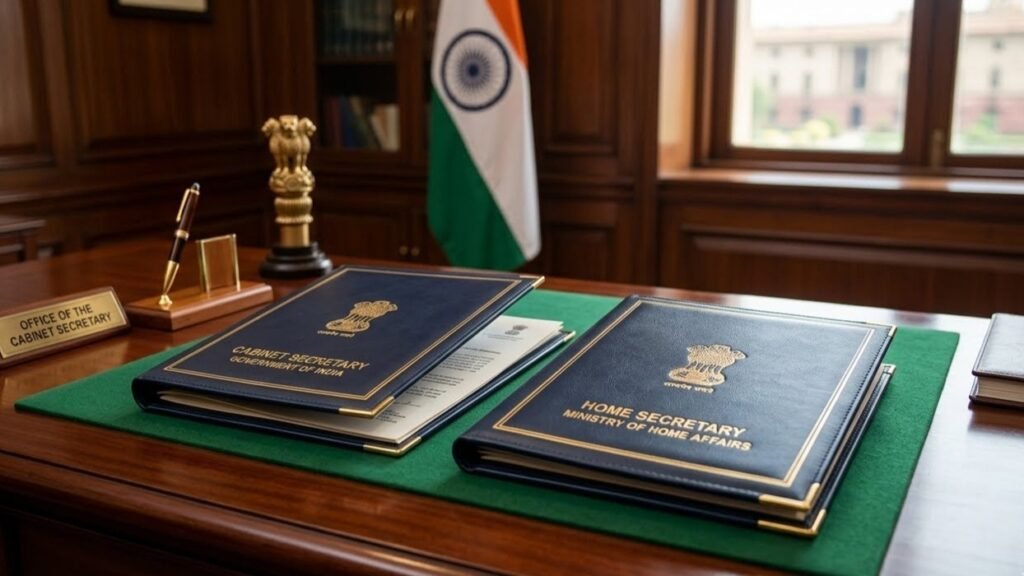
Recent Union Secretary Extension Highlights
- Approval: On 5 August 2026, the union government approved a one-year extension for Cabinet Secretary Dr. T. V. Somanathan and Home Secretary Govind Mohan.
- The extensions were granted under the Fundamental Rule (FR) 56(d) and Rule 16(1A) of the All India Services (Death-cum-Retirement Benefits) Rules, 1958.
- This decision was taken by the Appointments Committee of the Cabinet (ACC), chaired by the Prime Minister.
- The Department of Personnel and Training (DoPT) issued the formal notification implementing the extension orders for both officers.
- Dr. T. V. Somanathan: He is India’s 33rd Cabinet Secretary, the senior-most IAS officer and head of the permanent civil service.
- He assumed office on 30 August 2024 after succeeding Rajiv Gauba.
- He holds a Ph.D. in Economics from the University of Calcutta.
- He completed an Executive Development Program at Harvard Business School, and is a qualified Chartered Accountant, Cost Accountant, and Company Secretary.
- He belongs to the 1987 IAS batch of the Tamil Nadu cadre. In the 1987 UPSC Civil Services Examination, he secured All India Rank 2.
- He served in the Prime Minister’s Office, Ministry of Corporate Affairs, Government of Tamil Nadu, and held senior responsibilities in finance, planning, taxation, and infrastructure administration.
- He also served as Finance Secretary and Secretary, Department of Expenditure.
- His experience as former Finance Secretary enhanced fiscal governance and policy execution.
- He also worked with the World Bank Group in Washington through its prestigious Young Professionals Program.
- He helped shape major economic relief and growth programs, including Aatmanirbhar Bharat and the PM Garib Kalyan Yojana.
- He contributed to the rollout and framework of the Production Linked Incentive (PLI) schemes.
- He headed the high-level committee that reviewed the National Pension System, leading to the creation of the Unified Pension Scheme (UPS).
- Govind Mohan: He is the Union Home Secretary of India and a 1989-batch IAS officer of the Sikkim cadre.
- He assumed office on 23 August 2024, succeeding Ajay Kumar Bhalla.
- He earned a B.Tech in Electrical Engineering from the Institute of Technology, Banaras Hindu University (BHU) and a Post Graduate Diploma in Management from Indian Institute of Management (IIM) Ahmedabad.
- Govind Mohan has served in both the Government of Sikkim and the Government of India.
- His important assignments include Secretary, Ministry of Culture, Additional Secretary and Joint Secretary in the Ministry of Home Affairs, and Joint Secretary, Department of Economic Affairs.
- As Culture Secretary, he helped coordinate Azadi Ka Amrit Mahotsav and Har Ghar Tiranga.
- Govind Mohan contributed significantly during the COVID-19 pandemic by coordinating policy implementation between the Union Government and States.
- He supervised internal security, border management, Centre–State coordination, and the functioning of Central Armed Police Forces (CAPFs).
- From 2012 to 2015, he served as the Minister (Economic) at the Indian Embassy in Washington, D.C.
Union Secretary in India: Meaning, Appointment and Responsibilities
- Meaning: A Union Secretary or Secretary to the Government of India is the highest-ranking civil servant in a Union Ministry or Department.
- The Secretary serves as the administrative head, principal policy adviser to the Minister, and Chief Accounting Authority of the Ministry.
- Administrative responsibility is complete and undivided.
- Appointment Process: Union Secretaries are generally senior IAS officers empanelled for Secretary-level posts.
- Appointments are approved by the Appointments Committee of the Cabinet (ACC), chaired by the Prime Minister, based on merit, seniority, integrity, and experience.
- Basis: The post is not directly created by the Constitution.
- It functions under Article 77, the Government of India (Transaction of Business) Rules, 1961, and Allocation of Business Rules, 1961.
- The Manual of Office Procedure issued by the Department of Administrative Reforms and Public Grievances (DARPG) defines the Secretary’s powers and responsibilities.
- Position: The Cabinet Secretary is the senior-most civil servant in India.
- Below him are Secretaries, followed by Special Secretaries, Additional Secretaries, Joint Secretaries, Directors, Deputy Secretaries, and Under Secretaries.
- Responsibilities: A Union Secretary formulates policies, supervises implementation, coordinates departments, advises the Minister, manages finances, and monitors flagship schemes.
- Secretaries prepare Cabinet Notes, evaluate policy proposals, and provide evidence-based advice before decisions reach the Union Cabinet.
- As Chief Accounting Authority, the Secretary oversees budget preparation, expenditure control, audits, and financial discipline.
- The Secretary also represents the Ministry before the Parliamentary Committees, including the Public Accounts Committee, explaining policies and utilization of public funds.
- Union Secretaries coordinate with States, constitutional bodies, autonomous institutions, regulators, and other Ministries.
- They resolve inter-departmental issues and ensure uniform implementation of national programmes through effective administrative coordination.
- Important Positions: It includes:
- Cabinet Secretary: The top-most executive official and senior-most civil servant, heading the Cabinet Secretary (India) and serving as the ex-officio head of the IAS.
- Home Secretary: The administrative head of the Ministry of Home Affairs, overseeing internal security and central police organizations.
- Defence Secretary: The administrative head of the Department of Defence within the Ministry of Defence.
- Foreign Secretary: The administrative head and top diplomat leading the Ministry of External Affairs (India).
- Finance Secretary: A specific senior designation assigned to one of the secretaries serving within the Union Ministry of Finance (typically heading the Department of Economic Affairs).
- Revenue Secretary: The senior administrative official in charge of the Department of Revenue under the Ministry of Finance.
- Health Secretary: The administrative head managing policies and implementation for the Ministry of Health and Family Welfare.
- Note: A Union Minister is a political executive responsible to Parliament, whereas the Union Secretary is a permanent civil servant responsible for administration and policy execution.
Frequently Asked Questions (FAQs):
1. Why have Dr. T.V. Somanathan and Govind Mohan received a one-year extension?
To ensure administrative continuity, policy stability, and effective governance in key Union ministries.
2. What are the responsibilities of the Cabinet Secretary?
Coordinates ministries, advises the Prime Minister, heads the civil service, and ensures smooth government functioning.
3. What role does the Union Home Secretary perform?
Leads the Ministry of Home Affairs, overseeing internal security, border management, and Centre–State coordination.
4. Who approves service extensions for senior bureaucrats?
The Appointments Committee of the Cabinet (ACC), chaired by the Prime Minister.
5. How long is the extension granted to both officials?
Both officials received a one-year service extension beyond their scheduled retirement.
6. What are the major achievements of Dr. T.V. Somanathan?
Strengthened fiscal management, administrative reforms, expenditure efficiency, and inter-ministerial policy coordination.
Disclaimer: Information in this article is based on official announcements and public records. Regulations and implementation details may evolve over time.