



10th India-Thailand Defence Dialogue
| General Studies Paper II: Bilateral Groupings & Agreements |
Why in News?
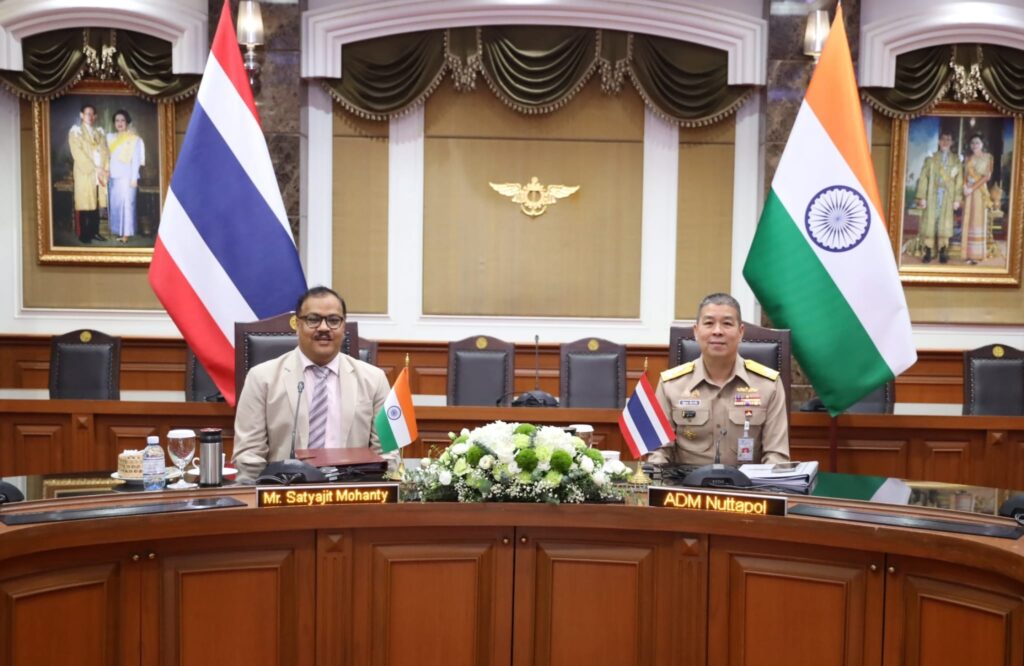
The 10th Thailand-India Defence Dialogue took place in Bangkok on June 16, 2026, to review the full spectrum of bilateral defence cooperation.
Highlights of 10th India–Thailand Defence Dialogue
- Leadership: The 10th India–Thailand Defence Dialogue was co-chaired by Satyajit Mohanty, Joint Secretary (Ministry of Defence, India), and Admiral Nuttapol Diewvanich, Thailand’s Deputy Permanent Secretary for Defence.
- Indo-Pacific Security: Both countries assessed the evolving Indo-Pacific security environment and exchanged views on emerging regional developments.
- They reaffirmed their commitment to ensuring peace, stability and prosperity in one of the world’s most strategically important maritime regions.
- They discussed strengthening maritime cooperation, including efforts related to regional security, sea-lane stability and common maritime challenges.
- Defence Manufacturing: They reaffirmed the decision to deepen cooperation in defence manufacturing, and Thailand’s modernization requirements.
- The dialogue emphasized mutually beneficial industrial linkages.
- Research and Innovation: The two sides agreed to expand collaboration in defence research, innovation and technology development, highlighting the growing importance of indigenous capabilities and advanced military technologies.
- Capability Development: Discussions focused on enhancing capability development through knowledge sharing, institutional cooperation and defence ecosystem partnerships.
- Both nations emphasized expanding training exchanges and capacity-building programmes, which remain key pillars of India–Thailand defence cooperation.
- Military-to-Military Engagements: Delegations reviewed ongoing military exchanges, service-level interactions and defence cooperation activities conducted since the previous dialogue.
- Regional Framework: The dialogue reviewed cooperation under ASEAN-led defence mechanisms and other multilateral platforms.
- Both sides stressed collective approaches to addressing shared security challenges in Southeast Asia and the wider Indo-Pacific.
India–Thailand Relations
- Historical Tiles: India and Thailand share over 2,000 years of civilizational links rooted in Buddhism, Hindu traditions, trade, language, art and culture.
- Buddhism was introduced to Thailand around the 3rd century BCE via missionaries sent by the Indian Emperor Ashoka. It remains the spiritual cornerstone of both societies.
- The Thai language and script are heavily derived from Indian roots. Elements of Sanskrit and Pali are deeply embedded in Thai religious texts, chants, royal titles, and everyday speech.
- The Hindu epic Ramayana is retold in Thailand as the Ramakien, permeating Thai classical dance, theatre, and mural paintings.
- Thai temple architecture (Watts) features spires reminiscent of Indian shikharas.
- Thai royalty has historically adopted the title “Rama“. Even today, the Thai monarchy incorporates Hindu Brahmanical traditions into its royal ceremonies and coronations.
- Diplomatic Ties: Formal diplomatic relations between India and Thailand were established in 1947 shortly after Indian independence.
- Both countries are guided by India’s Act East Policy and Thailand’s Act West Policy, creating a framework for sustained diplomatic coordination.
- Co-chaired by the Foreign Ministers, Joint Commission Meetings (JCM) is the highest mechanism for reviewing all aspects of bilateral relations.
- The 10th round of the JCM was held in New Delhi on February 27, 2024, to discuss broad diplomatic and regional cooperation.
- Both countries celebrated the 75th anniversary of diplomatic ties in 2022, providing a strong historical foundation for contemporary cooperation.
- Foreign Office Consultations (FOC) meetings review bilateral, regional, and multilateral issues. The 7th round of the FOC was convened on August 7, 2023, in Bangkok.
- Leaders maintain frequent contact on the margins of regional and global forums. For instance, Prime Minister Narendra Modi and Prime Minister Paetongtarn Shinawatra met in October 2024 at the ASEAN summits to discuss regional cooperation.
- Diplomatic groundwork is supported by specialized institutional mechanisms, including Joint Working Groups on Security Cooperation, Consular Matters, and Visa matters.
- In 2025, both nations officially elevated their ties to a Strategic Partnership, focusing on deepening cooperation, and enhancing regional stability.
- Trade & Economic Ties: Thailand is among India’s most important ASEAN economic partners and was India’s 4th largest trading partner in ASEAN in 2023.
- Bilateral trade between India and Thailand reached US$20.93 billion in 2025, expanding from US$16.51 billion in 2024.
- Major Exports (India to Thailand), precious stones, marine products, organic chemicals, and engineering goods.
- Major Imports (India from Thailand), electrical and electronic components, gold, plastic raw materials, and vegetable oils.
- Thailand is one of the leading sources of Foreign Direct Investment (FDI) in India among ASEAN countries, heavily investing in infrastructure, electronics, automotive, and renewable energy sectors.
- Major Indian conglomerates like Tata Steel, Aditya Birla Group, and Tech Mahindra have established operations in Thailand.
- Meanwhile, Thai companies like Charoen Pokphand (CP) Group and Delta Electronics have active footprints in the Indian market.
- Both governments have identified early-harvest pathways in high-tech and future-forward sectors, including semiconductors, artificial intelligence, automotives, and MSME integration.
- The proposed India-Thailand Comprehensive Economic Cooperation Agreement (CECA) is an overarching free trade pact currently under negotiation.
- Thai goods have benefited from tax reduction under the ASEAN–India Trade in Goods Agreement (AITIGA), which came into effect on 1 January 2010.
- Defence & Security Partnership: India and Thailand’s defense and security partnership is anchored by the 2012 MoU on Defence Cooperation.
- This MoU lays the foundation for ongoing bilateral defense initiatives, directing cooperation across the armed forces.
- Joint Working Group on Security Cooperation initiated in 2003, this council oversees joint efforts across seven focus areas, including military cooperation.
- Because Thailand shares strategic maritime borders with India, both navies hold joint patrols along the International Maritime Boundary Line (IMBL) to combat piracy, smuggling, and terrorism.
- Joint exercises, such as the in-situ drills between the Indian Air Force (IAF) and the Royal Thai Air Force (RTAF), help enhance mutual understanding and tactical coordination.
- Defense Exercises: Exercise MAITREE (Army), Exercise SIAM BHARAT (Air Force), India-Thailand Coordinated Patrol (Navy).
- The MoU facilitates regular officer training at each other’s Armed Forces Training institutions and Subject Matter Expert (SME) exchange visits.
- People-to-People Connect: Thailand is home to a vibrant and longstanding Indian diaspora, consisting of an estimated 150,000 to 200,000 people of Indian origin, primarily residing in Bangkok.
- India has actively shared Lord Buddha’s holy relics with Thailand, drawing millions of Thai devotees. The Ramayana remains deeply woven into Thai literature, classical dance (Khon), and art.
- Over 400 weekly flights connect more than 15 Indian cities to Thailand, making it one of the most accessible international getaways for Indian travelers.
- Thailand offers a 60-day visa-free entry for Indian passport holders, the country attracted nearly 2.5 million Indian tourists.
- Thailand features several India Studies Centers, and prominent Thai royals (such as Princess Maha Chakri Sirindhorn) have been honored with the Padma Bhushan for fostering language and education ties.
- Connectivity Projects: The flagship infrastructure connecting India and Thailand is the India-Myanmar-Thailand (IMT) Trilateral Highway.
- Spanning approximately 1,360 km, this ambitious four-lane route aims to link Moreh in Manipur, India, to Mae Sot in Thailand, passing through Mandalay and Yangon in Myanmar.
- The highway is designed to serve as the physical spine for the future ASEAN-India Connectivity Corridor.
- Countries are finalizing this cross-border facilitation agreement. Once fully implemented, it will be the first-ever agreement of its kind between South and Southeast Asia.
- Also Mekong-India Economic Corridor (MIEC) is a proposed multi-modal trade route linking India’s eastern seaports (primarily Chennai) to the Greater Mekong Sub-region (Vietnam, Myanmar, Thailand, and Cambodia). It integrates maritime shipping and land routes to reduce transit times, slash supply-chain costs, and boost bilateral commerce.
- Technology & Education: A MoU signed between India’s Ministry of Electronics and Information Technology (MeitY) and Thailand’s Ministry of Digital Economy and Society establishes direct cooperation in digital technologies and financial connectivity.
- Both countries actively promote exchange programs for entrepreneurs and SMEs. The framework facilitates business matchmaking, cross-incubation models, and investor pitching.
- Collaboration is being aggressively pushed into advanced sectors, including Artificial Intelligence (AI), semiconductors, robotics, biotechnology, renewable energy (like the Bio-Circular-Green Economy), and space exploration.
- NPCI has partnered with Liquid Group to facilitate UPI-based QR payments in Thailand and other Asian countries.
- India offers dedicated Ph.D. slots specifically for students and researchers from Thailand to study at premier Indian Institutes of Technology (IITs).
- Indian Science and Research Fellowship (ISRF) provides research grants and fellowships for Thai scientists to conduct research in Indian technology and science institutions.
- Universities like IIT Guwahati are actively engaging with Thai academic delegations to establish strong student exchange.
- Regional & Multilateral Cooperation: Both nations collaborate actively across regional and multilateral frameworks:
- ASEAN (Association of Southeast Asian Nations): Thailand is a core ASEAN member, and India is a strategic dialogue partner, cooperating on trade, connectivity, and digital integration.
- BIMSTEC (Bay of Bengal Initiative for Multi-Sectoral Technical and Economic Cooperation): The premier sub-regional group connecting South and Southeast Asia. Both countries partner closely on trade, energy, and counter-terrorism.
- Mekong-Ganga Cooperation (MGC): Fosters ties between India and five Mekong countries (including Thailand) in tourism, culture, education, and transportation.
- East Asia Summit (EAS): The premier forum for strategic dialogue in the Indo-Pacific, where both nations address regional security and geopolitical challenges.
- Indian Ocean Rim Association (IORA): Thailand and India both participate in this organization to promote maritime safety, security, and sustainable economic development in the Indian Ocean.
FAQs:
1. What is the India–Thailand 10th Defence Dialogue?
The 10th Defence Dialogue is a bilateral mechanism reviewing India–Thailand defence cooperation and discussing regional and global security issues.
2. What were the key outcomes of the defence dialogue?
Both countries agreed to deepen cooperation in defence manufacturing, research, innovation, capability development, training and maritime security.
3. Why is defence cooperation between India and Thailand important?
It strengthens strategic partnership, addresses shared security challenges, enhances military interoperability and supports stability in the Indo-Pacific region.
4. How does the dialogue strengthen Indo-Pacific security?
The dialogue promotes cooperation on maritime security, regional stability, peace, prosperity and ASEAN-led security frameworks in the Indo-Pacific.
5. When was the 10th India–Thailand Defence Dialogue held?
The 10th India–Thailand Defence Dialogue was held in Bangkok on 16 June 2026.