




Discovery of New Forester Moth Mimusemia Kali
| General Studies Paper lI: Biodiversity, Conservation |
Why in News?
Recently, scientists discovered Mimeusemia kali, a new forester moth species in Karnataka’s Kali Tiger Reserve, marking the first addition to its genus in nearly 30 years.
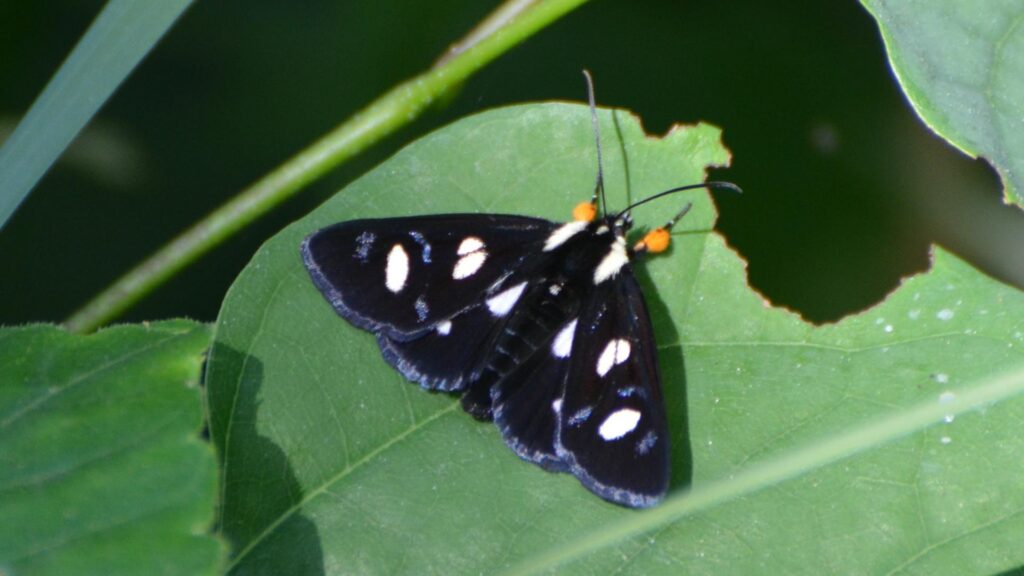
Highlights of Newly Discovered Mimeusemia kali
- Discovery: Scientists from the Zoological Survey of India (ZSI) discovered Mimeusemia kali, a new forester moth species.
- It is an incredible biological discovery, standing as the very first addition to the Mimeusemia genus in 30 years (since 1995).
- Publication: The documentation of this discovery was published in Zootaxa.
- It is a globally respected, peer-reviewed international scientific journal dedicated to animal taxonomy.
- Scientific Naming: The new moth was formally named Mimeusemia kali Kalawate & László, 2026.
- Location: The new insect species was discovered deep inside the Kali Tiger Reserve, located in the Uttara Kannada district of Karnataka.
- Discovered By: The identification was spearheaded by taxonomist Aparna Kalawate from the Western Regional Centre of the Zoological Survey of India (ZSI), Pune.
- The study was conducted in close global collaboration with Gyula M. László, who serves as the Senior Curator at the renowned Natural History Museum, London.
- Taxonomy: Mimeusemia kali belongs to the charismatic group of insects collectively known as forester moths.
- It is categorized under the diverse Noctuidae family, and more specifically within the Agaristinae subfamily.
- Characteristics: Mimeusemia kali was distinguished from its closest relatives based on highly distinct phenotypical markings and colour patterns.
- It shares structural similarities with sister taxa like Mimeusemia davidsoni and Mimeusemia basalis.
- Mimeusemia davidsoni was first discovered in India in 1899. It lives in the Karwar region of Karnataka. The moth has bright wing patterns.
- Mimeusemia basalis was first named by scientists in 1854. It lives across India and Asia. The caterpillars of this moth love to eat Dillenia plant leaves.
- The male and female genitalia of the newly discovered moth are highly unique, serving as the most definitive physical characteristic.
- Similar to other closely related forester moths, Mimeusemia kali is primarily day-flying.
- It shares structural similarities with sister taxa like Mimeusemia davidsoni and Mimeusemia basalis.
- DNA Barcoding: The morphological observations were fully validated using modern molecular science.
- Extensive DNA barcoding and mitochondrial (mt) DNA analysis were carried out to confirm that Mimeusemia kali is genetically completely distinct from previously known moths.
- Statistics: It has been established that there are currently 30 known taxa across the globe, comprising 23 species and seven subspecies.
- The ZSI confirmed that the total count of recognized Mimeusemia species in India now stands at six.
Key Facts About Forester Moth
- Classification: Forester moths belong primarily to the family Zygaenidae (order Lepidoptera), a group closely related to burnet moths.
- The family contains more than 1,000 species worldwide, with greatest diversity in tropical and subtropical regions.
- Physical Characteristics: Their wingspans generally measure between 24 mm and 37 mm (about 1 to 1.5 inches) depending on the specific species.
- Mostly forester moths are recognized by their striking metallic green, blue, or black coloration.
- Antennae are distinctly shaped, tapering to fine points or thickened at the tips.
- Day-Flying: Unlike most moths, forester moths are largely diurnal (day-flying).
- Adults are most active during bright sunshine and are often mistaken for butterflies because of their colorful appearance.
- Distribution: Forester moths occur across Europe, Asia, Africa, Australia, and the Americas. Many species are concentrated in tropical ecosystems.
- Warning Coloration: Their bright metallic colors function as aposematic (warning) signals to predators.
- These visual cues advertise that the insects possess chemical defenses and are often unpalatable.
- Defense Mechanism: Forester moths are famous for containing cyanogenic compounds that can release hydrogen cyanide (HCN). Both larvae and adults use these chemicals as protection against predators.
- Pollinators: Adult forester moths possess a well-developed proboscis and frequently visit flowers for nectar.
- Through this activity, they contribute to pollination and ecosystem functioning.
- Feeding Habits: Young caterpillars often begin life as leaf miners, feeding within plant tissues.
- Older larvae feed externally on leaves and herbaceous vegetation before pupation.
- Life Cycle: The larvae spin a strong silken cocoon for pupation, usually attached to grasses or vegetation.
- Ecological Indicators: Scientists consider moths, including forester moths, valuable bioindicators.
- Changes in their populations can reflect habitat quality, biodiversity levels, and environmental disturbances.
- Survival: Several forester moth species exhibit mimicry, resembling toxic butterflies or other protected insects.
- This evolutionary adaptation helps reduce predation and increases survival.
Karnataka’s Kali Tiger Reserve
- Location: Kali Tiger Reserve (KTR) is located in Uttara Kannada district, Karnataka, within the ecologically significant Western Ghats, one of the world’s eight major biodiversity hotspots.
- It spans the taluks of Joida, Karwar, Haliyal, and Dandeli.
- Naming: The reserve was formerly known as Dandeli–Anshi Tiger Reserve.
- In 2015, it was renamed Kali Tiger Reserve to highlight the ecological importance of the Kali River, which flows through the landscape.
- Formation History: The area originated as Dandeli Wildlife Sanctuary (1956). Anshi National Park was created in 1987.
- Later both protected areas were merged under Project Tiger in 2007 to form a tiger reserve.
- Area: KTR covers approximately 1,345 sq km, comprising a core area of about 815 sq km and a buffer area of about 531 sq km.
- The core-buffer model follows the conservation framework prescribed by the National Tiger Conservation Authority (NTCA).
- The reserve integrates Dandeli Wildlife Sanctuary (475.018 sq km) and Anshi National Park (339.866 sq km), forming one of the largest contiguous forest blocks in the Western Ghats.
- Vegetation: The reserve contains moist deciduous, semi-evergreen, and evergreen forests.
- Dominant species include teak, Terminalia, Hopea, Dipterocarpus, Garcinia, and bamboo, creating diverse habitats across elevations.
- Species: KTR is home to the Bengal Tiger, Indian Elephant, Leopard, Gaur, Sloth Bear, Wild Dog, and several deer species.
- The reserve has gained international attention for its population of Black Panthers (melanistic leopards).
- The area holds one of the highest populations of Great Indian Hornbills in the Western Ghats.
- Biodiversity: Official reserve records report around 923 plant species, 272 bird species, 66 reptile species, and 33 amphibian species, reflecting exceptional biological diversity.
- Significance: KTR protects sections of the North Western Ghats moist deciduous and montane rainforest ecosystems, globally recognized for high endemism and conservation value.
FAQs:
Q1. What is the newly discovered Forester Moth?
Mimeusemia kali is a newly identified Forester Moth species belonging to the family Zygaenidae, formally described in 2026.
Q2. Where was the new Forester Moth discovered?
The species was discovered in Kali Tiger Reserve, located in Uttara Kannada district, Karnataka, within the Western Ghats biodiversity hotspot.
Q3. Why is the species named Mimeusemia kali?
It is named after the Kali River and Kali Tiger Reserve, the locality where the species was first discovered and documented.
Q4. What is the significance of this discovery?
The discovery reveals undocumented biodiversity, strengthens conservation efforts, and represents the first major addition to this moth genus in decades.
Q5. Which organization discovered the new moth species?
The discovery was led by researchers associated with the Zoological Survey of India (ZSI) along with collaborating taxonomic experts.
Disclaimer: Information in this article is based on official announcements and public records. Regulations and implementation details may evolve over time.
| Also Read: Rebirth of the Dire Wolf |