IAF To Procure Nine Retired UK Jaguar Fighter Jets
| General Studies Paper III: Defence Technology |
Why in News?
Recently, the Indian Air Force (IAF) decided to acquire nine retired UK Jaguar fighter jets for spare parts and reusable components, helping sustain its ageing Jaguar fleet.
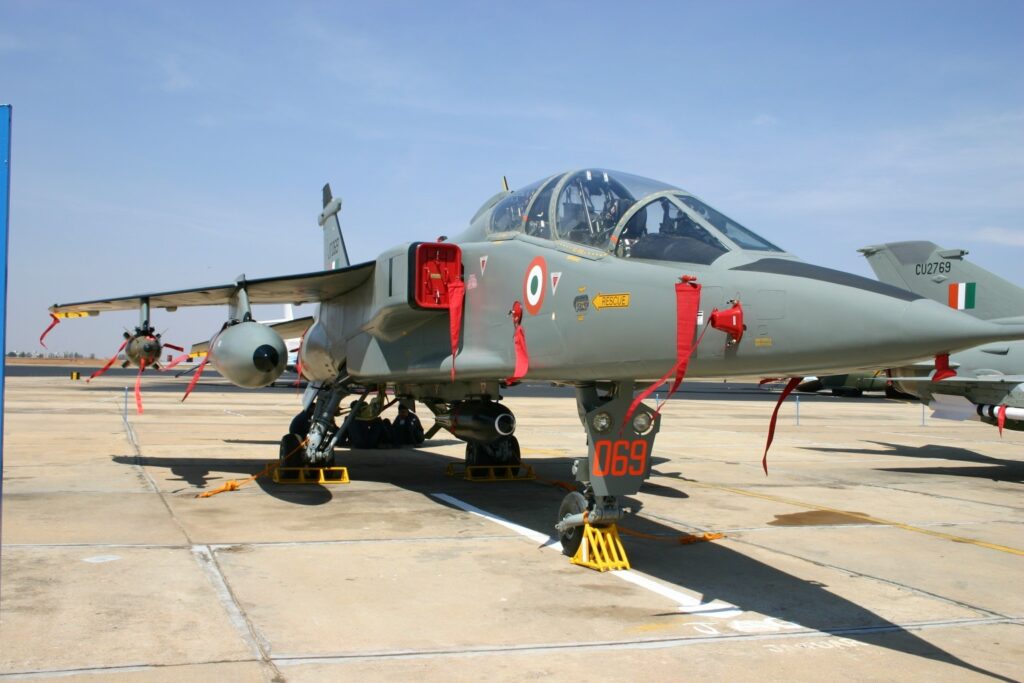
What is Jaguar Fighter Jet?
- About: Jaguar is a twin-engine, supersonic deep-penetration strike aircraft jointly developed by Britain and France through SEPECAT Program in the 1960s.
- It was designed primarily for low-level attack, battlefield interdiction, reconnaissance and precision strike missions.
- It served with the UK and France Air Force and also exported to and served in India, Oman, Ecuador, and Nigeria.
- It was developed under a joint venture between France’s Breguet and the British Aircraft Corporation (BAC).
- It first flew on 8 September 1968 and entered service in 1973. A total of 573 aircraft were produced.
- It was deployed in Mauritania, Chad, Iraq, Bosnia, Pakistan during war times.
- IAF: India selected the Jaguar in 1978 to meet its requirement, preferring it over competing aircraft.
- The Jaguar entered Indian Air Force (IAF) service in 1979 and was later licence-produced by HAL. It received the Indian name “Shamsher” (Sword of Justice).
- IAF is the world’s only active Jaguar operator, after retirement by the UK, France, Oman, Ecuador, and others.
- The IAF maintains roughly 120 Jaguar aircraft across six operational squadrons.
- India has inducted its various configurations including Jaguar IS (single-seat strike fighter), Jaguar IB (two-seat trainer), Jaguar IM (naval variant).
- Along with the Mirage 2000 and Rafale, the Jaguar is widely considered a key airborne delivery platform for India’s classified nuclear strike doctrines.
- Indian Jaguars supported operations in Sri Lanka (1987–90) and played an important strike role during the Kargil War (1999).
- Recently these jets played a critical role during Operation Sindoor.
- Features: The aircraft features a distinctive high-mounted swept-wing configuration and an all-metal aluminum alloy structure.
- It is equipped with spoilers, air brakes, and double-slotted flaps.
- The shoulder-high wings provide excellent stability during high-speed, low-level flights over varied terrain.
- The aircraft is powered by two Rolls-Royce/Turbomeca Adour turbofan engines, reaches around 1,700 km/h (Mach 1.6), has a maximum take-off weight of about 15.7 tonnes, and a combat radius exceeding 850 km.
- It features oleo-pneumatic struts to absorb severe shocks, dual low-pressure tires, and an airfield arrestor hook.
- Jaguar can carry bombs, precision-guided munitions, rockets, anti-ship missiles, air-to-air missiles, and two 30-mm cannons, making it a versatile strike platform.
- Through iterative upgrades, the cockpit has evolved into a modern glass cockpit with multi-function displays (MFDs).
- It also features helmet-mounted displays (HMD), advanced GPS integration, and inertial navigation systems (INS).
- It has a standard combat radius of 910 km, which extends up to 1,400 km with external drop tanks.
- The Jaguar possesses the rare ability to mount missiles (such as the ASRAAM) over its wings.
India’s Jaguar Fleet: Significance, Modernisation Challenges and Future Replacement
- Significance: The Jaguar remains India’s principal Deep Penetration Strike Aircraft (DPSA). Its ability to fly at low altitude and attack high-value targets deep inside hostile territory continues to provide a unique operational capability.
- The IAF currently has only 29 fighter squadrons against a sanctioned strength of 42 squadrons. Retiring Jaguars immediately would further widen this combat gap, making their continued service strategically necessary.
- Despite its age, the Jaguar remains effective for precision ground attack, interdiction, maritime strike and battlefield support missions. These specialized roles reduce pressure on frontline multirole fighters.
- Modernisation Programme: India upgraded the fleet under the DARIN III programme, incorporating AESA radar, advanced mission computers, improved navigation systems, digital cockpit architecture and enhanced targeting capability.
- The upgraded Jaguars are receiving modern electronic warfare enhancements, improving survivability against advanced air-defence networks and strengthening strike effectiveness.
- Since all other operators have retired the aircraft, global supply chains have collapsed. Obtaining spare parts has become increasingly difficult, affecting fleet availability.
- The IAF faces shortages of critical Martin-Baker Mk-9 ejection-seat components, creating maintenance and long-term safety concerns for the ageing fleet.
- To sustain operations, India has procured retired Jaguars from France, Oman and the UK.
- In 2018, France gifted 31 retired airframes along with engines and spares at no cost.
- India and Oman formalized an agreement to transfer over 20 decommissioned Royal Air Force of Oman (RAFO) SEPECAT Jaguar aircraft.
- These imported aircraft are important for critical components such as hydraulics, avionics, landing gears and Rolls-Royce Adour engines, helping the IAF overcome shortages.
- Replacement: The IAF expects a significant portion of the Jaguar fleet to remain operational until approximately 2030–32.
- Jaguars are expected to be gradually replaced by newer platforms such as the HAL Tejas Mk1A, future HAL Tejas Mk2, Dassault Rafale and eventually the Advanced Medium Combat Aircraft.
- The HAL Tejas Mk1A is an advanced, indigenously designed 4.5-generation multi-role light combat aircraft (LCA) developed by Hindustan Aeronautics Limited (HAL) for the Indian Air Force (IAF).
- The HAL Tejas Mk2 evolves into a heavier, medium-weight delta-wing fighter powered by the robust General Electric F414 engine to drastically increase its operational range and weapon payload capacity.
- The Dassault Rafale is a French twin-engine, canard delta wing, 4.5th-generation multirole fighter aircraft designed and manufactured by Dassault Aviation. India has finalized a Letter of Request to acquire an additional 114 Rafale multi-role fighters for the IAF.
- The Advanced Medium Combat Aircraft (AMCA) is India’s indigenous, fifth-generation, twin-engine, multi-role stealth fighter jet. It will feature advanced low-observable characteristics, internal weapon bays, sensor fusion, and supercruise capability.
FAQs:
1. Why is India acquiring retired Jaguar fighter jets?
India is acquiring retired Jaguars mainly for spare parts and components to sustain its ageing fleet and improve aircraft availability.
2. How will the Jaguar aircraft benefit the Indian Air Force?
The acquisition supports maintenance, enhances operational readiness, and helps preserve India’s deep-strike capability amid fighter shortages.
3. Which country is supplying the retired Jaguars?
The retired Jaguar aircraft are being supplied by the United Kingdom, which retired the type from service.
4. What role do Jaguar fighter jets play in the IAF?
Jaguars serve as deep-penetration strike aircraft, conducting precision attacks, interdiction missions, maritime strikes and battlefield support operations.
5. How long will the Jaguar fleet remain in service?
The Indian Air Force plans to operate Jaguars until approximately 2030–2032, depending on modernization and replacement progress.
Disclaimer: Information in this article is based on official announcements and public records. Regulations and implementation details may evolve over time.