




NPCIL Installs Reactor Vessel at Kudankulam Unit-5
| General Studies Paper IlI: Nuclear Technology, Government Policies & Interventions |
Why in News?
Recently, Nuclear Power Corporation of India Limited (NPCIL) achieved a major milestone at the Kudankulam Nuclear Power Project by installing the 320-tonne Reactor Pressure Vessel (RPV) in Unit-5.
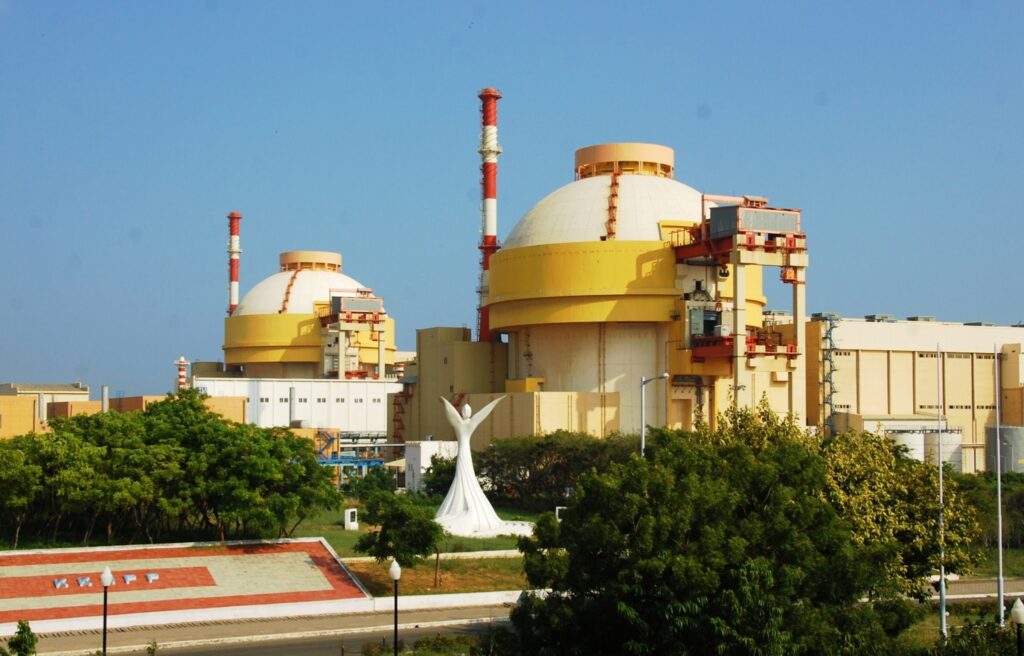
What is Kudankulam Nuclear Power Project (KKNPP)?
- About: The Kudankulam Nuclear Power Project (KKNPP) is India’s largest nuclear power generation complex, developed by Nuclear Power Corporation of India Limited (NPCIL).
- It is a flagship component of India’s clean-energy strategy, providing reliable baseload electricity while reducing dependence on fossil fuels.
- Location: KKNPP is located at Kudankulam village, Tirunelveli district, Tamil Nadu, near the southern tip of India on the Gulf of Mannar coast.
- Agreement: The project originated from the India–Russia Inter-Governmental Agreement of 1988.
- After subsequent agreements and technical clearances, Russia’s Rosatom became the principal international partner.
- Development Agency: The plant is owned and operated by NPCIL, while Russia’s Rosatom and Atomstroyexport provide design and engineering support.
- Technology: The project uses Russian-designed VVER-1000/V-412 models, which are water-cooled, water-moderated pressurized water reactors (PWRs).
- It incorporates Generation-III+ safety features.
- This is India’s first nuclear facility to implement imported PWR technology, which uses enriched uranium dioxide as fuel.
- Capacity: The project consists of six reactors of 1,000 MW each, giving a total planned capacity of 6,000 MW.
- Upon completion, it will remain among the largest nuclear-energy hubs in Asia.
- Features: The reactors incorporate passive heat-removal systems, double containment structures, emergency core cooling systems, meeting international nuclear safety standards.
- These reactors incorporate further design upgrades based on operational feedback and post-Fukushima safety guidelines.
- Development Progress: Units 1 and 2 are fully operational, having been connected to the grid in 2013 and 2016.
- Units 3 and 4 are in advanced stages of construction, while Units 5 and 6 are actively being built.
- Unit-5 recently achieved a major milestone with installation of the Reactor Pressure Vessel (RPV), often called the reactor’s “heart.”
- Contribution: NPCIL reports that Units 1 and 2 have generated nearly 130 billion units of electricity, helping avoid around 112 million tonnes of CO₂ emissions, demonstrating nuclear power’s role in climate-change mitigation.
- The 2,000 MW generated by the active units 1 & 2 is distributed to several southern states; Tamil Nadu (925 MW), Karnataka (442 MW), Kerala (266 MW), and Puducherry (67 MW), along with an unallocated reserve.
Kudankulam Unit-5 Reactor Vessel Installation
- Milestone: On 15 June 2026, NPCIL successfully installed the Reactor Pressure Vessel (RPV) at Kudankulam Unit-5 in Tamil Nadu.
- The achievement marks one of the most critical construction milestones before reactor assembly and commissioning.
- The RPV is considered the “heart” of a nuclear reactor because it houses the reactor core, fuel assemblies, and nuclear chain reaction process. Without the vessel, reactor operations cannot begin.
- Technical Specifications: The installed vessel weighs about 320 tonnes. It was placed through a high-precision heavy-lift operation inside the reactor building.
- It was installed using the “open-top” method. By lowering the vessel into the structure prior to closing the containment dome, engineering teams achieved high precision and increased installation safety.
- Regulatory: The installation became possible after the Atomic Energy Regulatory Board (AERB) granted approval for major equipment installation at Units 5 and 6 in May 2026.
- Construction Progress: RPV installation shifts Unit-5 from civil construction toward nuclear island equipment integration, including steam generators, coolant systems, and reactor internals.
- Following RPV installation, reactor assembly and system integration will accelerate.
- NPCIL indicates that Unit-5 may become operational by the end of 2026, bringing India closer to its nuclear capacity expansion goals.
Significance
- Energy Security: The Kudankulam project strengthens India’s energy security by expanding domestic electricity generation capacity.
- India imports over 85% of its crude oil requirements, making reliable nuclear power crucial for reducing external energy dependence.
- Unlike solar and wind, nuclear reactors operate continuously regardless of weather conditions. Kudankulam enhances grid stability through 24×7 baseload electricity.
- Clean Energy Commitments: Kudankulam directly contributes to India’s commitment to increase the share of non-fossil fuel energy sources.
- India’s updated Nationally Determined Contributions (NDCs) target 60% non-fossil electricity capacity and a 47% reduction in emissions intensity by 2035. Large-scale nuclear projects are essential for achieving these international climate commitments.
- It supports India’s Net-Zero 2070 pledge by providing large-scale low-carbon power that complements solar and wind energy.
- Nuclear Energy Mission: The project aligns with India’s Nuclear Energy Mission, which seeks major expansion of nuclear capacity, including a long-term ambition of 100 GW nuclear power by 2047 under the Viksit Bharat vision.
- It contributes to India’s global climate responsibilities under the Paris Agreement and broader sustainable-development agenda.
- India–Russia Partnership: Kudankulam represents one of the most successful examples of India–Russia strategic cooperation.
- The project demonstrates long-term collaboration in advanced technology, engineering, and nuclear fuel-cycle support.
- Economic Growth: A fully operational 6,000 MW nuclear complex will provide reliable electricity for industries, digital infrastructure, manufacturing, and urban growth, supporting India’s aspiration to become a developed economy.
India–Russia Nuclear Cooperation
- Nuclear Fuel Supply: Russia’s TVEL Fuel Company supplies enriched nuclear fuel for Russian-designed reactors in India under lifetime contracts.
- Recent agreements cover fuel requirements for multiple reactor units throughout their operational lifespan, ensuring uninterrupted energy production.
- Nuclear Fuel Technology: Since 2022, India has been receiving improved TVS-2M fuel assemblies from Russia.
- These contain enhanced safety features, higher uranium loading, and allow extension of reactor fuel cycles from 12 months to 18 months, improving efficiency and reducing operational costs.
- Nuclear Fuel Cycle: Recent bilateral agreements extend cooperation to the entire nuclear fuel cycle, including fuel fabrication, lifecycle support, spent-fuel management, and technical services.
- Joint Research: Both countries have agreed to intensify collaboration in advanced reactor technologies, including next-generation nuclear systems and high-technology applications.
- Russia has invited India to join the international consortium around the MBIR Research Reactor, expected to become the world’s most powerful fast-neutron research reactor after commissioning.
- SMR Cooperation: India and Russia are exploring cooperation on Small Modular Reactors (SMRs).
- These compact reactors offer flexible deployment, lower upfront costs, and support India’s long-term clean-energy expansion strategy.
- Manufacturing: Both countries are accelerating efforts for localisation of nuclear equipment manufacturing and joint production of reactor components and fuel assemblies in India.
- This aligns with India’s Atmanirbhar Bharat objectives.
FAQs:
1. What is the significance of the reactor vessel installation at Kudankulam Unit 5?
It marks a crucial construction milestone, enabling nuclear steam system installation and bringing the 1,000 MW Unit-5 closer to commissioning.
2. What is a reactor pressure vessel?
A reactor pressure vessel is the reactor’s core component, housing fuel assemblies and the reactor core where nuclear fission occurs.
3. Who is developing the Kudankulam Nuclear Power Plant?
The project is being developed by NPCIL with technical collaboration from Russia’s Rosatom/Atomstroyexport under India-Russia nuclear cooperation.
4. How will Unit 5 contribute to India’s energy needs?
Unit-5 will add 1,000 MW of low-carbon baseload electricity, strengthening energy security and supporting India’s clean-energy expansion goals.
5. What is the current status of the Kudankulam project?
Units 1 and 2 are operational; Units 3–6 are under construction, with Unit-5 expected to become operational by end-2026.
Disclaimer: Information in this article is based on official announcements and public records. Regulations and implementation details may evolve over time.