First-Ever India-Japan Defence Co-Development Pact
| General Studies Paper II: Regional Groupings, Groupings & Agreements Involving India and/or Affecting India’s Interests |
Why in News?
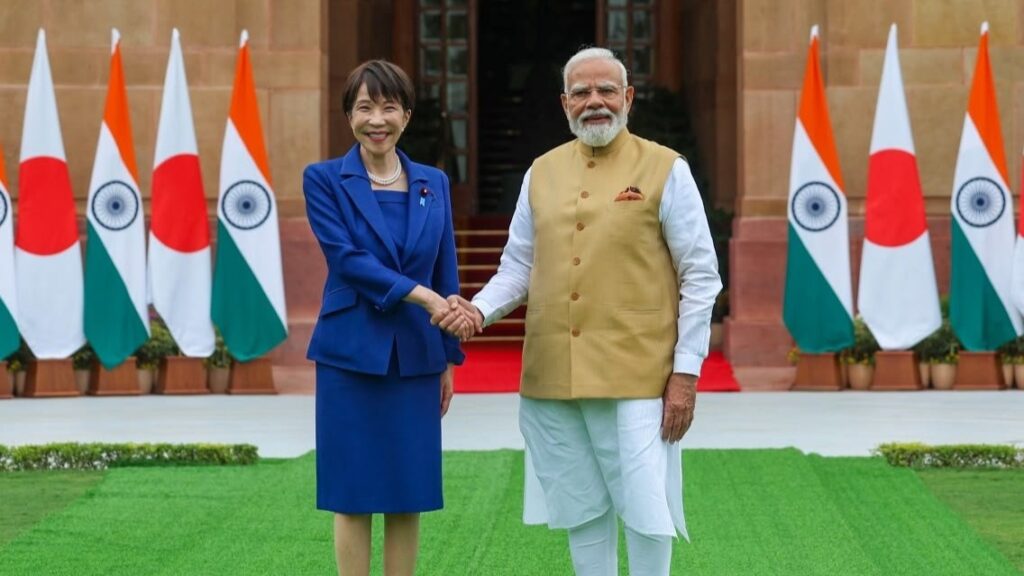
Recently, during 16th India-Japan Annual Summit, India and Japan announced their first-ever defence co-development pact to jointly develop the UNICORN naval radio antenna system.
Highlights of India-Japan Defence Co-Development Pact
- Nature: It is the first-ever bilateral defence co-development agreement between the two countries.
- It formalizes joint research and a legal framework for bilateral defense logistics to enhance shared operational approaches.
- Collaboration: The agreement establishes a structured framework for joint research, co-development and future co-production of defence technologies.
- It enables both governments to undertake collaborative projects instead of limiting cooperation to procurement or technology discussions.
- The pact provides for sharing engineering expertise, technical design inputs and development responsibilities between the two countries for mutually agreed defence systems.
- The agreement acknowledges Japan’s review of its principles governing the transfer of defence equipment and technology, creating provisions for wider industrial collaboration in future defence projects.
- Institutional Mechanism: The pact places defence collaboration under the broader India–Japan Special Strategic and Global Partnership.
- The overarching framework will be governed by the ongoing Joint Working Group on DETC.
- Operational logistics will be governed by the Acquisition and Cross-Servicing Agreement (ACSA).
- The framework relies on a foundational Information Security Agreement between the nations.
- This treaty guarantees that all classified military information and sensitive data shared during joint research and equipment development remain protected from unauthorized disclosure.
- Project: Under the pact both countries will jointly develop the UNICORN (Unlimited Communication and Radio Networking) system.
- It will be the first military hardware to be jointly developed by India and Japan under their defence partnership.
- It is implemented under the bilateral Agreement on Defence Equipment and Technology Transfer (2015) and the Memorandum of Implementation (MoI) signed in Tokyo on 15 November 2024.
- Under this project both countries will jointly develop, integrate and co-production of this advanced naval communication technology for the Indian Navy.
- Japan will provide advanced design expertise, engineering know-how and technical architecture, while India will undertake system integration, manufacturing and co-production for Indian Navy requirements.
- India’s Bharat Electronics Limited (BEL) is the designated industrial partner for integration and co-production in India. Japan contributes through NEC Corporation (lead contractor), Sampa Kogyo K.K., and The Yokohama Rubber Co. Ltd., which jointly developed the original technology.
- The project includes transfer of design expertise, collaborative engineering, technical documentation, manufacturing assistance and integration support from Japanese partners.
What is UNICORN?
- About: UNICORN (Unified Complex Radio Antenna) is a state-of-the-art integrated naval communication mast that combines multiple communication and electronic antennas into a single enclosed structure (radome).
- It is also designated as the NORA-50 Integrated Mast, representing Japan’s next-generation naval communication architecture.
- It is designed specifically for modern warships to reduce structural complexity while improving operational efficiency.
- Developer: The system was jointly developed by NEC Corporation, Sampa Kogyo K.K., and The Yokohama Rubber Co. Ltd. NEC served as the principal system integrator.
- Integrated Architecture: Unlike conventional naval masts carrying numerous exposed antennas, UNICORN integrates communication, navigation and electronic support antennas into one streamlined mast.
- Communication Functions: The mast accommodates multiple communication functions, including Link-16 tactical data link, UHF/VHF communications, TACAN, Identification Friend or Foe (IFF), and Electronic Support Measures (ESM) within one integrated structure.
- Radome Technology: A Fibre-Reinforced Plastic (FRP) radome encloses the entire mast.
- It provides high radio-wave transparency, weather resistance, corrosion protection, and lightning protection without degrading antenna performance.
- Detection Performance: The optimised placement of antennas enhances the maximum reception range of external radio waves, minimises mutual electromagnetic interference, and improves overall communication reliability.
- Maintenance Design: UNICORN adopts a modular integrated design, enabling the complete mast to be replaced as a single unit.
- This reduces maintenance time, simplifies installation, and improves lifecycle support.
- Operational Deployment: The NORA-50 UNICORN mast is operational aboard Mogami-class frigates of the Japan Maritime Self-Defense Force (JMSDF), where it has demonstrated advanced integrated communication capability.
- Recognition: In FY2023, UNICORN received the Defence Structure Improvement Foundation’s Top Award, supported by Japan’s Acquisition, Technology and Logistics Agency (ATLA).
India–Japan Defence Partnership
- Foundation: India–Japan defence engagement began with the Global Partnership (2000) and gradually expanded.
- The relationship gained formal security orientation with the 2008 Joint Declaration on Security Cooperation, Japan’s first such agreement with a country other than Australia.
- The 2008 Declaration established institutional cooperation in maritime security, counter-terrorism, disaster relief, peacekeeping, defence dialogue, intelligence exchanges and military consultations.
- Special Partnership: In September 2014, bilateral ties were upgraded to a Special Strategic and Global Partnership.
- The accompanying Memorandum on Defence Cooperation and Exchanges expanded defence consultations, technology collaboration and military engagement into a long-term strategic framework.
- Defence Technology Agreements (2015): In December 2015, both countries concluded the Agreement on Transfer of Defence Equipment and Technology and the Agreement on Protection of Classified Military Information, creating the legal basis for technology transfer, secure information exchange and industrial defence cooperation.
- Institutional Dialogue Mechanisms: Defence cooperation is coordinated through the Annual Defence Ministerial Dialogue, 2+2 Foreign and Defence Ministers’ Dialogue (since 2018), National Security Adviser Dialogue, Defence Policy Dialogue, staff talks and Coast Guard consultations.
- Military Exercises: Both countries conduct regular bilateral and multilateral exercises, including JIMEX (naval), Dharma Guardian (army), Veer Guardian (air force), Malabar, PASSEX, Milan and coast guard exercises
- Naval Cooperation: The 2018 Implementing Arrangement between the Indian Navy and the Japan Maritime Self-Defense Force (JMSDF) strengthened Maritime Domain Awareness (MDA), information sharing, coordinated exercises and operational cooperation across the Indo-Pacific.
- Logistics Cooperation: The Reciprocal Provision of Supplies and Services (RPSS/ACSA) Agreement, signed in 2020 and effective from 2021, enables reciprocal logistics, fuel, maintenance, transportation and operational support during exercises, UN missions and humanitarian operations.
Significance of This Pact
- Strengthening Indo-Pacific Security: The pact advances the shared vision of a Free, Open and Rules-Based Indo-Pacific by deepening India–Japan defence cooperation.
- As Quad partners, both countries reinforce regional security architecture and coordinated responses to emerging maritime challenges.
- In the East and South China Sea, this drastically limits China’s PLA-Navy and coast-guard ISR networks from using radar fingerprinting to track individual vessels.
- Enhancing Maritime Cooperation: By jointly developing advanced naval technologies, the agreement expands maritime cooperation beyond naval exercises to defence technology collaboration.
- It supports improved interoperability and long-term cooperation between the Indian Navy and the Japan Maritime Self-Defense Force (JMSDF).
- Accelerating Defence Modernisation: The pact enables India to access advanced Japanese defence engineering through collaborative development rather than conventional imports.
- This strengthens India’s ongoing military modernisation with modern communication and defence technologies.
- Boosting Defence Manufacturing: The agreement marks India’s transition from a defence buyer to a co-developer and co-producer of sophisticated military systems.
- It promotes indigenous manufacturing through participation of Indian defence industries in advanced production programmes.
- Diversifying Defence Partnerships: India broadens its defence cooperation beyond traditional suppliers by partnering with Japan, one of Asia’s leading high-technology nations.
- This supports India’s policy of diversified strategic partnerships and multiple technology sources.
- Supporting Atmanirbhar Bharat: The agreement complements Atmanirbhar Bharat by promoting technology transfer, domestic production, industrial capability enhancement and skilled workforce development instead of dependence on fully imported defence equipment.
FAQs:
1. What is the India–Japan Defence Co-development Pact?
It is the first bilateral agreement for jointly developing defence technologies and equipment, beginning with the UNICORN programme.
2. Why is the defence co-development agreement significant?
It shifts cooperation from defence dialogue and procurement to joint research, development and co-production of advanced military technologies.
3. Which defence technologies are expected to be developed jointly?
Initially, the UNICORN integrated naval communication mast, with scope for future mutually agreed defence technology projects.
4. How will the pact strengthen India–Japan strategic relations?
It institutionalises long-term defence technology cooperation under the Special Strategic and Global Partnership.
5. What are the key objectives of the agreement?
To promote joint research, co-development, co-production, technology sharing and defence industrial collaboration.
6. How does the pact support the Indo-Pacific strategy?
It reinforces Quad cooperation and supports a Free and Open Indo-Pacific through stronger defence collaboration.
7. Will the agreement promote defence manufacturing in India?
Yes. It enables co-production, technology transfer and indigenous manufacturing with Indian industry participation.
8. How does the pact benefit both countries’ armed forces?
It enhances interoperability, access to advanced technologies and future collaborative defence capabilities.
Disclaimer: Information in this article is based on official announcements and public records. Regulations and implementation details may evolve over time.
| Also Read: 15th India-Japan Annual Summit |