India-Malaysia-Singapore Submarine Cable Project I-2SEA
| General Studies Paper II: Infrastructure, Growth & Development |
Why in News?
Recently, the I-2SEA Submarine Cable Project was unveiled, connecting India, Malaysia, and Singapore through a 3,600-km undersea network.
What is the India–Malaysia–Singapore Submarine Cable Project (I-2SEA)?
- About: The India–Malaysia–Singapore Submarine Cable Project (I-2SEA) is a new international fibre-optic submarine cable system unveiled on 2 July 2026.
- It is designed to establish a dedicated, high-capacity digital corridor linking India, Malaysia and Singapore through a modern undersea communication network.
- Objective: The project aims to build a direct subsea connectivity route for transmitting massive volumes of digital data between the three countries.
- It is specifically engineered for AI workloads, cloud services, hyperscale computing and enterprise connectivity with lower latency and higher resilience.
- Route and Length: The I-2SEA cable will extend approximately 3,600 km beneath the sea, connecting Singapore with India’s east coast while providing connectivity through Malaysia.
- Infrastructure Design: The project incorporates dual landing architecture, dedicated subsea fibre routes and diversified terrestrial integration to improve operational continuity.
- Landing Stations: The system includes dual landing stations in India at Machilipatnam (Andhra Pradesh) and South Chennai.
- Machilipatnam offers the shortest subsea path to Hyderabad, enabling faster connectivity to one of India’s rapidly expanding AI and hyperscale data-centre clusters.
- Outside of India, the network will connect directly to the rapidly expanding Kuala Lumpur data centre corridor in Malaysia and to Singapore.
- Singapore remains a central point, acting as the region’s main cloud interconnect and AI hub.
- Consortium Members: The consortium comprises Lightstorm, Microsoft, Singtel, Tata Communications, ASEAN Cableship, and NEC Corporation.
- Lightstorm is the majority owner and project developer.
- NEC Corporation has been appointed as the system supplier, responsible for designing and supplying the submarine cable infrastructure.
- ASEAN Cableship will execute the marine installation operations.
- Network Integration: The cable will seamlessly connect with Lightstorm’s 30,000+ km terrestrial fibre network, extending connectivity to 80+ data centres and major digital hubs across India.
- AI and Cloud Focus: Unlike older subsea systems, I-2SEA will be custom-designed for intensive AI training and inference workloads.
- It explicitly caters to the high-bandwidth needs of hyperscalers and GPU infrastructure providers in the region.
- Operational Timeline: Construction has been announced, with the Ready for Service (RFS) target scheduled for Q4 2029.
Significance of This Project
- Strengthens India’s Digital Infrastructure: The 3,600-km I-2SEA cable adds a new international data corridor, complementing India’s 17 operational submarine cables with 960 Tbps potential capacity and improving overall network resilience.
- By passing through the secure areas of the Malacca Strait and the Indian Ocean, the cable will protect India’s communications sovereignty from Chinese cyber or physical interference.
- Powers AI and Cloud Growth: The cable is specifically designed for AI, cloud computing and hyperscale workloads. Microsoft joined the consortium to support rapidly expanding AI infrastructure across India and Southeast Asia.
- Boosts India’s Data Centre: The landing station at Machilipatnam supports the emerging data-centre hub where Meta and Alphabet have announced facilities, ensuring faster global data connectivity.
- Strengthens India–ASEAN Digital Integration: By directly linking India, Malaysia and Singapore, the project improves cross-border data movement, supporting regional digital trade, cloud services and enterprise communication.
- It ensures route diversity and reduces service disruption risks caused by cable faults or natural disasters.
- This project gives a strong digital dimension to India’s ‘Act East Policy’, which will strengthen economic and strategic relations with South-East Asia.
- Expands AI Network Coverage: Lightstorm currently connects 19 AI and cloud zones across India. The I-2SEA project will increase this coverage to 29 zones, enabling broader high-capacity digital infrastructure.
- Meets Future Data Demand: India’s operational data-centre capacity is projected to double from 1.4 GW by 2027 and could increase fivefold by 2030, making additional international bandwidth essential.
- This undersea cable will act as the backbone for seamless delivery of gaming, 5G/6G rollout, cloud computing and e-governance services to rural India.
- Improves International Connectivity: Submarine cables carry roughly 95% of global internet traffic. I-2SEA increases India’s international communication capacity and strengthens uninterrupted cross-border digital connectivity.
- It will reduce data transfer time (latency) by 10-15% between India (especially Hyderabad and Chennai) and the Singapore-Malaysia corridor.
Major International Submarine Cable Projects Connected to India
- SEA-ME-WE-6 (Southeast Asia–Middle East–Western Europe 6): It is a 21,700-km submarine cable connecting Singapore to France (Marseille) through India and the Middle East.
- India Asia Xpress (IAX): Developed by Reliance Jio, IAX spans about 5,791 km, linking Mumbai and Chennai with Singapore, including branches to Sri Lanka, Thailand and Malaysia.
- It provides 200+ Tbps design capacity together with IEX.
- India Europe Xpress (IEX): The IEX system extends about 9,775 km, connecting India with the Middle East and Europe.
- Interconnected with IAX, it creates an India-centric global data corridor with very high-capacity fibre connectivity.
- MIST (Myanmar/Malaysia-India-Singapore Transit): The 8,100-km MIST cable connects Mumbai and Chennai with Myanmar, Thailand, Malaysia and Singapore.
- Built by NEC Corporation, it strengthens India’s digital links across Southeast Asia.
- 2Africa Pearls: 2Africa Pearls forms the India extension of the world’s largest submarine cable ecosystem, connecting India with Africa, Europe and the Middle East through a 45,000-km global network.
- Blue-Raman: The Blue-Raman project links India with Europe through the Middle East and Israel, creating an alternative route that reduces dependence on traditional corridors.
- Bay of Bengal Gateway (BBG): Commissioned in 2016, the 8,100-km BBG system connects India with Malaysia, Singapore, Oman and the UAE, improving regional internet connectivity.
- Asia Africa Europe-1 (AAE-1): The 25,000-km AAE-1 cable links Hong Kong to Europe via India and the Middle East, providing high-speed, low-latency connectivity across Asia, Africa and Europe.
- Europe India Gateway (EIG): Operational since 2011, the 15,000-km EIG system directly connects India with Europe through the Middle East, enhancing redundancy for international telecom traffic.
- IMEWE (India-Middle East-Western Europe): The 12,091-km IMEWE cable links India, Pakistan, the Middle East and Europe, offering diversified international connectivity.
IMPORTANT POINTS:
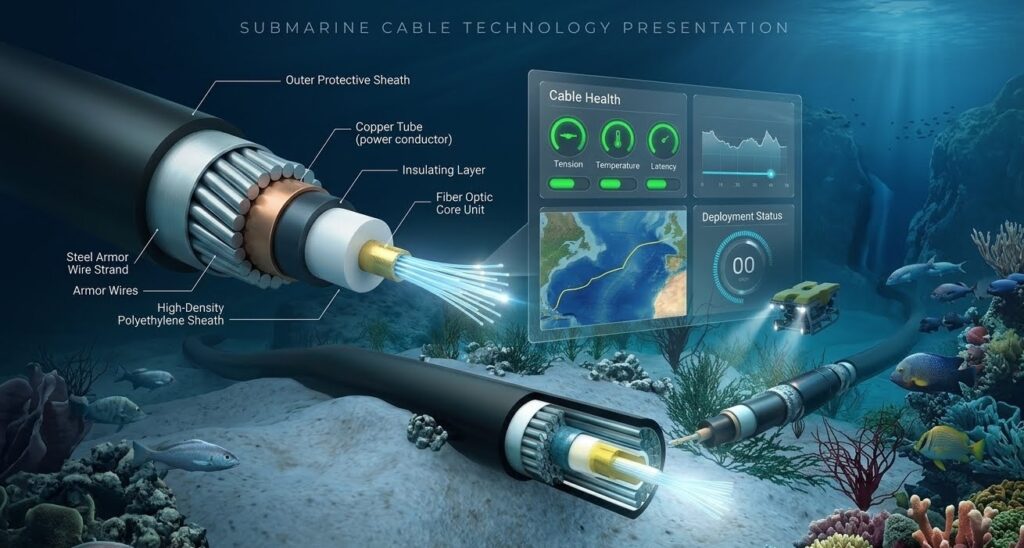
- Submarine Communication Cable: It is an undersea fibre-optic cable laid on the ocean floor to transmit internet, voice and data between countries and continents.
- Its main purpose is to provide high-speed, high-capacity international telecommunications, connecting countries more efficiently than satellites for most intercontinental traffic.
- Modern submarine cables use optical fibres, where information travels as light pulses rather than electrical signals.
- A typical cable contains optical fibres, gel, copper conductor (power supply), steel armour, and polyethylene insulation for deep-sea protection.
- Submarine cables provide higher bandwidth, lower latency and greater reliability than satellite communication.
- They support internet services, cloud computing, banking, digital payments, video conferencing, AI workloads and international telecommunications.
- Fibre Optics: Fibre optics is a communication technology that transmits information as light pulses through ultra-thin strands of glass or plastic fibres.
- It operates on Total Internal Reflection (TIR), where light continuously reflects within the fibre core without escaping.
- A fibre consists of a core, cladding, and protective coating. The cladding has a lower refractive index, keeping light confined within the core.
- Electrical data are converted into light signals, transmitted through the fibre, and reconverted into electrical signals at the receiving end.
- Light travels through optical fibre at about two-thirds the speed of light in vacuum, enabling extremely fast communication.
- Optical fibres provide very high bandwidth, experience much lower attenuation, allowing communication across hundreds of kilometres before amplification.
- Optical fibres are difficult to tap without detection, making them suitable for government, defence, banking and secure enterprise networks.
FAQs:
- What is the India, Malaysia and Singapore Submarine Cable Project?
It is a 3,600-km fibre-optic undersea cable connecting India, Malaysia and Singapore for AI and cloud connectivity. - What is the objective of the new submarine cable project?
To provide high-capacity, low-latency connectivity supporting AI, cloud services and hyperscale data workloads across the region. - Which countries are participating in the project?
The project directly connects India, Malaysia and Singapore through a dedicated submarine fibre-optic cable system. - How will the submarine cable improve digital connectivity?
It offers direct, high-capacity routes, lower latency, diversified communication paths and stronger network resilience. - Why are undersea cables important for global internet infrastructure?
They carry about 95% of global internet traffic, enabling fast and reliable international digital communications. - What benefits will the project bring to India?
It strengthens AI infrastructure, expands cloud connectivity, supports data centres and increases international digital capacity. - How does the project strengthen regional cooperation?
It enhances digital infrastructure, cross-border connectivity and technology collaboration between India, Malaysia and Singapore. - When is the submarine cable project expected to become operational?
The I-2SEA submarine cable is expected to become operational in the fourth quarter of 2029.
Disclaimer: Information in this article is based on official announcements and public records. Regulations and implementation details may evolve over time.
| Also Read: Strait of Hormuz Cable Threat |