India’s First Greenfield Refinery-Cum-Petrochemical Complex
| General Studies Paper III: Development & Infrastructure, Energy Security |
Why in News?
Recently, the government inaugurated India’s first Greenfield Refinery-cum-Petrochemical Complex at Pachpadra, Rajasthan, strengthening energy security.
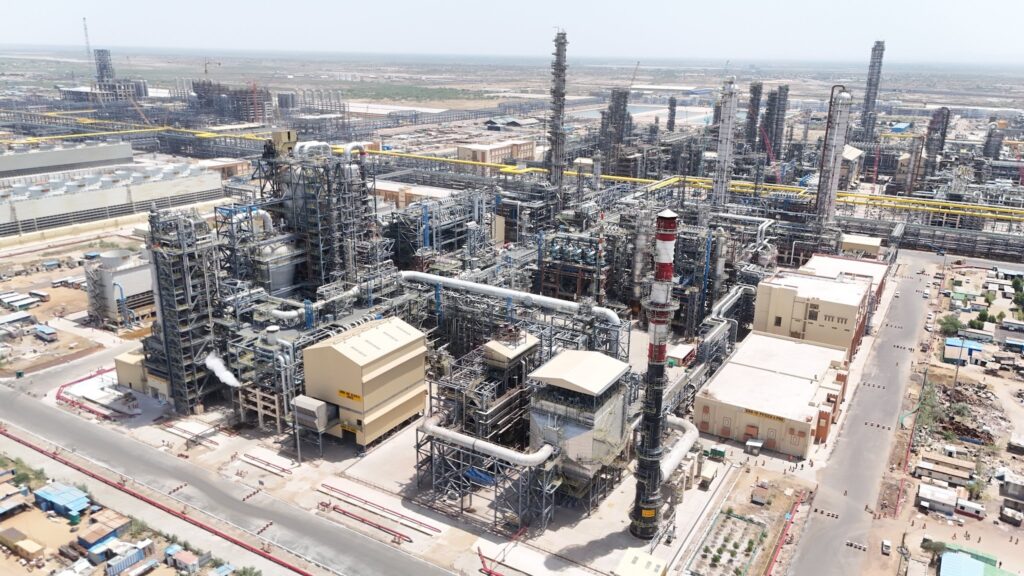
Highlights of India’s First Greenfield Refinery-Cum-Petrochemical Complex
- Inauguration: Prime Minister Narendra Modi dedicated India’s first Greenfield Integrated Complex to the nation on 4 July 2026 in Rajasthan.
- Location: The complex is located at Pachpadra in Balotra district, Rajasthan, close to the Barmer oilfields.
- Its strategic desert location enables efficient linkage with domestic crude, imported crude through western ports.
- Timeline: The project was announced in 2013, foundation stone laid the same year, relaunched in 2018 after restructuring.
- It experienced pandemic and construction delays, and finally became operational in 2026.
- Developed By: The refinery has been developed by HPCL Rajasthan Refinery Limited (HRRL), a joint venture between Hindustan Petroleum Corporation Limited (74%) and the Government of Rajasthan (26%).
- Area: The integrated complex spreads across nearly 4,400 acres, making it among India’s largest refinery projects.
- The vast campus accommodates refining units, petrochemical facilities, storage infrastructure, utilities, pipelines, and logistics systems.
- Investment: The project has been established with an investment of over ₹79,450 crore, making it among India’s largest energy infrastructure projects.
- It represents the first new Greenfield refinery commissioned in nearly a decade.
- Refining Capacity: The complex has a 9 Million Metric Tonnes Per Annum (MMTPA) crude refining capacity.
- It enables large-scale production of petrol, diesel, LPG, aviation fuel, and petrochemical feedstock.
- Petrochemical Production: It incorporates a 2.4 MMTPA petrochemical capacity, allowing simultaneous production of high-value chemicals and polymers.
- Integration improves profitability and maximizes crude utilization.
- Refinery Design: The refinery possesses a Nelson Complexity Index (NCI) of 17.0, placing it among the world’s most advanced refineries.
- It can efficiently process diverse crude grades while producing higher-value, cleaner petroleum products.
- Petrochemical Yield: The facility delivers over 26% petrochemical yield, significantly higher than conventional refineries.
- This enhances value addition and strengthens domestic polymer production.
- Crude Processing: The refinery is designed to process both Rajasthan crude oil and imported crude, ensuring operational flexibility and resilience against global supply disruptions.
- Engineering: Built using cutting-edge engineering, the project integrates advanced process units, automation, safety systems, and environmentally efficient technologies.
- Product Portfolio: The complex will manufacture petrol, diesel, LPG, polypropylene, HDPE, LLDPE, benzene, toluene, and butadiene.
- It supports sectors including automobiles, packaging, pharmaceuticals, textiles, and consumer goods.
- Feedstock Flexibility: The facility can process a mix of 1.5–2.5 million tonnes of Rajasthan crude and 6.5–7.5 million tonnes of imported crude annually.
- Environmental Safety: The refinery aligns with environmental norms by utilizing a strict zero liquid waste discharge principle.
- This conserves regional water resources, prevents pollution, and minimizes the overall ecological footprint.
- It ensures compliance with Bharat Stage (BS) VI emission standards.
- The facility incorporates expansive greenbelt zones to boost biodiversity.
- Complementing this, dedicated solar installations managed under HPCL’s green energy subsidy ensure a sustainable, renewable power supply.
- Industrial Cluster: The refinery will anchor a Petrochemical and Plastic Park, encouraging downstream industries, MSMEs, ancillary manufacturing, and value-chain integration.
- Employment Generation: The project is expected to create substantial direct and indirect employment, stimulate infrastructure development, improve regional incomes, and accelerate socio-economic transformation across Rajasthan and adjoining states.
- Significance: The integrated refinery strengthens India’s energy security, enhances petrochemical self-sufficiency.
- It reduces import dependence on value-added petrochemicals, supports the Make in India initiative.
- It reinforces Rajasthan’s emergence as a major national energy and manufacturing hub.
- Higher domestic refining and petrochemical output helps reduce foreign exchange outflow on imported petroleum products.
- It boosts sectors such as consumer goods, electronics, healthcare, agriculture, automotive components, and infrastructure materials through affordable raw material availability.
FAQs:
- What is a Greenfield Refinery-Cum-Petrochemical Complex?
A new integrated refinery and petrochemical facility built on undeveloped land, combining fuel refining with petrochemical production. - Why is India’s first Greenfield refinery project significant?
It boosts energy security, petrochemical self-reliance, industrial growth, and marks India’s first new greenfield refinery in nearly a decade. - Where is the Greenfield refinery-cum-petrochemical complex located?
It is located at Pachpadra, Balotra district, Rajasthan, near the Barmer oil-producing region. - What products will be produced at the complex?
It will produce petrol, diesel, LPG, polypropylene, HDPE, LLDPE, benzene, toluene, and butadiene. - How will the project strengthen India’s energy security?
It expands domestic refining capacity, reduces import dependence, and ensures reliable fuel and petrochemical supplies. - What economic benefits will the project provide?
It will attract investments, generate employment, promote downstream industries, and accelerate regional economic development. - How will the project support the petrochemical industry?
It supplies domestic feedstock, supports a Petrochemical and Plastic Park, and strengthens manufacturing value chains. - Why are Greenfield industrial projects important?
They create modern infrastructure, adopt advanced technologies, improve productivity, and drive long-term industrial and economic growth.
Disclaimer: Information in this article is based on official announcements and public records. Regulations and implementation details may evolve over time.
| Also Read: EU Sanction on Indian Refinery |