


India Supports UN Resolution on Cuba, Votes Against US Embargo on Cuba
| General Studies Paper II: Groupings & Agreements Involving India and/or Affecting India’s Interests |
Why in News?
Recently, India supported a UN General Assembly resolution urging an end to the US embargo on Cuba, reaffirming multilateralism.
Highlights of UN Resolution on Cuba
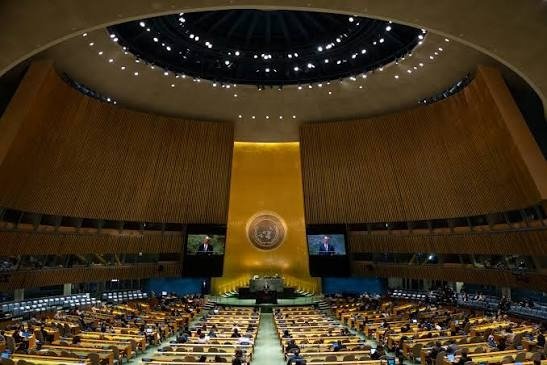
- Resolution: The UN General Assembly (UNGA) adopted its annual resolution during the 81st session plenary meeting.
- The official draft title is “Necessity of ending the economic, commercial and financial embargo imposed by the United States of America against Cuba”.
- The resolution was first introduced to the provisional agenda of the General Assembly in 1992.
- The current session marks the 34th consecutive time the international body has debated and voted on this.
- Voting Results: The resolution passed with 130 countries voting in favour, 17 against, and 25 abstentions.
- The United States and Israel led the opposition, joined by nations like Ukraine and Morocco.
- Major economies including Germany, Italy, and South Korea shifted their stands to abstain for the first time.
- Representing India, Counsellor Soumya Nair voted in favour, strongly rejecting extraterritorial laws that infringe on state sovereignty.
- India stated that the 64-year-old embargo cripples Cuba’s progress.
- Nair highlighted that Cuba suffers a 60% shortage of essential medicines and a 50% drop in food production over five years, urging dialogue over blockade.
- Support for the resolution fell to a 20-year low.
- In 2024, the resolution secured an overwhelming 187 in favour, 2 against, and 1 abstention.
- In 2025, the support dipped to 165 in favour, 7 against, and 12 abstentions.
What is UN Resolution?
- UN resolutions function as formal expressions of the collective opinion or will of United Nations organs.
- Their structural legal status depends primarily on the specific body:
- UN Security Council (UNSC) resolutions carry the heaviest legal weight within the global framework.
- When adopted under Chapter VII of the UN Charter, these decisions become legally binding international law for all member states.
- The UNSC consists of 15 members and requires nine affirmative votes to pass a resolution.
- For substantive matters, this majority must include the concurring votes of all five permanent members (P5).
- A negative vote from any P5 member constitutes a veto, blocking the resolution immediately.
- UN General Assembly (UNGA) resolutions are generally non-binding recommendations under international law.
- They lack enforcement power, but carry massive moral authority and reflect the geopolitical consensus of the international community.
- All 193 UN Member States have a seat and one vote in the Assembly.
- Routine UNGA decisions require a simple majority of members present and voting.
- Important questions—such as budgetary matters, admitting new members, or peace recommendations—require a two-thirds majority.
- UN Security Council (UNSC) resolutions carry the heaviest legal weight within the global framework.
US Embargo on Cuba: Background, Evolution and Impact
- Background: Cuba is a Caribbean island nation located near the United States, Mexico and the wider Gulf of Mexico region.
- Both countries relations deteriorated after Fidel Castro’s 1959 revolution, as Cuba nationalised foreign-owned properties, including US assets, and moved closer to the Soviet Union.
- Washington increasingly viewed Cuba’s political alignment as a strategic and security concern during the Cold War.
- Embargo:
- The United States introduced major trade restrictions in October 1960. On 3 February 1962, President John F. Kennedy issued Proclamation 3447, establishing a comprehensive trade embargo effective from 7 February.
- The measures aimed to isolate Cuba economically and reduce the resources available to its government.
- The Cuban Missile Crisis in October 1962 further intensified bilateral hostility.
- In 1963, the United States introduced the Cuban Assets Control Regulations, expanding restrictions on financial transactions and property interests.
- During subsequent decades, the embargo became a central instrument of US policy towards Cuba.
- The collapse of the Soviet Union in 1991 weakened Cuba’s principal economic partnership, contributing to a severe economic contraction known as the Special Period.
- The Cuban Democracy Act of 1992 tightened restrictions, including those affecting foreign subsidiaries of US companies.
- The Helms–Burton Act of 1996 codified the embargo into law and expanded provisions concerning property confiscated after the revolution.
- Its Title III created potential litigation against persons trafficking in certain confiscated property.
- The Helms–Burton Act of 1996 codified the embargo into law and expanded provisions concerning property confiscated after the revolution.
- In 2000, the Trade Sanctions Reform Act allowed the export of U.S. food and medicine for humanitarian reasons.
- Decades later, President Barack Obama initiated a historic diplomatic thaw in 2014, restoring formal relations, easing travel restrictions, and expanding authorized commercial trad.
- The Trump administration tightened several restrictions from 2017.
- The administration enacted “maximum pressure”, restricted travel, targeted shipping, and placed Cuba on the State Sponsors of Terrorism list.
- The Biden administration eased minor limits on family remittances and consular services, the foundational embargo remains strictly active.
- Some provisions have extraterritorial effects on third-country entities doing business involving Cuba.
- The administration enacted “maximum pressure”, restricted travel, targeted shipping, and placed Cuba on the State Sponsors of Terrorism list.
- The United States introduced major trade restrictions in October 1960. On 3 February 1962, President John F. Kennedy issued Proclamation 3447, establishing a comprehensive trade embargo effective from 7 February.
- Impacts: It causes severe humanitarian, energy, and economic hardships across the island, heavily restricting trade, medical supplies, and fuel.
- Restrictions prevent direct purchases of raw materials or medical equipment with over 10% U.S.-origin components, causing delayed surgeries and disrupting the vaccine cold chain.
- Food production and availability have dropped steeply, compounding daily survival challenges for civilians.
- Recent de facto U.S. fuel and oil blockades have triggered acute energy shortages, leading to widespread power blackouts lasting days, even in Havana.
India–Cuba Relations
- Historical Foundations: India was among the first nations to officially recognize the revolutionary government of Cuba in January 1959. Diplomatic ties were established in 1960.
- The foundational bond was solidified when Jawaharlal Nehru welcomed Che Guevara to New Delhi later that year.
- Diplomatic ties grew through the iconic camaraderie between Indira Gandhi and Fidel Castro under the Non-Aligned Movement (NAM) framework.
- Trade: Bilateral trade is modest, hovering around $30–35 million annually.
- India exports pharmaceuticals, organic chemicals, and machinery, while importing Cuban tobacco, cigars, and raw hides.
- Discussions are underway for a Preferential Trade Agreement to expand investment.
- India exports pharmaceuticals, organic chemicals, and machinery, while importing Cuban tobacco, cigars, and raw hides.
- Development: India has extended over $243 million in Lines of Credit to Cuba.
- India provided the historic “Bread of India” grain donation in 1992, waived a $62 million debt in 2008, and recently delivered 80 tons of pharmaceutical ingredients in 2024.
- Energy Cooperation: Cuba is a founding member and regional Vice-President of the International Solar Alliance.
- India funds major renewable projects in Cuba, including a solar power installation, a wind energy farm, and a sugar mill cogeneration plant.
- Healthcare & Biotechnology: Ties are anchored by a biotech and traditional medicine partnership.
- India supplies affordable generics, Cuba shares advanced biotechnology innovations like cancer vaccines. Proposals exist for a trilateral India-Cuba-Africa health partnership.
- Digital Technology: The launch of the India–Cuba IT Council facilitates collaborative frameworking.
- This initiative promotes digital public infrastructure, artificial intelligence, cybersecurity, and knowledge transfer to boost Cuba’s technological sovereignty.
- Cultural Exchange: A Mutual Legal Assistance Treaty and Cultural Exchange Protocol signed in late 2025 cemented legal and social ties.
- Yoga is part of Cuba’s health curriculum, and the country honors Indian figures like Mahatma Gandhi and Rabindranath Tagore.
- Cuba celebrated International Day of Yoga, Mahatma Gandhi’s 150th birth anniversary and 550th anniversary of Guru Nanak Dev.
- Significance: By supporting Cuba, India asserts its role as a decisive voice for the Global South.
- Cuba firmly supports India’s bid for a permanent UN Security Council seat.
- Cuba has also supported India’s International Solar Alliance (ISA) initiative.
- India consistently votes against the US economic blockade on Cuba at the UN General Assembly.
- Cuba’s induction as a BRICS partner country strengthens multipolar diplomacy. It acts as a reliable gateway for India to enhance its geopolitical footprint, trade routes, and development models across Latin America.
Frequently Asked Questions (FAQs):
1. Why did India support the UN resolution against the US embargo on Cuba?
India supports multilateralism, sovereignty, international law, and opposes unilateral measures that adversely affect Cuba’s development and essential supplies.
2. What is the US economic embargo on Cuba?
It is a longstanding system of US trade, financial and economic restrictions imposed on Cuba since 1960 and expanded subsequently.
3. What is the purpose of the UN General Assembly resolution on Cuba?
It urges the United States to end its embargo, highlighting its economic and humanitarian consequences and promoting international cooperation.
4. How has India historically voted on resolutions concerning the Cuba embargo?
India has consistently supported resolutions calling for an end to the embargo, reflecting its longstanding commitment to multilateral diplomacy.
5. How does India’s support for Cuba reflect its foreign policy?
It reflects strategic autonomy, Global South solidarity, sovereignty, and multilateralism, while allowing India to maintain independent relations with the United States.
Disclaimer: Information in this article is based on official announcements and public records. Details may evolve over time.
| Also Read: UN Votes to Adopt New Africa’s True Size Map |