Tripura Mandates Vande Mataram and Jana Gana Mana in Morning Assemblies
| General Studies Paper II: Modern Indian History, Constitution, Government Policies & Interventions |
Why in News?
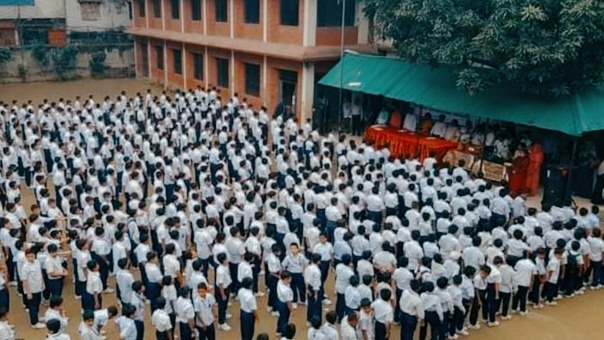
Recently, the Tripura government mandated all schools to begin morning assemblies with the full rendition of Vande Mataram, followed by Jana Gana Mana.
Highlights of Tripura Government’s Directive
- Approval: The Tripura Council of Ministers approved a directive requiring all educational institutions to begin the day with the full rendition of Vande Mataram (National Song) and National Anthem, Jana Gana Mana.
- The order has been announced by Chief Minister Manik Saha to promote national consciousness among students.
- The decision follows the Tripura Cabinet’s resolution that was approved on 25 June 2026.
- It is implemented in accordance with Ministry of Home Affairs guidelines dated 28 January 2026 on respect, protocol, and rendition of the National Song.
- Order of Rendition: Schools must first sing the complete version of Vande Mataram and then render Jana Gana Mana during every morning assembly.
- This sequence aligns with the latest national guidelines that came into effect on 3 July 2026.
- Uniform Applicability: The directive applies uniformly to government schools, government-aided schools, private schools, and recognised aided as well as unaided madrasas.
- The directive makes the practice a daily compulsory assembly activity, integrating patriotic observance into routine school functioning.
- Mandatory Decorum: During the rendition, students, teachers, and staff are expected to maintain proper discipline, attention, and respect.
- Objective: The policy seeks to strengthen patriotism, constitutional values, civic discipline, national identity, and respect for national symbols through regular participation by students and school staff.
- The directive reflects the state’s use of education policy to institutionalise patriotic practices.
Ministry of Home Affairs Guidelines on Respect, and Rendition of National Song
- Comprehensive Protocol: The Ministry of Home Affairs (MHA) issued India’s first comprehensive guidelines on 28 January 2026.
- It is to standardise the rendition, protocol, and ceremonial observance of the National Song, Vande Mataram, ensuring uniform implementation across the country.
- Official Version Defined: The guidelines officially recognise the complete six-stanza version of Vande Mataram, replacing the earlier practice where generally only the first one or two stanzas were sung.
- The prescribed duration of the official rendition is 3 minutes and 10 seconds (190 seconds).
- Sequence of Performance: Whenever both the National Song and the National Anthem are performed at the same event, Vande Mataram must always precede Jana Gana Mana.
- Coverage of Official Functions: The protocol applies to government ceremonies, State functions, schools, educational institutions, public events, and mass singing programmes where the National Song is officially rendered.
- The song can be used at ceremonial flag parades, addresses by Governors/Lieutenant Governors, and the arrival or departure of the President at public functions.
- Respect and Decorum: Audiences and participants are required to stand at attention whenever the official version of the National Song is sung or played.
- During the rendition, participants are expected to maintain dignity, discipline, and respect, avoiding movement or activities.
- The audience is not expected to stand if the song is played as background music in a documentary, film, or newsreel, as standing would disrupt the exhibition.
- Standardised Musical Rendition: The MHA fixed an officially approved musical version with a uniform duration to eliminate regional variations.
- Akashvani adopted this standard version from 26 March 2026.
Constitutional and Legal Framework Governing National Symbols
- Foundation: The Constitution of India does not define all national symbols in a single provision.
- Their status is derived from the Constituent Assembly’s resolutions, constitutional provisions, parliamentary laws, and judicial interpretations.
- India’s recognised national symbols include the National Flag (Tiranga), State Emblem of India, National Anthem, National Song, National Calendar, National Animal, National Bird, National Flower, and other officially notified symbols.
- Constituent Assembly Resolution: On 24 January 1950, the Constituent Assembly adopted Jana Gana Mana as the National Anthem and recognised Vande Mataram as the National Song, with Dr. Rajendra Prasad stating that both deserve equal honour and respect.
- Vande Mataram was composed by Bankim Chandra Chattopadhyay in the 1870s and later incorporated into his novel Anandamath (1882).
- Written in Sanskritised Bengali, it personifies India as the Motherland, becoming one of the most influential patriotic compositions in Indian history.
- The hymn was first published independently in 1875 before appearing in Anandamath.
- Set against the backdrop of the Sannyasi Rebellion, it reflected the growing spirit of Indian nationalism during British colonial rule.
- Rabindranath Tagore first sang Vande Mataram at the 1896 Calcutta Session of the Indian National Congress, introducing it to the national political movement.
- During the Swadeshi Movement (1905), Vande Mataram became the principal slogan against the Partition of Bengal. British authorities frequently restricted its public recital.
- The song celebrates India’s natural beauty, fertility, and civilisational heritage, symbolising the nation as a nurturing mother.
- Jana Gana Mana was written and composed by Rabindranath Tagore in Bengali on 11 December 1911 under the original title Bharoto Bhagyo Bidhata.
- The anthem was first sung publicly on 27 December 1911 at the Calcutta Session of the Indian National Congress.
- The Constituent Assembly adopted the first stanza of Jana Gana Mana as India’s National Anthem on 24 January 1950, two days before the Constitution came into force.
- The full official rendition lasts approximately 52 seconds, while a short version comprising the opening and concluding lines lasts about 20 seconds for ceremonial use.
- The anthem invokes the “Dispenser of India’s Destiny” and celebrates the country’s unity in diversity, referring to various geographical and cultural regions.
- Vande Mataram was composed by Bankim Chandra Chattopadhyay in the 1870s and later incorporated into his novel Anandamath (1882).
- Fundamental Duty: Article 51A(a), inserted by the 42nd Constitutional Amendment Act, 1976, makes it the Fundamental Duty of every citizen to abide by the Constitution and respect the National Flag and National Anthem.
- Although Vande Mataram is not expressly mentioned, it enjoys official recognition through government resolutions.
- Prevention of Insults to National Honour Act, 1971: The Prevention of Insults to National Honour Act, 1971 provides statutory protection against intentional disrespect to the National Flag, Constitution, and National Anthem.
- Disturbing or preventing the singing of the National Anthem is punishable with imprisonment up to three years, fine, or both.
- It explicitly prohibits overt acts of insult—such as burning, trampling, defiling, or mutilating—the National Flag, the Constitution, or the National Map in any public view.
- It includes a clear provision stating that honest and bona fide criticism or disapprobation of the symbols, aimed at lawful amendment or alteration, does not constitute an offense.
- Flag Code of India, 2002: The Flag Code of India, 2002 consolidates rules governing the display, handling, hoisting, and use of the National Flag by governments, institutions, and citizens while preserving its dignity and prescribed protocol.
- Emblems and Names Act, 1950: The Emblems and Names (Prevention of Improper Use) Act, 1950 strictly regulates commercial usage.
- It prevents the use of the National Flag, the State Emblem, and official seals of the Government of India in trademarks, patents, or business advertisements for professional gain without prior permission.
- Judicial Interpretation: In Bijoe Emmanuel v. State of Kerala (1986), the Supreme Court held that citizens who stand respectfully but refrain from singing the National Anthem due to genuine religious beliefs cannot be penalised, affirming the balance between Fundamental Rights and national respect.
- Recent Legislative Developments: In May 2026, the Union Cabinet approved a proposal to amend the 1971 Act to extend statutory protection to Vande Mataram, placing it on par with the National Anthem.
- As of now, this reflects a proposed legislative change, not an enacted law.
FAQs:
1. Where will Vande Mataram and Jana Gana Mana be compulsory?
In all government, aided, private, and recognised madrasa schools across Tripura during daily morning assemblies.
2. Why has the Tripura government introduced this rule?
To promote patriotism, discipline, national consciousness, civic responsibility, and national unity among students.
3. When will the new directive come into effect?
The directive came into effect on 3 July 2026, following the School Education Department notification.
4. Does the order apply to all schools in Tripura?
Yes. It covers government, government-aided, private, and recognised aided and unaided madrasa schools.
5. What is the difference between Vande Mataram and Jana Gana Mana?
Vande Mataram is the National Song; Jana Gana Mana is the National Anthem of India.
6. Is singing the National Anthem mandatory under Indian law?
No. Respect is mandatory; compulsory singing is not required under Supreme Court jurisprudence.
Disclaimer: Information in this article is based on official announcements and public records. Regulations and implementation details may evolve over time.