



India-Uzbekistan Relations
| General Studies Paper II: Groupings & Agreements Involving India and/or Affecting India’s Interests |
Why in News?
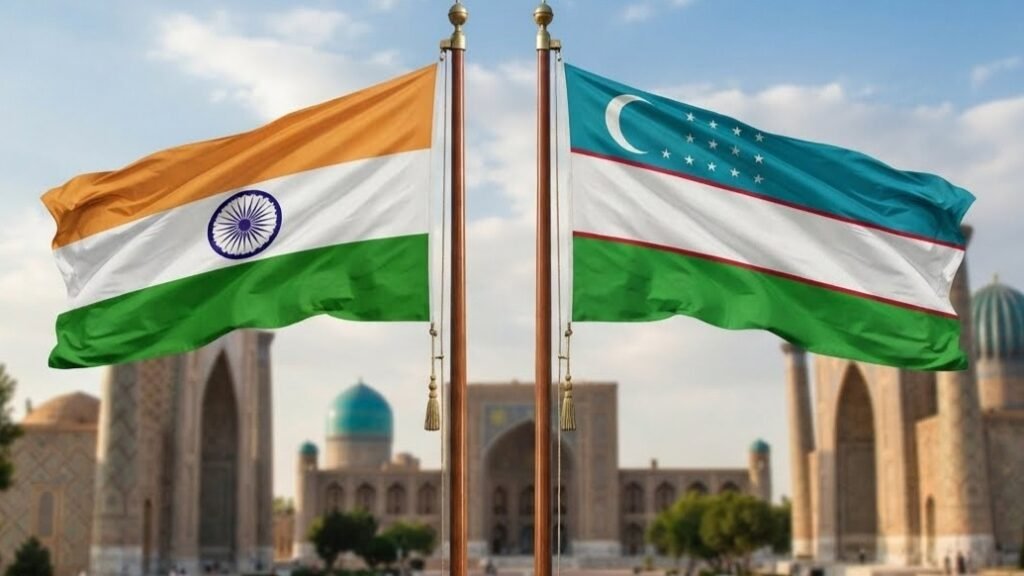
India and Uzbekistan set a joint economic goal to scale their bilateral trade to $3 billion over the next three years.
India–Uzbekistan Relations Detailed
- Historical Ties: India–Uzbekistan relations are rooted in over 2,000 years of civilizational contact through the Silk Route.
- Historic links between Samarkand, Bukhara and India promoted trade, Buddhism, Sufism and cultural exchange.
- The Mughal Empire of India traces its roots to the Fergana Valley of Uzbekistan.
- The historic Tashkent Agreement (1966) to establish peace after the India-Pakistan 1965 war was signed in the capital of Uzbekistan.
- After Uzbekistan’s independence in 1991 from the Soviet Union, India recognized it immediately and established diplomatic relations in 1992.
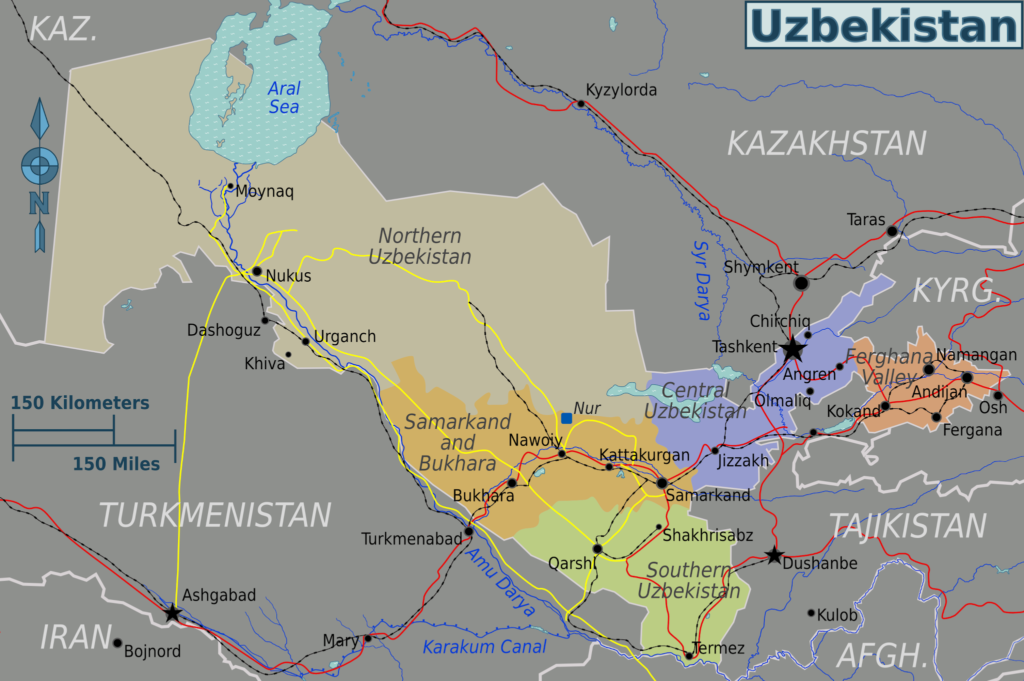
- Uzbekistan is a landlocked country located in Central Asia. It is bordered by Kazakhstan to the north, Tajikistan to the east, Turkmenistan to the south, and Afghanistan to the south.
- Political Ties: Diplomatic relations were established between the two on 18 March 1992.
- The relationship was elevated to a Strategic Partnership in 2011.
- Regular engagements between Prime Minister Narendra Modi and President Shavkat Mirziyoyev have accelerated cooperation.
- Important meetings include the India-Central Asia Summit (2022), SCO Summits, bilateral visits, and ministerial consultations.
- In May 2026, the 17th India-Uzbekistan Foreign Office Consultations reviewed political, trade, technology, education and regional cooperation.
- Institutional Framework and Agreements: The partnership is guided through the Intergovernmental Commission (IGC) on Trade, Economic, Scientific and Technological Cooperation, Foreign Office Consultations, Joint Working Groups, Business Council, Defence consultations, and India-Central Asia Dialogue.
- During the 14th India-Uzbekistan Intergovernmental Commission (June 2026), both countries agreed to remove non-tariff barriers, strengthen logistics, improve regulatory cooperation and double bilateral trade within three years.
- In August 2026, Commerce Minister Piyush Goyal and the Uzbek leadership reiterated the objective of achieving US$3 billion bilateral trade, explored a possible Free Trade Agreement (FTA) and expanded cooperation in critical minerals, mining, pharmaceuticals, healthcare, textiles and digital infrastructure.
- Economic Cooperation: Bilateral trade reached about US$1.3 billion in 2025, recording nearly 33% annual growth.
- Uzbekistan exported approximately US$164.6 million to India, while imports from India reached nearly US$1.15 billion. India has maintained a significant trade surplus.
- Major Indian exports include pharmaceuticals, medical devices, machinery, automobiles, engineering goods, chemicals, textiles, tea, coffee, rice and IT services.
- Uzbekistan exports fertilisers, fruits, vegetables, cotton, minerals, copper and strategic raw materials.
- India seeks greater access to uranium, rare earths and critical minerals.
- Currently around 400 Indian companies are operating in Uzbekistan.
- Indian companies are active in pharmaceuticals, healthcare, education, IT, hospitality, construction materials and textiles.
- More than 85 joint projects worth over US$3 billion have been undertaken with Indian partners.
- Both countries are improving connectivity through the International North-South Transport Corridor (INSTC) and Chabahar Port, reducing transport costs and improving Eurasian market access.
- To enhance investment protection between the two countries, a Bilateral Investment Treaty (BIT) has recently been finalised, which will strengthen investor confidence.
- Indian groups like iCreate are working with local partners to build start-up networks and train new business leaders on setting up incubators.
- Strategic Cooperation: India and Uzbekistan cooperate closely on counter-terrorism, extremism, cyber security and regional stability, particularly concerning Afghanistan.
- Defence exchanges include military training, capacity building and joint exercises such as Exercise DUSTLIK.
- Both countries share a ‘zero tolerance’ policy against cross-border terrorism, radicalism and drug trafficking.
- Energy cooperation focuses on renewable energy, critical minerals, mining, uranium, rare earth elements and energy security.
- Science and technology partnerships include digital governance, innovation, information technology, biotechnology, healthcare research and start-up collaboration.
- Infrastructure cooperation is expanding in transport logistics, customs digitalisation, industrial parks and multimodal corridors.
- Both countries are encouraging collaboration in digital infrastructure, logistics platforms, smart customs systems and industrial manufacturing.
- The Indian foreign minister announced the establishment of the India-Uzbekistan Parliamentary Friendship Group to enhance legislative cooperation.
- People-to-People Relations: The Indian community in Uzbekistan numbers about 20,000, almost all of them citizens of India, and only 67 are Overseas Citizens of India (OCI).
- Currently more than 16,000 Indian students (mainly pursuing medical studies) are studying in various universities of Uzbekistan.
- Academic cooperation has expanded through ICCR scholarships, educational exchanges and technical training under Indian Technical and Economic Cooperation (ITEC).
- Amity University opened a campus in Tashkent and Sharda University launched one in Andijan.
- Tourism, Buddhism and Sufi heritage continue strengthening people-to-people ties.
- Uzbekistan has broadened its e-Visa program for Indian travelers, India remains a key destination for roughly 8,000 Uzbek medical tourists annually.
- Lal Bahadur Shastri Indian Cultural Centre located in Tashkent is playing an important role in the promotion of Indian culture and Hindi language.
- Thousands of Indian films, music and yoga traditions enjoy immense popularity in Uzbekistan.
- Cultural centres regularly organize Hindi, yoga and Indian classical dance programmes.
- Multilateral Cooperation: Their multilateral cooperation is primarily driven through global and regional forums like the Shanghai Cooperation Organisation (SCO), the United Nations (UN), and the Non-Aligned Movement (NAM).
- Both countries are actively working through the India-Central Asia Dialogue.
- They cooperate through CICA and the India-Iran-Uzbekistan trilateral mechanism.
- Strategic Importance: Uzbekistan occupies a central geostrategic position in Central Asia, making it indispensable for India’s Connect Central Asia Policy and wider Eurasian engagement.
- It strengthens India’s outreach to Central Asia, Russia, Europe and the Caucasus through emerging transport corridors.
- Uzbekistan supports India’s vision of a stable Afghanistan, secure Eurasia and diversified supply chains.
- Uzbekistan is an important and long-term supplier of uranium to India’s nuclear power plants.
- Because Uzbekistan is a landlocked country, India is promoting the use of Iran’s Chabahar Port and INSTC to give it access to the sea.
- Uzbekistan has supported India’s candidature for the 2026 BRICS Presidency, while India has supported Uzbekistan’s candidature for the presidency of the Non-Aligned Movement (NAM) for the years 2027-2029.
Frequently Asked Questions (FAQs):
1. Why is Uzbekistan strategically important for India?
Answer: It connects India with Central Asia through energy, connectivity, critical minerals, and regional security cooperation.
2. What is the bilateral trade target between India and Uzbekistan?
Answer: Both countries aim to increase bilateral trade to US$3 billion within three years.
3. Which sectors dominate India–Uzbekistan economic cooperation?
Answer: Pharmaceuticals, critical minerals, textiles, digital infrastructure, healthcare, agriculture, mining, and engineering goods lead cooperation.
4. Through which multilateral platforms do India and Uzbekistan cooperate?
Answer: They cooperate through the UN, SCO, India-Central Asia Dialogue, CICA, and Chabahar trilateral mechanism.
5. What were the major outcomes of the August 2026 India–Uzbekistan meeting?
Answer: Both sides advanced trade, FTA discussions, investments, critical minerals, logistics, and digital infrastructure cooperation.
Disclaimer: Information in this article is based on official announcements and public records. Regulations and implementation details may evolve over time.
| Also Read: India–Cyprus Bilateral Ties |