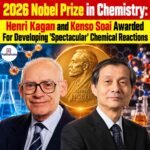




2026 Nobel Prize in Chemistry: Henri Kagan and Kenso Soai Awarded For Developing ‘Spectacular’ Chemical Reactions
| General Studies Paper I: Awards, International Recognition |
Why in News?
Henri B. Kagan and Kenso Soai won the 2026 Nobel Prize in Chemistry for explaining molecular handedness through nonlinear effects and autocatalysis.

2026 Nobel Prize in Chemistry Highlights
- Announcement: The Royal Swedish Academy of Sciences announced the 2026 Nobel Prize in Chemistry on 7 October 2026.
- The announcement was made by professor Ellen Moons, the Secretary General of the Royal Swedish Academy of Sciences.
- Laureates: The prize was jointly awarded to Henri B. Kagan of Université Paris-Sud, France, and Kenso Soai of Tokyo University of Science, Japan.
- Kagan was born in 1930 and earned his PhD in 1960 from Collège de France.
- Soai was born in 1950 and earned his PhD from the University of Tokyo in 1979.
- Citation: The official citation is: “for the discovery of non-linear effects and autocatalysis in asymmetric organic synthesis.”
- Their work demonstrated how small chemical asymmetries can be amplified, rather than remaining statistically insignificant.
- Their decades of independent research solved a century-old chemical enigma regarding how homochirality can spontaneously emerge.
- Prize Money: The 2026 Chemistry Nobel carries SEK 12 million, which is shared equally between Kagan and Soai—SEK 6 million each.
- Along with the cash, both laureates will receive a custom gold medal and an official diploma during the formal ceremony on December 10, 2026.
Chirality and Homochirality: Chemistry’s Mirror-Image Problem
- Chirality: Chirality is a molecular property in which an object or molecule cannot be superimposed on its mirror image.
- Derived from the Greek word for hand (kheir), it is best understood through human hands: your left and right hands are reflections of each other but cannot perfectly overlap.
- In chemistry, a molecule is considered chiral if it lacks an internal plane of symmetry.
- When a molecule is chiral, it exists in two distinct forms called enantiomers.
- These pairs share identical chemical and physical properties, such as melting points and densities.
- However, they differ entirely in how they rotate plane-polarized light—one turns it to the left (levorotatory or L-form) and the other to the right (dextrorotatory or D-form)—and how they interact with other chiral environments.
- Molecular chirality most commonly arises from a stereogenic center, typically an sp³-hybridized carbon atom bonded to four distinct chemical groups.
- This asymmetric arrangement locks the groups into a fixed three-dimensional spatial orientation.
- If even two attached groups are identical, the center gains a bisecting plane, rendering the molecule achiral.
- Homochirality: Homochirality refers to a structural uniformity where a system exclusively utilizes one specific enantiomer out of the two possible mirror-image forms.
- Earth’s biological machinery operates on a strict single-handed rule. All living systems construct proteins using L-amino acids, whereas the sugar backbones of DNA and RNA are built strictly from D-sugars.
- This structural uniformity is vital; mixing mirror images would disrupt the precise folding of molecular spirals, stopping the creation of life’s essential polymers.
- Earth’s biological machinery operates on a strict single-handed rule. All living systems construct proteins using L-amino acids, whereas the sugar backbones of DNA and RNA are built strictly from D-sugars.
- Problem: The central scientific puzzle is that ordinary chemical processes do not automatically explain why life should overwhelmingly favourone enantiomer. If mirror-image forms begin under apparently symmetrical conditions, why should one become dominant?
- In pharmaceuticals, one form provides a therapeutic effect, while the other mirror image can be highly toxic or inactive, as seen in historical tragedies like thalidomide. This made developing selective asymmetric synthesis pathways vital.
- Assumption: For decades, chemists operated on a strict assumption: a chemical product’s purity would always perfectly mirror its catalyst’s purity.
- They believed a linear relationship existed—if a catalyst mixture was 80% left-handed and 20% right-handed, the resulting product would inevitably reflect that exact same 80/20 ratio.
- Breakthrough: Winners of 2026 Nobel Prize in Chemistry discovered chemical reactions that selectively produce only one of two possible mirror-image molecules.
Henri Kagan’s Non-Linear Effect Breakthrough
- Henri B. Kagan shared the honor for discovering non-linear effects (NLE) in asymmetric organic synthesis.
- In 1986, Kagan published a historic breakthrough demonstrating that the relation between catalyst composition and product purity is not linear.
- He showed that a catalyst with moderate enantiomeric purity could yield a product with an unexpectedly high enantiomeric excess (ee).
- Kagan rationalized these observations mathematically through his famous ML2 model.
- When catalyst species form complexes containing two or more chiral ligands, they form homochiral (right-right/left-left) or heterochiral (left-right) dimer combinations.
- The heterochiral pairings are often less active or act as a “reservoir” that suppresses the minority form.
- This leaves the majority-handed catalyst free to dominate and amplify the final product’s optical purity.
- Kagan’s discovery provided a mathematical framework for chiral amplification.
- It dramatically altered pharmaceutical manufacturing by enabling the production of single-handed drugs without needing 100% chirally pure catalysts.
- It fulfilled the secondary criteria of Charles Frank’s 1953 model, offering an explanation for how biological homochirality spontaneously emerged in nature.
Kenso Soai’s Autocatalysis and the Soai Reaction
- Kenso Soai was honored for his discovery of asymmetric autocatalysis.
- Autocatalysis is a chemical system where a reaction product acts as its own catalyst to generate more of itself, creating a self-reinforcing loop. While autocatalytic reactions were known in the early 1990s, none were asymmetric.
- Soai sought to build a reaction where the chiral product could amplify its own enantiomeric excess (ee) from a microscopic imbalance.
- In a landmark 1995 publication (Soai Reaction), Soai discovered the alkylation of pyrimidine-5-carbaldehyde using diisopropylzinc.
- The resulting chiral product, 5-pyrimidyl alkanol, catalyzed the creation of itself.
- Starting with a tiny two percent excess of one enantiomer, the self-reinforcing reaction dramatically amplified the final output to an 87 percent excess.
- Soai continued refining this self-correcting loop, and in 2003, he successfully designed a system where a miniscule initial imbalance grew into complete symmetry breaking.
- The reaction ultimately yielded near 100 percent enantiomeric purity.
- The reaction is so sensitive that it can be initiated by external chiral triggers, including chiral hydrocarbons or even nitrogen isotopomers.
- The Soai reaction stands as one of the most spectacular experiments in modern chemistry.
- By combining Kagan’s non-linear effects with self-replication, Soai fulfilled the final criteria of Charles Frank’s model (the reaction fuels itself through autocatalysis, creating a self-reinforcing cycle).
- This provides the ultimate laboratory model explaining how life on Earth came to rely exclusively on left-handed amino acids and right-handed sugars.
- Autocatalysis is a chemical system where a reaction product acts as its own catalyst to generate more of itself, creating a self-reinforcing loop. While autocatalytic reactions were known in the early 1990s, none were asymmetric.
Frequently Asked Questions (FAQs):
1. Who won the 2026 Nobel Prize in Chemistry?
Henri B. Kagan of France and Kenso Soai of Japan jointly won the 2026 Nobel Prize in Chemistry.
2. Why did Henri B. Kagan and Kenso Soai receive the Nobel Prize in Chemistry?
They were honoured for discovering nonlinear effects and autocatalysis in asymmetric organic synthesis.
3. What did Kagan and Soai discover?
They discovered how small molecular asymmetries can be amplified, enabling chemical reactions to favour one mirror-image molecule.
4. What is asymmetric organic synthesis?
It is the chemical production of molecules where reactions are controlled to preferentially form one enantiomer over its mirror image.
5. What are nonlinear effects in chemical reactions?
They occur when product enantiomeric excess is disproportionately different from the catalyst’s enantiomeric composition.
6. What is autocatalysis in chemistry?
Autocatalysis occurs when a reaction product catalyses its own formation, creating positive feedback that can amplify molecular asymmetry.
Disclaimer: Information in this article is based on official announcements and public records. Details may evolve over time.
| Also Read: Nobel Prize 2026 in Physiology or Medicine |