




DRDO Successful AHAP Trials in Ladakh, Strengthening High-Altitude Logistics Support
| General Studies Paper III: Defence Technology, Indigenous Technology |
Why in News?
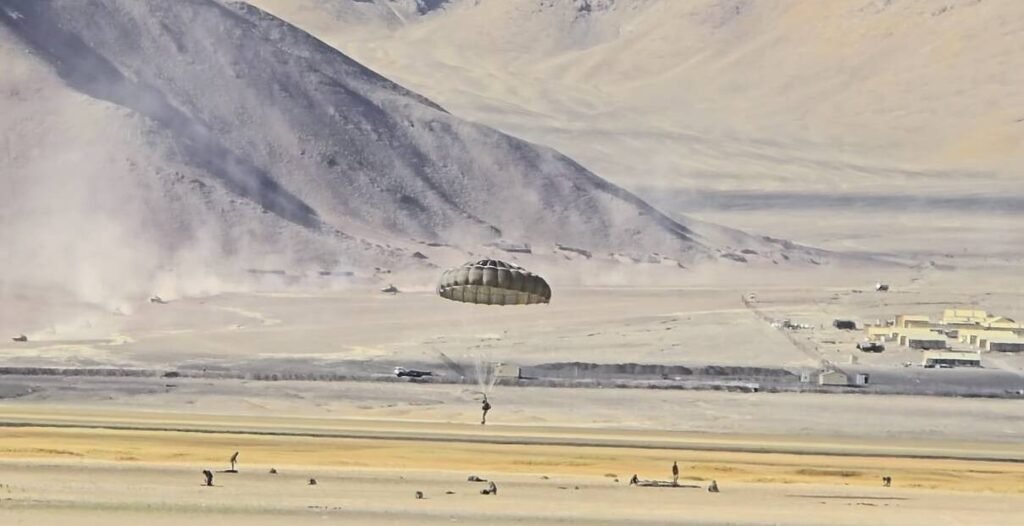
Recently, the Defence Research and Development Organisation (DRDO)’s indigenous Advanced High-Altitude Parachute (AHAP) achieved its maiden live jump in Nyoma, Ladakh.
What is Advanced High-Altitude Parachute (AHAP)?
- About: The Advanced High-Altitude Parachute (AHAP) is an indigenous static-line parachute system designed for the mass drop of paratroopers in high-altitude environments.
- Unlike individually deployed free-fall systems, a static-line arrangement is intended for coordinated troop deployment from an aircraft.
- Objective: The principal objective of AHAP is to enable safe and tactically effective mass airborne insertion at high altitudes.
- Such operations are difficult because extreme altitude creates challenging conditions, including high opening shock and demanding descent characteristics.
- Developer: AHAP was designed and developed by DRDO’s Aerial Delivery Research and Development Establishment (ADRDE), Agra, the organisation specialising in parachutes and aerial-delivery systems.
- Manufacturing: The system was manufactured by Ordnance Parachute Factory (OPF), Kanpur.
- Multiple Modes: AHAP provides various deployment modes, giving operational planners greater flexibility according to mission requirements.
- Operational Altitude: Its operational altitude capability is up to 18,000 feet.
- Certification: The system was inspected by the Directorate General of Aeronautical Quality Assurance (DGAQA) and certified by CEMILAC, RCMA Kanpur.
- Maiden Live Trial: On 6 October 2026, DRDO conducted AHAP’s maiden live jump at Nyoma (Mudh Drop Zone), Ladakh, one of the country’s high-altitude drop zones.
- The jump began at 16,000 feet AMSL; the parachute was deployed at 15,500 feet, while landing occurred at 13,700 feet.
- The successful jump demonstrated AHAP’s efficacy and tactical employability in extremely high-altitude terrain.
- The achievement was welcomed by Defence Minister Rajnath Singh as another step towards Aatmanirbhar Bharat.
Significance of AHAP
- Prior to AHAP, static-line mass paratrooper drops were restricted by thin air and excessive fall speeds. This system allows India to safely drop troops directly onto Himalayan ridges, transforming high-altitude troop movement.
- It strengthens India’s ability to conduct airborne operations in high-altitude terrain, particularly relevant to mountainous operational environments.
- High-altitude borders create major logistical and geographical constraints. A reliable mass-drop parachute can contribute to rapid movement and deployment of trained personnel where conventional surface movement is difficult.
- The successful trials at the Nyoma airstrip environment demonstrate that India can rapidly reinforce its positions along the Line of Actual Control (LAC) during sudden border escalations, nullifying terrain bottlenecks.
- AHAP demonstrates the integration of indigenous design, development, manufacturing, inspection and certification, illustrating an indigenous defence-industrial chain.
- The project strengthens India’s accumulated expertise in aerial delivery and parachute technologies.
- ADRDE’s wider portfolio includes combat free-fall, heavy-drop and controlled aerial-delivery systems, creating technological synergies across different airborne applications.
Similar Projects and Achievements
- India has also developed the Military Combat Parachute System (MCPS) through ADRDE, Agra, and DEBEL, Bengaluru.
- In October 2025, it successfully demonstrated a combat free-fall jump from 32,000 feet.
- It features a low rate of descent, advanced steering, and integrates NavIC compatibility to enable paratroopers to navigate securely through contested airspaces.
- DRDO’s Combat Free Fall System (CFF) provides a complete parachute solution for paratroopers jumping from heights of up to 30,000 feet.
- It supports both HAHO (High Altitude High Opening) and HALO (High Altitude Low Opening) modes, can glide up to 30 km, and has been inducted into the Services.
- The indigenous P-7 Heavy Drop System is designed to paradrop military stores in the 7-ton class from IL-76 aircraft.
- The system has been developed using 100% indigenous resources and inducted into the Army.
- DRDO’s Heavy Drop System (HDS)-16T represents India’s capability to deliver substantially heavier loads. With a 16-ton capacity, it uses a multi-stage parachute arrangement and is intended for military stores including vehicles and ammunition.
- It has been successfully demonstrated in different terrains, including Ladakh, and is being inducted into the Indian Army.
- The Controlled Aerial Delivery System (CADS) uses a high-performance RAM-air parachute with gliding and manoeuvring capability.
- It can operate autonomously with manual override, deliver a 500-kg payload, and has demonstrated delivery within a 100-metre circular error probable (CEP).
- It uses GPS and onboard flight sensors to execute waypoint navigation, allowing safe supply line replenishment.
- ADRDE is also contributing to India’s human-spaceflight programme. In collaboration with VSSC, it developed a two-stage reefed main parachute for Gaganyaan’s crew-module recovery system.
- DRDO reported that this was the first use of two-stage reefing in an Indian parachute.
- In March 2026, DRDO and the Indian Navy successfully completed four in-flight release trials of the indigenous ADC-150 from a P-8I aircraft.
- The system can deliver a 150-kg payload to naval vessels requiring urgent stores, equipment or medical assistance.
Frequently Asked Questions (FAQs):
1. What is DRDO AHAP and why was it tested in Ladakh?
AHAP is an indigenous static-line parachute for mass paratrooper drops, tested in Ladakh to validate high-altitude tactical employability under extreme terrain conditions.
2. What did DRDO achieve during the successful AHAP trials in Ladakh?
DRDO successfully conducted AHAP’s maiden live jump from 16,000 feet, proving its efficacy and tactical employability at extremely high altitudes.
3. How will AHAP strengthen high-altitude logistics support for the Indian Armed Forces?
AHAP can enable rapid airborne deployment of personnel where difficult terrain restricts conventional movement, strengthening tactical mobility and high-altitude operational support.
4. Why is high-altitude logistics support important for the Indian Army in Ladakh?
Ladakh’s extreme altitude, rugged terrain and difficult connectivity make airborne logistics crucial for rapidly supporting troops, supplies and operational deployments in remote areas.
Disclaimer: Information in this article is based on official announcements and public records. Details may evolve over time.