



EyeROV Delivers India’s First Military-Grade ROV, Fortifying India’s Maritime Security and Subsurface Capabilities
| General Studies Paper III: Defence Technology, Indigenization of Technology |
Why in News?
Recently, Kochi-based deep-tech startup EyeROV has delivered two TROUT military-grade underwater Remotely Operated Vehicle (ROV) to the Indian Navy.
What is EyeROV Military-Grade ROV “TROUT”?
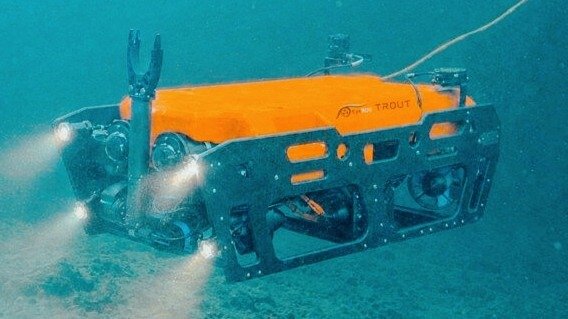
- About: TROUT is a tethered Underwater Remotely Operated Vehicle (UWROV) developed by Kochi-based IROV Technologies Pvt. Ltd. (EyeROV) for demanding underwater inspection and naval missions.
- It is remotely operated from the surface while carrying cameras, sonar, navigation and specialised payloads underwater.
- It is India’s first military-grade ROV designed, developed, manufactured and qualified domestically.
- Objective: It is developed to provide the Indian Navy with an indigenous robotic platform capable of undertaking underwater inspection, surveillance, reconnaissance, detection, search-and-recovery and robotic intervention.
- Development Programme: TROUT originated under the iDEX DISC-7 SPRINT Challenge.
- iDEX—Innovations for Defence Excellence—is the Ministry of Defence’s defence-innovation ecosystem, while SPRINT promotes indigenous naval technologies.
- Navy Contract: In September 2025, the Indian Navy placed an approximately ₹47-crore order for five TROUT systems.
- In October 2026, EyeROV delivered the first two systems.
- Operating Depth: TROUT has a stated 300-metre depth rating.
- EyeROV’s product material additionally describes a 400-metre neutrally buoyant tether, through which power and data are transmitted between the surface and underwater vehicle.
- Capabilities & Missions:
- TROUT combines high manoeuvrability, autonomous-navigation functions, advanced imaging and modular payload integration.
- It is equipped with 4K imaging with 10× optical zoom, wide-angle imaging, imaging sonar, DVL/USBL positioning, ultrasonic thickness measurement and a 3-DoF robotic arm with grabber, rope cutter and recovery jaws.
- Its i-Control Hub supports auto-depth, auto-heading, station keeping, GPS waypoints, geofencing, data logging and return/retrace-to-home functions.
- Validation: TROUT underwent extensive field trials and system-level validation.
- Testing examined manoeuvrability, deep-diving performance, operation in strong underwater currents, and operator control.
- Qualification: The platform underwent the Directorate of Quality Assurance (Naval)—DQA(N) quality-assurance framework and Environmental Stress Screening (ESS) under applicable DGQAN policies and military requirements.
- It also completed type testing, establishing conformity of the design with specified test conditions.
| Note: A Remotely Operated Vehicle (ROV) is an uncrewed underwater robot connected to a surface control station by an umbilical tether that transmits power, video, and data in real time. |
Significance of India’s First Military-Grade ROV
- Strategic Autonomy: TROUT diminishes reliance on foreign imports for specialized maritime defense technology.
- It secures local mastery over sensitive deep-tech intellectual property, promoting national security resilience.
- Indigenous Manufacturing: The platform serves as a massive success milestone for the government’s “Make in India” and “Atmanirbhar Bharat” initiatives.
- It validates the country’s local capacity to design, manufacture, and assemble elite-tier deep-sea electronic architectures from scratch.
- Enhanced Maritime Domain Awareness: India possesses extensive maritime interests covering the Indian Ocean Region, ports, naval facilities and underwater infrastructure.
- TROUT can support underwater inspection, surveillance, detection and recovery, thereby contributing to maritime domain awareness and subsea security.
- Reducing Diver Risk: Conventional underwater inspection may expose personnel to poor visibility, strong currents, depth-related hazards and confined spaces.
- A remotely operated robotic platform allows operators to perform observation and intervention while remaining on the surface, potentially reducing human exposure to dangerous environments.
- Dual-Use Industry Spillovers: The core technology of the TROUT platform supports massive commercial spillovers.
- Its advanced ruggedization can easily scale to assist civilian agencies with dam safety audits, deep-water volcanic studies, and scientific research in extreme environments like the Antarctic.
- Fostering the Startup Ecosystem: The successful deployment of startup-developed products marks a major shift in military procurement.
- It provides a powerful validation loop for young private deep-tech innovators, proving that Indian startups can reliably deliver combat-ready systems to the armed forces.
Other Similar Developments
- Jalasimha: It is developed by Coratia Technologies under the iDEX DISC-7 framework.
- It is a tethered underwater ROV intended for inspection and repair, with reported capabilities including a 4K camera, scanning sonar, 3-DoF robotic arm, DVL, USBL, NDT probes and powerful thrusters.
- NIOT: The National Institute of Ocean Technology (NIOT) has developed a 6000-metre-depth-rated ROV. NIOT’s work forms part of India’s broader technology-development ecosystem under the Ministry of Earth Sciences.
- Under the Deep Ocean Mission/Samudrayaan, NIOT is developing MATSYA-6000, a human-occupied deep-sea submersible designed to carry three people to 6000 metres.
- Wet harbour trials were conducted in January–February 2025. Unlike TROUT, MATSYA-6000 is a crewed scientific submersible, designed primarily for deep-ocean exploration and scientific investigation.
- DRDO Man-Portable: DRDO’s Naval Science & Technological Laboratory (NSTL) has also developed man-portable Autonomous Underwater Vehicles (MP-AUVs) for mine-countermeasure operations.
- These systems use side-scan sonar, underwater cameras, autonomous target recognition and underwater acoustic communication.
Frequently Asked Questions (FAQs):
1. What is the EyeROV TROUT military-grade ROV?
TROUT is an indigenous 300-metre-depth tethered ROV developed by EyeROV for advanced naval underwater inspection, surveillance, recovery and intervention missions.
2. Why is EyeROV TROUT significant for the Indian Navy?
It strengthens indigenous underwater capabilities, reduces diver risks, supports maritime security, and advances defence self-reliance through domestic marine-robotics technology.
3. Is EyeROV TROUT India’s first military-grade ROV?
Yes. TROUT has been described as India’s first military-grade ROV developed, qualified and manufactured domestically for Indian Navy requirements.
4. What is an ROV and how does it work?
An ROV is a remotely operated underwater vehicle controlled from the surface through a tether transmitting power, commands, data and video.
5. What missions can the EyeROV TROUT perform?
TROUT supports underwater inspection, surveillance, reconnaissance, detection, search-and-recovery, navigation, infrastructure assessment and robotic intervention in challenging underwater environments.
Disclaimer: Information in this article is based on official announcements and public records. Details may evolve over time.