Indigenous ULPGM-V3 Missile
|
General Studies Paper III: Defence Technology, Indigenization of Technology |
Why in News?
Recently, India’s DRDO successfully completed final development trials of the indigenous Unmanned Aerial Vehicle Launched Precision Guided Missile (ULPGM-V3) at the National Open Area Range (NOAR), Kurnool, Andhra Pradesh.
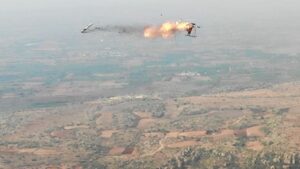
What is ULPGM-V3 Missile?
- About: The ULPGM-V3 (Unmanned Aerial Vehicle Launched Precision Guided Missile-V3) is an indigenous drone-launched smart missile developed for precise attacks on ground and aerial targets during modern warfare.
- It is an upgraded version of the DRDO’s ULPGM-V2, enhancing India’s indigenous drone-launched precision strike capability.
- Objective: The missile was designed to provide high-precision strike capability against tanks, bunkers, drones, helicopters, and armored vehicles while reducing risks to soldiers through stand-off drone operations.
- Developed By: The missile was developed by Defence Research and Development Organisation through laboratories including Research Centre Imarat, DRDL, TBRL, and HEMRL under India’s indigenous defence modernization programme.
- Production partners include Bharat Dynamics Limited and Adani Defence Systems & Technologies Limited with support from more than 30 Indian MSMEs and startups.
- Launch Platform: The missile is launched from indigenous Unmanned Aerial Vehicles (UAVs) developed by NewSpace Research Technologies for advanced drone warfare missions.
- Strike Modes: ULPGM-V3 operates in both Air-to-Ground and Air-to-Air modes. It can attack enemy vehicles on land and airborne threats including drones and helicopters.
- Guidance Feature: The missile uses a high-definition dual-channel seeker for highly accurate targeting. This advanced seeker improves lock-on capability during difficult battlefield conditions.
- It uses an integrated Ground Control System (GCS) for automated launch and command operations.
- Night Capability: ULPGM-V3 has complete day-and-night operational capability. It can conduct precision strikes even during darkness and low-visibility combat conditions.
- Data Link: The missile contains a two-way real-time data link. Operators can update targets after launch and correct aim points during flight operations.
- Warhead Types: The missile carries three modular warheads including anti-armour, penetration-cum-blast, and pre-fragmentation variants for different battlefield missions.
- Operational Range: Reports indicate the missile has an operational strike range of nearly 10 kilometres, enabling safe stand-off attacks from long distances.
- Operational Versatility: Designed to perform in both extreme high-altitude mountain environments and flat plains, ensuring mission flexibility.
- Precision Lethality: Equipped with a Penetration-cum-Blast (PCB) warhead optimized to destroy reinforced concrete bunkers and fortified structures.
Strategic Significance of ULPGM-V3 Missile
- Drone Warfare: The ULPGM-V3 significantly strengthens India’s unmanned combat capability by enabling drones to conduct precision attacks without exposing pilots or troops to enemy fire.
- This supports the Indian military’s transition toward network-centric and autonomous warfare systems, which are increasingly important in modern conflicts such as Ukraine and West Asia.
- Border Security: The missile improves India’s capability to monitor and strike hostile targets across difficult terrains including high-altitude Himalayan regions, deserts, and border zones.
- Its integration with UAVs enhances rapid response against infiltration, armored movement, and cross-border threats along sensitive frontiers.
- Defence Modernisation: ULPGM-V3 represents India’s growing shift toward smart precision weapons instead of conventional unguided systems.
- The missile supports military modernization programmes focused on AI-enabled targeting, real-time battlefield surveillance, and precision engagement technology.
- Indigenous Manufacturing: The project strengthens Aatmanirbhar Bharat by reducing dependence on imported precision-guided munitions.
- Participation of Indian public and private defence industries, startups, and MSMEs expands the domestic defence manufacturing ecosystem.
- By substituting imported munitions like Israeli Spike or American Hellfire missiles, India secures its sovereign defense supply chain.
- Strategic Deterrence: The missile increases India’s stand-off strike capability, allowing forces to neutralize targets from safer distances.
- Such capability improves deterrence against hostile armored formations, drone attacks, and tactical threats in future battlefield scenarios.
- Export Potential: The weapon positions India as a competitive supplier of low-cost precision guided tech in the global south market.
- Offering a field-tested, dual-mode missile system allows India to expand its strategic defense exports to friendly foreign nations.
|
India’s Indigenous Drone Strike Missiles:
|
|
Also Read: India Successfully Tests Agni-III Nuclear-Capable Missile |