CCEA Approves Railway Multi-Tracking Infrastructure Projects, Aligning with PM Gati Shakti National Master Plan
| General Studies Paper III: Inclusive Growth & Development, Government Policies |
Why in News?
Recently, the Cabinet Committee on Economic Affairs (CCEA) approved eight railway multi-tracking projects worth ₹20,804 crore, under the PM Gati Shakti National Master Plan.
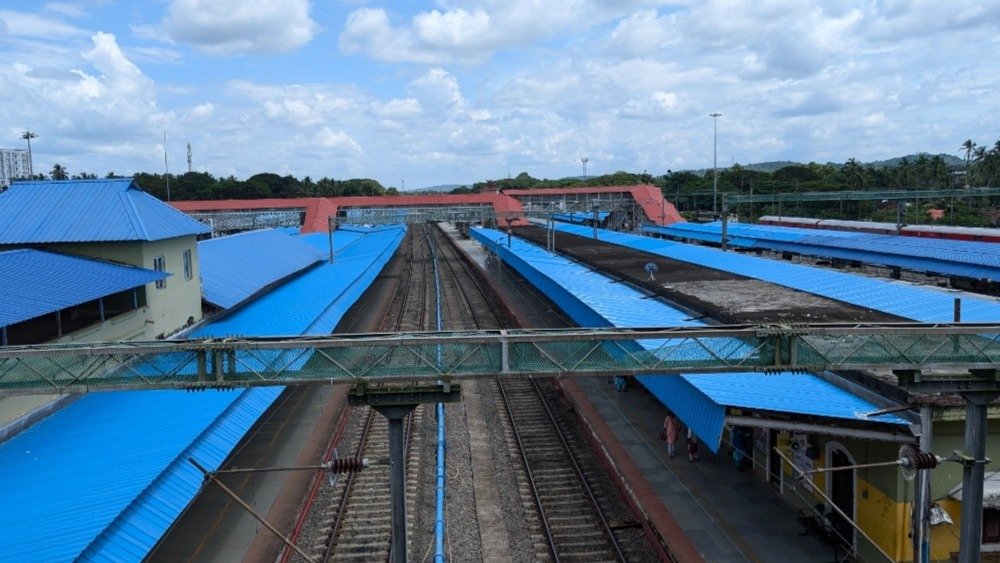
CCEA Railway Multi-Tracking Infrastructure Projects 2026 Details
- Approval: The Cabinet Committee on Economic Affairs (CCEA), chaired by Prime Minister Narendra Modi, approved eight multitracking railway projects on 9 September 2026.
- Together, they involve an estimated investment of ₹20,804 crore.
- They will add approximately 1,196 km to the existing Indian Railways network.
- The projects are planned for completion by 2029–30.
- Project Alignment: All eight projects have been planned under the PM Gati Shakti National Master Plan.
- Coverage: The projects cover 31 districts across nine states.
- The first package covers Tamil Nadu, Andhra Pradesh, Karnataka and Telangana.
- The first package contains five projects costing about ₹10,021 crore, adding approximately 540 km.
- These include Arakkonam–Renigunta third and fourth lines (77 km), Whitefield–Bangarapet third and fourth lines (47 km), Hosur–Omalur doubling (147 km), Salem–Karur–Dindigul doubling (159 km) and Secunderabad (Ghatkesar)–Kazipet multitracking (110 km).
- The second covers West Bengal, Jharkhand, Odisha, Madhya Pradesh and Chhattisgarh.
- The second package involves three projects costing ₹10,783 crore, adding approximately 656 km.
- These are Kharagpur–Jharsuguda (Bagdehi) fourth line, Katni–Pendra Road fourth line, and Bilaspur (Uslapur)–Pendra Road third line.
- The first package covers Tamil Nadu, Andhra Pradesh, Karnataka and Telangana.
- Connectivity Impact: The first package will improve connectivity to nearly 2,121 villages, representing nearly 52 lakh people.
- The second package will connect around 4,790 villages, benefiting approximately 56 lakh people.
- Collectively, the projects therefore expand railway access for roughly 1.08 crore people.
- The second package will connect around 4,790 villages, benefiting approximately 56 lakh people.
- Tourism Impact: The projects will improve access to major religious, cultural and tourism destinations, including Tirupati, Tiruttani, Kodaikanal, Sathyamangalam, Yadagirigutta, Bhongir, Amarkantak, Bandhavgarh and Achanakmar.
- This can strengthen pilgrimage tourism, regional tourism and associated local economic activity.
- Freight Capacity: The routes are important for transporting coal, cement, iron and steel, containers, automobiles, food grains, petroleum products and fertilisers.
- The first package is expected to generate an additional 47 MTPA freight capacity, while the second could add 27 MTPA.
- Together, this represents approximately 74 MTPA additional freight traffic.
- Environmental Outcomes: The projects are expected to support a shift towards the more energy-efficient railway mode.
- The first package could reduce oil imports by about 8 crore litres and CO₂ emissions by approximately 42 crore kg.
- The second could reduce oil imports by around 12 crore litres and CO₂ emissions by approximately 62 crore kg.
What is PM Gati Shakti National Master Plan?
- About: PM Gati Shakti National Master Plan (NMP) is an integrated infrastructure-planning framework designed to coordinate different transport and infrastructure systems.
- It is a Rs 100 lakh crore investment plan for development of infrastructure over the next five years.
- Launch: The National Master Plan was formally launched on 13 October 2021.
- Objectives: Its central objective is to replace silo-based planning with multimodal and data-driven infrastructure development.
- It was introduced as a major shift towards integrated planning and coordinated implementation of infrastructure projects across India.
- Its broad objective is to create seamless multimodal connectivity, improve logistics efficiency, strengthen economic-zone connectivity and reduce infrastructure-related bottlenecks.
- Pillars:
- Seven Economic Drivers: Railways, roads, ports, waterways, airports, mass transport, and logistics infrastructure.
- Supportive Infrastructure: Energy transmission, IT communication, bulk water, and social infrastructure (schools and hospitals).
- Integration: Combines existing initiatives like Bharatmala, Sagarmala, and UDAN into a single unified framework.
- Institutional Mechanism: The Department for Promotion of Industry and Internal Trade (DPIIT), through its Logistics Division, plays a central coordinating role.
- It includes the Empowered Group of Secretaries (EGoS), Network Planning Group (NPG) and Technical Support Unit (TSU).
- Empowered Group of Secretaries (EGoS) chaired by the Cabinet Secretary to monitor execution and review plan alignment.
- Network Planning Group (NPG) comprises planning division heads from infrastructure ministries to evaluate projects for multi-modal connectivity.
- As of February 2026, it had evaluated 352 projects worth ₹16.10 lakh crore; 201 were sanctioned, with 167 under implementation.
- Technical Support Unit (TSU) provides GIS mapping, spatial tools, and satellite imagery via BISAG-N and ISRO.
- It enables planners to view infrastructure assets, proposed alignments and relevant spatial information before finalising projects.
- By February 2026, the platform had brought together 57 Central Ministries and all States and UTs, with more than 1,700 data layers.
- Advantages:
- Whole-of-Government Approach: Breaks departmental silos by bringing 44 Central Ministries and 36 States/UTs onto one geospatial platform with over 1,600 data layers.
- Logistics Efficiency: Aims to lower high logistics costs (historically 13–14% of GDP) to global standards, improving India’s Logistics Performance Index rank.
- Cooperative Federalism: Aligns central and state-level planning without introducing separate dedicated budgetary allocations.
- Private Sector Access: Recent policy shifts open portal access to industries for collaborative, data-driven supply chain planning.
- Last-Mile Connectivity: Connects infrastructure with industrial corridors, textile clusters, pharmaceutical clusters, defence corridors, electronic parks, agricultural zones and other economic nodes.
- Indian Railways Projects: Indian Railways has incorporated PM Gati Shakti principles into new-line, gauge-conversion and doubling surveys.
- During FY 2022–23, FY 2023–24, FY 2024–25 and FY 2025–26, Indian Railways sanctioned 300 projects covering 13,808 km under PM Gati Shakti.
- These comprised 51 new-line projects, 17 gauge-conversion projects and 232 doubling projects.
- Projects like 272-km Udhampur–Srinagar–Baramulla new line, 51-km Bhairabi–Sairang new line, 467-km Pune–Miraj–Londa doubling and 279-km Katni–Bina third line were recently completed.
- During the same period, 982 surveys covering 67,010 km were sanctioned.
- These included 295 new-line surveys, 13 gauge-conversion surveys and 674 doubling surveys.
- In FY 2025–26, 100 railway projects involving new lines, doubling, multitracking and other works were sanctioned.
- They represented more than 6,000 km and approximately ₹1.53 lakh crore of investment.
- Indian Railways has identified 434 projects under three major economic-corridor programmes: Energy, Mineral and Cement Corridors, High Traffic Density Routes, and Rail Sagar Corridors.
- All 434 were mapped on the PM Gati Shakti portal; 121 projects covering 12,133 km had been sanctioned, while 162 projects covering 16,910 km were under appraisal or inter-ministerial consultation.
- The Eastern Dedicated Freight Corridor, measuring 1,337 km, and the Western Dedicated Freight Corridor, measuring 1,506 km, form a major capacity-enhancement backbone.
- The corridors had been operationalised except the 102-km Vaitarna–JNPT Mumbai section remained under progress.
- Gati Shakti Cargo Terminals, in July 2026 that 142 GCTs had been commissioned, providing approximately 224 MTPA freight-handling capacity, while 310 additional GCTs had been approved.
- Around ₹10,000 crore of private investment had been mobilised through the terminals.
- During FY 2022–23, FY 2023–24, FY 2024–25 and FY 2025–26, Indian Railways sanctioned 300 projects covering 13,808 km under PM Gati Shakti.
Significance of Railway Multi-Tracking Infrastructure Projects
- Unlocking Existing Network Capacity: Multi-tracking is important because Indian Railways carries exceptionally high traffic over a large network.
- The 2024–25 Railway Year Book shows that routes forming only 16% of the total network carried 52% of passenger traffic and 58% of freight traffic.
- Additional tracks can therefore relieve pressure on the most intensively used sections and improve network utilisation.
- Higher Throughput Without New Routes: Multi-tracking can increase the number of train paths on an existing corridor without requiring an entirely new railway alignment.
- This is particularly valuable where demand is concentrated along established industrial and population corridors.
- Better Utilisation of Electrification: Additional tracks become more effective when combined with electrification and higher-powered electric locomotives.
- Electric locomotives can support higher speeds and greater loading. This creates a capacity multiplier: more tracks + electric traction + improved operations can raise corridor productivity.
- Improving Freight-Heavy Corridors: The Railway Ministry’s environmental assessment has estimated railways to be about 12 times more energy-efficient for freight and 3 times more efficient for passengers compared with road transport.
- Multitracking can consequently support greater movement of commodities while strengthening the economic case for rail-based logistics.
- Reducing Dependence on Diesel: Capacity expansion also complements India’s transition towards electric railway operations. The 2024–25 annual report records 2,701 route km of electrification during the year.
- Greater electric-network capacity can improve operational flexibility while reducing dependence on imported fossil fuels.
- Building a Resilient National Transport: Multi-tracking creates operational redundancy. If one track becomes temporarily unavailable because of maintenance, an incident or another disruption, additional tracks can provide alternative operating capacity.
- This is strategically important for a continental-scale railway system serving 69,439 route km, as reported in the Economic Survey 2025–26, and supports greater resilience of India’s passenger and freight supply chains.
Frequently Asked Questions (FAQs):
1. What railway projects worth ₹20,804 crore were approved by the Cabinet?
The CCEA approved eight multitracking projects, adding about 1,196 km, across nine states, with completion targeted by 2029–30.
2. Why did the Cabinet approve Railway Projects Worth ₹20,804 Crore?
The approval aims to reduce congestion, increase capacity, improve reliability, strengthen logistics, and facilitate smoother passenger and freight movement.
3. How will the Cabinet Railway Project Approval improve rail connectivity?
The projects will expand railway capacity, connecting approximately 6,911 villages and benefiting around 1.08 crore people across the covered regions.
4. What is the total cost of the Railway Projects 2026?
The latest eight approved projects have a combined estimated cost of ₹20,804 crore, comprising ₹10,021 crore and ₹10,783 crore packages.
5. How will Indian Railways Projects improve transportation infrastructure?
They will strengthen multimodal connectivity, freight capacity, operational efficiency and logistics, supporting seamless movement of people, goods and services.
6. Which regions will benefit from the new Railway Expansion Projects India?
Benefits extend across Tamil Nadu, Andhra Pradesh, Karnataka, Telangana, West Bengal, Jharkhand, Odisha, Madhya Pradesh and Chhattisgarh.
Disclaimer: Information in this article is based on official announcements and public records. Regulations and implementation details may evolve over time.