



NASA’s SpaceX Crew-13 Launch, Astronauts Reached ISS in Fastest Journey
| General Studies Paper III: Space Technology |
Why in News?
Recently, NASA’s SpaceX Crew-13 launched successfully to the International Space Station (ISS), carrying four international astronauts for long-duration research advancing space technology.
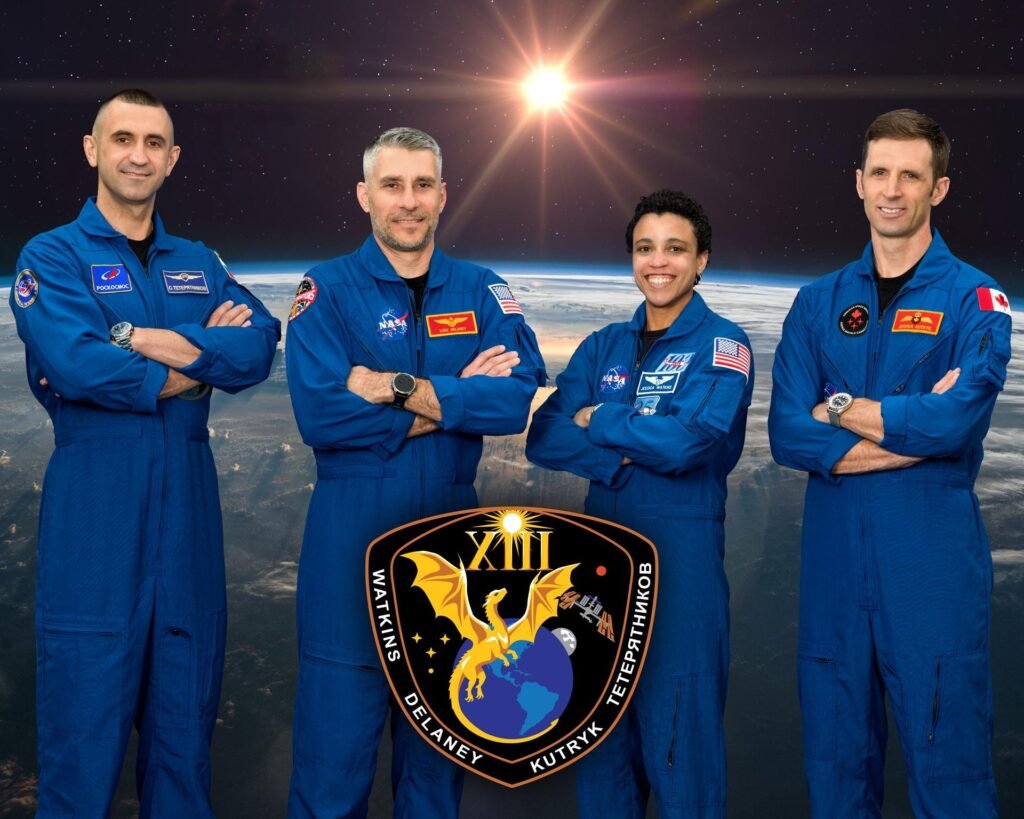
Image Credit: NASA
What is NASA’s SpaceX Crew-13 Mission?
- About: NASA’s SpaceX Crew-13 is a crew-rotation mission transporting four astronauts to the International Space Station (ISS) for a long-duration scientific expedition.
- It is the 13th SpaceX crew-rotation mission and the 14th Dragon flight carrying people for NASA’s Commercial Crew Program, counting the earlier Demo-2 test flight.
- Collaboration: This is primarily a joint commercial crew mission of NASA and Elon Musk’s company SpaceX.
- Launch: Crew-13 launched on 1 October 2026 at 11:10 a.m. EDT from Space Launch Complex 40 (SLC-40) at Cape Canaveral Space Force Station, Florida.
- The mission was originally planned later in 2026 but was advanced to increase the frequency of U.S. crew rotations to the ISS.
- Crew Members: The four-member multinational crew comprises Jessica Watkins (NASA, Commander), Luke Delaney (NASA, Pilot), Joshua Kutryk (Canadian Space Agency, Mission Specialist) and Sergey Teteryatnikov (Roscosmos, Mission Specialist).
- Jessica Watkins became the first Black woman to lead a crew during orbital insertion.
- Spacecraft: Crew-13 flew aboard SpaceX’s Dragon spacecraft, named Grace. Grace’s first ISS mission was Axiom Mission 4 in 2025, making Crew-13 its second ISS flight.
- Dragon is an autonomous crew spacecraft, capable of being monitored and controlled by astronauts and ground controllers.
- Launch Vehicle: The Dragon was launched by SpaceX Falcon 9, a reusable orbital launch vehicle.
- Following ascent, the first stage separated and landed at Landing Zone 40, while the second stage placed Dragon into orbit before spacecraft separation.
- This illustrates the operational importance of rocket reusability in modern commercial spaceflight.
- Docking and Transit Time: After orbital insertion, Dragon independently rendezvoused with the ISS and docked at 7:05 p.m. EDT at the forward port of the Harmony module.
- The journey lasted 7 hours 55 minutes, establishing the fastest launch-to-docking time achieved by a U.S. spacecraft at the ISS.
- ISS Operations: After docking, the crew completed leak checks, pressurisation and hatch-opening procedures, joining the existing Expedition 75 team.
- Expedition 75 began on 26 July 2026 and is scheduled to continue until spring 2027.
- Crew-13 became part of this expedition alongside Jessica Meir, Jack Hathaway, Sophie Adenot, Andrey Fedyaev, Anil Menon, Pyotr Dubrov and Anna Kikina.
- Mission Objectives: Crew-13 will exploit microgravity to produce human stem-cell-derived tissues, supporting research relevant to personalised medicine, disease modelling and pharmaceutical testing.
- Investigations specifically include conditions such as heart disease and Parkinson’s disease, demonstrating how space-based research can generate terrestrial medical applications.
- Researchers will investigate factors associated with blood-flow abnormalities in space, an important problem during prolonged missions.
- Crew-13 will also test a new inflight diagnostic device for monitoring astronaut health, contributing to medical autonomy.
- Crew-13 will investigate crop production in microgravity, including a new largely autonomous plant-growth facility and cultivation using plant pillows.
- Duration: The crew will carry out these innovative experiments within six-month duration.
NASA’s Commercial Crew Programme
- NASA’s Commercial Crew Program (CCP) is a public-private framework designed to provide safe, reliable and cost-effective human transportation to low-Earth orbit and the ISS using commercially developed spacecraft and launch systems.
- Program emerged following the 2011 retirement of the Space Shuttle.
- Its goal is to end reliance on Russian Soyuz rockets.
- The program utilizes fixed-price service contracts.
- Private entities own and operate the infrastructure, while NASA acts as a customer setting strict safety and performance requirements.
- NASA selected SpaceX and Boeing under the Commercial Crew Transportation Capability (CCtCap) contracts.
- SpaceX received $2.6 billion to build the Crew Dragon, while Boeing secured $4.2 billion to develop the CST-100 Starliner.
- SpaceX launches from Florida using the Falcon 9 rocket, recovering capsules via ocean splashdowns.
- Boeing pairs its Starliner with the United Launch Alliance (ULA) Atlas V rocket, opting for land-based airbag touchdowns.
- NASA retains certification and oversight responsibilities.
- Commercial systems must satisfy NASA requirements covering spacecraft, launch vehicles, software, engineering, mission operations and crew safety.
- The program maintains continuous crew rotations to the International Space Station (ISS). Spacecraft carry up to four astronauts per mission.
- The ISS functions as a critical laboratory for understanding long-duration human spaceflight.
- The CCP frees NASA from low-Earth orbit management, letting it focus resources on the Artemis initiative.
- The CCP’s public-private paradigm serves as the absolute template for future Moon and Mars exploration.
- Commercial companies are contributing technologies including lunar landers, while NASA develops systems such as Orion and SLS.
Significance of Crew-13-Type Missions — Seven Aspects
- Geopolitical Continuity: Despite escalating terrestrial conflicts, these missions preserve vital space diplomacy by seamlessly integrating international crews (e.g., NASA, Roscosmos, and CSA), upholding space as a global commons.
- Technological Benchmarking: Achieving record-breaking “fast-track” transit times (e.g., under 8 hours) optimizes automated orbital maneuvers, providing critical operational data for India’s Gaganyaan Program regarding trajectory and docking precision.
- Maturity of the Space Economy: Transitioning crewed transport entirely to the private sector via public-private partnerships (PPP) like NASA’s Commercial Crew Program models a sustainable, cost-effective framework for upcoming commercial space stations.
- Advancements in Reusability: Routine flights using flight-proven boosters and capsules demonstrate the economic feasibility of circular space infrastructure, directly addressing the global need for reducing orbital launch costs.
- Decentralized Infrastructure Utilization: Launching crewed missions from complex pads like SLC-40 proves the feasibility of converting standard national defense/commercial launch pads into diversified human-rated spaceports.
- Precursor for Deep-Space Exploration: Serving as low-Earth orbit (LEO) testbeds, these long-duration missions generate invaluable biomedical and engineering baselines crucial for enduring future crewed transits to the Moon and Mars.
- Incentivizing Global Supply Chains: Sustaining rapid crew-rotation frequencies forces an expansion of highly resilient, cross-border aerospace component manufacturing, standardizing critical hardware configurations globally.
Frequently Asked Questions (FAQs):
1. What is NASA’s SpaceX Crew-13 mission?
Crew-13 is NASA’s 13th SpaceX crew-rotation mission, transporting four astronauts to the ISS for long-duration science operations.
2. When was the SpaceX Crew-13 mission launched?
Crew-13 launched on 1 October 2026 at 11:10 a.m. EDT from SLC-40, Cape Canaveral Space Force Station, Florida.
3. How many astronauts are part of the Crew-13 mission?
Four crew members participated: Jessica Watkins, Luke Delaney, Joshua Kutryk, and Sergey Teteryatnikov.
4. What is the objective of the NASA SpaceX Crew-13 mission?
Its objective is conducting scientific research and technology demonstrations aboard the ISS, supporting future human exploration beyond low Earth orbit.
5. When did Crew-13 astronauts reach the International Space Station?
They reached the ISS on 1 October 2026 at 7:05 p.m. EDT, docking with Harmony’s forward port.
6. Why was Crew-13’s journey to the ISS significant?
Its 7-hour-55-minute transit established the fastest launch-to-docking time by a U.S. spacecraft in ISS history.
Disclaimer: Information in this article is based on official announcements and public records. Details may evolve over time.
| Also Read: Nasa Artemis II Mission |