India Launches First AI Satellite MOI-1A, India’s Rise in Space-Based Hardware Innovation
| General Studies Paper III: Science & Technology, Indigenisation of Technology, and Commercial Space Sector |
Why in News?
Recently, Indian startup TakeMe2Space launched its MOI-1A satellite aboard a SpaceX rocket, marking India’s formal entry into orbital AI computing and demonstrating India’s rise in space-based hardware innovation.
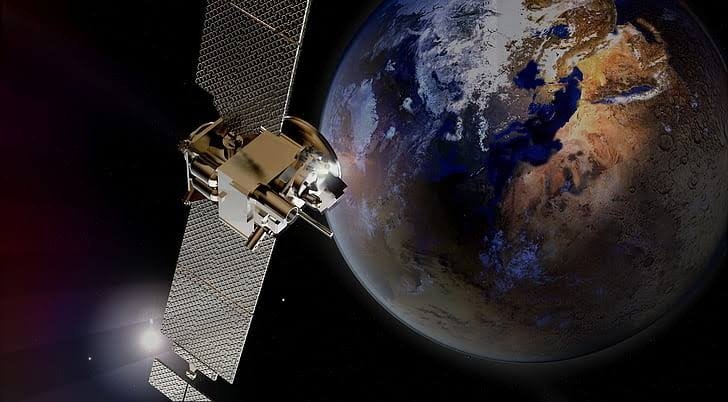
MOI-1A: India’s First Orbital AI Computing Satellite
- About: My Orbital Infrastructure (MOI-1A) is a 6U CubeSat-class orbital computing satellite. It is designed to perform AI-based processing directly in Low Earth Orbit (LEO) instead of routinely sending large volumes of raw Earth-observation data to ground stations. It is India’s first orbital computing satellite.
- Objective: Its objective is to convert raw satellite observations into useful intelligence in space.
- AI models can analyse imagery onboard, identify relevant information and transmit mainly the processed insights.
- Developer: MOI-1A has been developed by TakeMe2Space, a Hyderabad-based Indian space-tech startup. It is focused on orbital computing and space-based data infrastructure.
- Launch: MOI-1A was launched on 1 October 2026 as part of SpaceX’s Transporter-18 rideshare mission.
- The Falcon 9 lifted off from Space Launch Complex 4E at Vandenberg Space Force Base, California, carrying 130 payloads into orbit.
- Architecture: The satellite uses a 6U small-satellite architecture, integrating an AI computing unit, multispectral imager, onboard storage, power system and precision attitude-control system.
- Its weight is approximately 14 kg.
- AI-Cube: The core computing payload is the AI-Cube, based on an NVIDIA Jetson Orin NX processor.
- TakeMe2Space specifies up to 117 TOPS of computing performance, 16 GB LPDDR5 memory and 102.4 GB/s memory bandwidth, enabling AI inference close to the point where imagery is generated.
- Multispectral Imaging: Its imaging system uses a CMV4000 CMOS sensor and supports nine-band multispectral imaging.
- The sensor provides 2048 × 2048-pixel raw resolution, with the company specifying approximately 682 × 682 pixels per band.
- Storage and Power: MOI-1A carries 2 TB of onboard storage, configurable to 4 TB.
- Its payload has a stated 120-W power allocation, with 67.2 W peak solar generation and a 200-Wh lithium-ion battery, supporting continuous payload operations.
- Precision Pointing: Accurate imaging requires precise spacecraft orientation. MOI-1A uses a StarSense Lite star tracker and four reaction wheels, with specified pointing accuracy below 0.025° (1σ) and a 3°/second slew rate, allowing rapid targeting of selected areas.
- Radiation Protection: TakeMe2Space uses its proprietary RadShield coating to protect electronics against the LEO radiation environment.
- Operating Model: Through its OrbitLab platform, users can upload AI models and process Earth-observation information in orbit.
- The company reported 23 customers associated with the mission, technology demonstration towards a commercial service model.
What Is Orbital Computing?
- About: Orbital computing means performing data processing, storage and AI inference onboard spacecraft rather than transferring all collected information to Earth first.
- It represents a form of space-based edge computing, where computation occurs close to the source of data generation.
- Traditional Earth-observation satellites generate enormous datasets, creating constraints involving bandwidth, ground-station availability, transmission time and processing costs.
- Workflow: In orbital AI computing, the satellite first captures data, then an onboard processor applies a trained AI model.
- The system can identify objects, changes or anomalies and transmit only the relevant information or compressed result.
- This changes the satellite from a passive data collector into an active information-processing platform.
- Advantages:
- The major advantage is data reduction. Instead of transmitting every image, algorithms can identify only useful observations.
- This can reduce downlink requirements, communication congestion and ground-processing workload.
- AI-enabled multispectral analysis can support crop-health monitoring, vegetation assessment, drought indicators and agricultural mapping.
- Orbital AI can identify flooded areas, damaged infrastructure, wildfire signatures or other rapid changes.
- Multispectral imagery combined with AI can help detect land-use changes, mining activity and infrastructure patterns. Instead of downloading every captured frame, systems can flag specific areas.
- Satellite-derived intelligence can support asset monitoring, logistics visibility, infrastructure assessment and insurance-related risk analysis.
- The major advantage is data reduction. Instead of transmitting every image, algorithms can identify only useful observations.
- Scenario:
- Axiom Space launched its first dedicated orbital data center nodes on January 11, 2026.
- Google’s Project Suncatcher (deploying solar-powered TPU clusters) and Microsoft Azure Space compute nodes on the ISS are in testing phase.
- China is advancing an integrated “Space Cloud” network strategy.
- Pathfinder is India’s first AI-powered orbital data centre satellite, scheduled for launch by the fourth quarter of 2026.
- It is developed through a partnership between space-tech startup Pixxel and Sarvam AI.
- Challenges: The technology faces difficult constraints including radiation, limited electrical power, thermal management, computing reliability, storage limitations and communication availability.
- AI models require validation, updating and careful handling of false positives and false negatives.
- Uploading AI models and processing commercially sensitive data introduces cybersecurity and data-integrity risks.
- Orbital computing does not eliminate ground infrastructure. Satellites still require communications, ground stations, mission control, model development and post-processing.
- Deploying computing constellations adds to LEO congestion. This escalates the risk of the Kessler Syndrome.
Significance for India’s Space Economy
- Technological Sovereignty: With this launch, India becomes the fourth nation/bloc (after the US, EU, and China) to validate orbital edge-computing capabilities.
- Real-Time Intelligence & Border Surveillance: MOI-1A allows for near real-time target detection, critical for tracking maritime movements in the Indian Ocean Region (IOR) or monitoring sensitive geopolitical land borders.
- Bandwidth Optimization and Cyber Resilience: By converting raw data into intelligence before transmission, it addresses a core strategic vulnerability: the choking of satellite downlink bands.
- Minimizing the size of the data stream also reduces the surface area vulnerable to electronic interception.
- Pivoting to High-Value Downstream Services: Historically, India’s space revenue has been heavily launch-centric.
- However, global space economics indicate that 70% of future revenues will come from downstream applications and data monetization.
- MOI-1A places Indian companies at the forefront of the global “Space-as-a-Service” sector.
- Drastic Cost Reductions for End-Users: Downloading raw satellite imagery is financially prohibitive due to ground station downlink fees. By offsetting raw downloads with a premium for in-space compute, the net data acquisition cost falls significantly.
- Commercialization & Global Market Capture: TakeMe2Space launched MOI-1A with 23 committed global and domestic customers, including US-based space analytics firms like Little Place Labs.
- This demonstrates India’s potential to scale up its current 2% share in the global space market toward its target of $40–45 billion by 2035.
- Synergy with IN-SPACe Reforms: Enabled by the Indian Space Policy 2023 and 100% liberalized Foreign Direct Investment (FDI) guidelines, private consortiums are transforming Indian space assets into open public-private digital public goods.
Frequently Asked Questions (FAQs):
1. What is India’s first AI satellite, MOI-1A?
MOI-1A is an Indian orbital-computing satellite designed to process Earth-observation data using onboard AI before transmitting useful insights to Earth.
2. Who developed the MOI-1A satellite?
TakeMe2Space, a Hyderabad-based Indian space-tech startup, developed MOI-1A, including its AI-Cube, satellite bus and imager.
3. What is TakeMe2Space?
TakeMe2Space is an Indian space-tech startup developing orbital computing and storage-as-a-service, enabling AI-based processing directly aboard satellites.
4. How does the MOI-1A AI satellite work?
MOI-1A captures multispectral imagery, processes it using onboard AI, filters actionable information, and downlinks selected insights instead of raw data.
5. What is orbital computing?
Orbital computing means processing, analysing and storing data directly in spacecraft, reducing dependence on ground-based processing and large-scale data transmission.
Disclaimer: Information in this article is based on official announcements and public records. Details may evolve over time.
| Also Read: India’s First Orbital Data Centre Mission |