



India’s Mega 114 Rafale Fighter Jets Acquisition, Projected to Conclude by FY-End
| General Studies Paper III: Defence Technology, Procurement, and Indigenisation Policies |
Why in News?
India’s mega acquisition of 114 Rafale fighter jets under the Multi-Role Fighter Aircraft (MRFA) program is projected to conclude by the end of FY 2026–27.
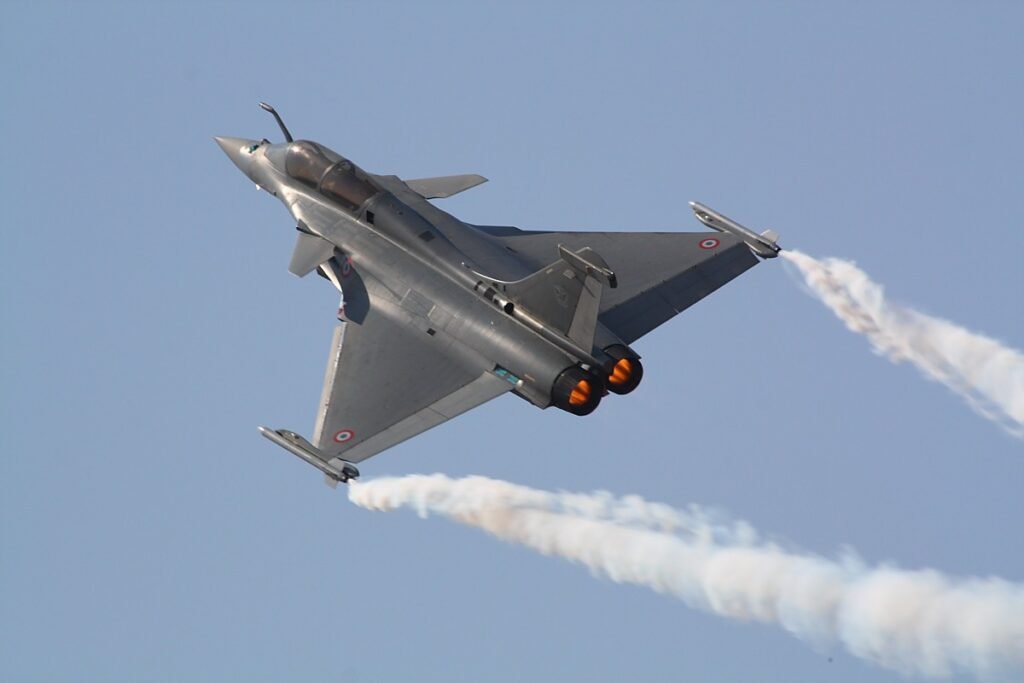
India’s Rafale Fighter Jet Acquisition
- India’s Rafale acquisition emerged from the earlier 126-aircraft MMRCA (Medium Multi-Role Combat Aircraft) programme. The original proposal envisaged 18 aircraft in fly-away condition and 108 aircraft manufactured in India. The earlier tender was withdrawn in 2015.
- On 23 September 2016, India and France signed an Inter-Governmental Agreement (IGA) for 36 Rafales.
- The package included weapons, simulators, associated equipment and long-term maintenance support, with deliveries scheduled to begin in 2019.
- The first five Rafales reached India on 29 July 2020 and were formally inducted into No. 17 Squadron at Ambala in September 2020.
- The second Rafale squadron, No. 101 Squadron, was established at Hasimara in July 2021. France completed delivery of all 36 aircraft in December 2022.
- Separately, the IAF issued an RFI in 2018 for 114 Multi-Role Fighter Aircraft (MRFA). The objective was to expand combat capability. The requirement associated with the MRFA programme.
- In July 2023, the DAC approved procurement of 26 Rafale-Marine aircraft for the Indian Navy.
- India and France signed the IGA on 28 April 2025 for 22 single-seat and four twin-seat aircraft, including training, simulators, weapons and performance-based logistics. Delivery is planned for completion by 2030.
- On 12 February 2026, the Defence Acquisition Council granted Acceptance of Necessity (AoN) for 114 Rafales for the IAF.
- The proposal is estimated at about ₹3.25 lakh crore. The government stated that the majority would be manufactured in India.
- The aircraft will meet the advanced F4 standard, featuring secure data links, enhanced satellite communications, and active electronically scanned array (AESA) radars.
- France has agreed to a comprehensive Transfer of Technology (ToT) covering the airframe, avionics, and Safran M88 engines.
- The current proposal envisages 18 aircraft delivered in fly-away condition, while 96 aircraft would be manufactured/assembled in India under a Buy-and-Make approach.
- The proposal is designed to increase indigenous manufacturing, technology transfer and industrial participation.
- The proposal is estimated at about ₹3.25 lakh crore. The government stated that the majority would be manufactured in India.
- France’s technical and commercial proposal has been submitted and is under evaluation.
- The Defence Secretary said on 2 October 2026 that the government expects to reach a conclusion by the end of the current financial year, subject to the ongoing procurement process.
- Media estimates have suggested that the first fly-away aircraft could arrive around 2032.
| The Multi-Role Fighter Aircraft (MRFA) program is a major defense procurement initiative launched by the Indian Air Force (IAF) to acquire 114 advanced fighter jets. |
What Is the Rafale Fighter Jet?
- About: The Rafale is a French twin-engine, multirole/“omnirole” fighter aircraft.
- Rafale is a 4.5-generation fighter aircraft. It means “gust of wind”.
- It is designed to perform air superiority, air defence, ground attack, reconnaissance, deep strike and anti-ship missions.
- It can operate from land bases and aircraft carriers.
- Developer: Rafale was developed by Dassault Aviation, France’s major aerospace company.
- Its first flight took place in 1991; naval Rafales became operational in 2004 and Air Force Rafales in 2006.
- Variants: The principal variants are Rafale C, a single-seat land-based fighter; Rafale B, a twin-seat land-based version; and Rafale M, a naval carrier-based version.
- India is acquiring both the Air Force and naval variants.
- Features:
- Its central feature is omnirole capability, allowing one aircraft to perform different combat missions during the same sortie.
- It can combine air-to-air combat, air-to-ground attack, reconnaissance and maritime strike roles.
- The Rafale uses the RBE2-AESA active electronically scanned array radar.
- It supports multi-target detection and tracking, including operations in difficult weather and contested electronic environments.
- Its SPECTRA electronic warfare suite provides warning against radar, missile and laser threats and supports electronic countermeasures, threat identification and survivability.
- The Rafale can employ weapons such as Meteor, MICA, SCALP, HAMMER, Exocet AM39 and precision-guided bombs, alongside its internal 30-mm cannon.
- Dassault lists a maximum speed of Mach 1.8, 50,000-foot service ceiling, 24.5-tonne maximum take-off weight and up to 9.5 tonnes of external load.
- Its central feature is omnirole capability, allowing one aircraft to perform different combat missions during the same sortie.
- Users: Besides France, Rafale has been ordered by Egypt, Qatar, India, Greece, Croatia, UAE, Indonesia and Serbia.
- India is particularly significant because it is the first foreign operator of the Rafale M.
- Significance: For India, Rafale strengthens air-combat capability, long-range strike, maritime aviation and deterrence.
- The IAF currently operates with 31 combat squadrons, which is significantly below the government-authorized strength of 42 squadrons. Legacy jets like the MiG-21, MiG-29, and Jaguar are nearing retirement.
- It provides a decisive technological edge against Chinese J-20 and Pakistani J-10C fleets.
- Deploying Rafale-M fighters on INS Vikrant strengthens India’s blue-water capabilities, directly securing critical Sea Lines of Communication (SLOCs) across the Indian Ocean Region (IOR).
India-France Partnership
- India and France established a Strategic Partnership in 1998, making France one of India’s earliest major strategic partners.
- The relationship has expanded from defence cooperation into space, nuclear energy, technology, trade and the Indo-Pacific.
- In 2023, India and France adopted the Horizon 2047 Roadmap, covering the long-term trajectory of bilateral relations up to 2047.
- Defence cooperation, strategic autonomy and advanced technology are important components of this framework.
- During President Emmanuel Macron’s February 2026 India visit, both countries elevated their relationship to a “Special Global Strategic Partnership.”
- They also established an annual Foreign Ministers’ Comprehensive Dialogue to review implementation of the enhanced partnership.
- The relationship increasingly focuses on co-design, co-development and co-production.
- The Kalvari-class Scorpene submarine programme is an important example of technology collaboration and Make in India in naval shipbuilding.
- The two countries regularly conduct major bilateral military exercises to improve interoperability.
- These include Exercise Varuna for navies, Exercise Garuda for air forces, and Exercise Shakti for armies.
- India and France share interests in a free, open and rules-based Indo-Pacific. France has territories and military interests in the Indo-Pacific, while India views the region as central to its maritime-security and strategic priorities.
- The national space agencies, ISRO and CNES, share a deep history of collaboration.
- Current projects include the TRISHNA climate-monitoring satellite.
- The year 2026 was declared the Year of Innovation, focusing heavily on trusted AI developments.
- Both nations are expanding their clean energy ties under the 2008 civil nuclear pact.
- They are collaborating on the Jaitapur Nuclear Power Project and co-developing modern Small Modular Reactors (SMRs).
- The partnership now covers AI, cyber technologies, space, advanced defence technologies and critical technologies.
- The 2026 partnership includes initiatives such as the BEL-Safran joint venture for HAMMER missiles and expansion of French-linked aerospace manufacturing in India.
- These developments support India’s objective of building a more capable domestic defence-industrial base.
- The 2026 partnership includes initiatives such as the BEL-Safran joint venture for HAMMER missiles and expansion of French-linked aerospace manufacturing in India.
Frequently Asked Questions (FAQs):
What is India’s 114 Rafale fighter jet deal?
India proposes acquiring 114 Rafales for the IAF, with most aircraft manufactured in India to strengthen combat capability and indigenous defence production.
When is India expected to finalise the 114 Rafale deal?
India expects to conclude the 114-Rafale contract by the end of FY 2026–27, subject to ongoing bid evaluation and negotiations.
How many Rafale fighter jets will India acquire?
The proposed acquisition covers 114 Rafale fighter jets for the Indian Air Force under the MRFA programme.
Why is India planning to buy 114 additional Rafale jets?
The acquisition aims to strengthen IAF combat capability, air dominance, long-range strike capacity, deterrence and indigenous fighter manufacturing.
Which company manufactures the Rafale fighter jet?
The French aerospace company Dassault Aviation manufactures the Rafale fighter aircraft.
Disclaimer: Information in this article is based on official announcements and public records. Details may evolve over time.
| Also Read: India-France 114 Rafale Fighter Jets Deal |