Presidential Assent to Gujarat UCC Bill, Becomes 2nd State To Get UCC
| General Studies Paper II: Government Policies and Interventions, Directive Principles of State Policy |
Why in News?
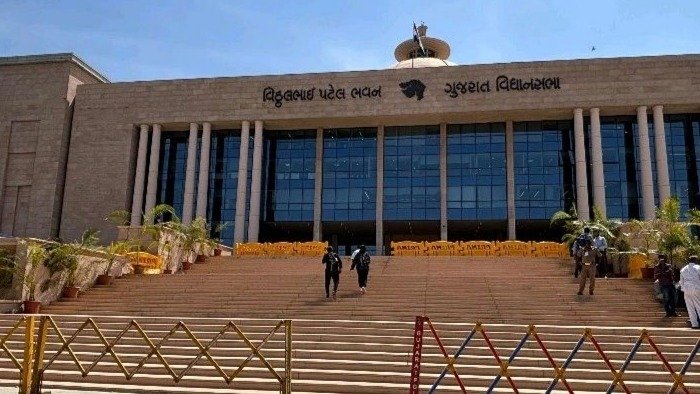
Recently, President Droupadi Murmu granted presidential assent to the Gujarat Uniform Civil Code (UCC) Bill, 2026, making Gujarat the second state after Uttarakhand to enact a state-level UCC.
What is Gujarat UCC Bill 2026?
- About: The Gujarat Uniform Civil Code (UCC), Bill 2026 is a common statutory framework for specified civil and family matters, irrespective of religion, caste, creed or gender.
- Objective: The Bill’s stated objectives include uniformity in civil law, gender justice, secularism, social reform and equal legal treatment.
- Its approach is to replace religion-specific differences in specified personal-law matters with common statutory rules.
- Background: On 4 February 2025, Gujarat constituted a five-member committee headed by retired Supreme Court judge Justice Ranjana Prakash Desai to examine the need for a UCC and prepare a draft.
- The committee submitted its final report to Chief Minister Bhupendra Patel on 17 March 2026. The Bill was introduced in the Gujarat Assembly on 18 March 2026; the Assembly passed it on 24 March 2026 after more than seven hours of debate.
- President Droupadi Murmu gave assent on 17 September 2026, and the law was published in the extraordinary Gazette dated 1 October 2026.
- Provisions:
- The Code extends throughout Gujarat and also covers eligible Gujarat residents living outside the state.
- Scheduled Tribes covered by Article 366(25) read with Article 342, and groups whose customary rights are protected under Part XXI, are excluded.
- A valid marriage requires free consent, prescribed age, monogamy and compliance with statutory conditions.
- The minimum age remains 21 years for men and 18 years for women.
- Religious/customary ceremonies such as Nikah, Saptapadi and Anand Karaj may continue, but marriages must satisfy the Code’s legal requirements.
- Registration of marriages is mandatory, creating an official legal record of marital status.
- Couples must officially register their marriage with the designated state authority within a window of 60 days from the date of solemnization.
- Failure to register within the prescribed period can attract a fine up to ₹10,000, although non-registration does not itself automatically invalidate the marriage.
- The Code prohibits bigamy/polygamy by preventing another marriage while an existing spouse is alive.
- Marriage obtained through force, coercion or fraud can attract imprisonment of up to seven years.
- The legislation provides uniform grounds and procedures for divorce, including mutual-consent divorce subject to statutory conditions.
- Couples seeking legal separation must acquire a formal decree from a civil court, and executing a divorce outside this judicial purview is punishable by up to three years in prison.
- It also covers maintenance, interim and permanent alimony, custody and welfare of children, bringing these matters within a common framework.
- The Code establishes common rules for intestate succession, with sons and daughters receiving equal inheritance rights.
- Spouses, children and parents are recognised in the prescribed succession structure; testamentary succession through a valid will remains available.
- Partners residing in live-in unions are required to register their relationship with the state within 30 days of moving in.
- Partners are legally obligated to formally log a notification of termination with the designated authority whenever their relationship ends.
- Children born from live-in relationships are recognised as legitimate, with associated legal protections.
- The framework includes adoption, guardianship and child-related rights within its civil-law architecture.
- The Bill also recognises children born within or outside marriage, including children born through assisted reproductive technologies, on an equal legal footing in relevant matters.
- The Code extends throughout Gujarat and also covers eligible Gujarat residents living outside the state.
Uniform Civil Code: Constitutional Framework and Implementation
- Constitutional Framework: Article 44 of the Constitution states that the State shall endeavour to secure a Uniform Civil Code throughout India. It is located in the Directive Principles of State Policy (Part IV) and therefore is not directly enforceable by courts like a Fundamental Right.
- Family-law subjects largely fall within the Concurrent List, enabling both Parliament and State Legislatures to legislate. A state law reserved for the President may require Presidential assent, particularly where constitutional or existing central-law interactions arise.
- In Sarla Mudgal (1995), the Supreme Court discussed Article 44 in relation to marriage and conversion.
- In John Vallamattom (2003), the Court again discussed Article 44 and observed that marriage and succession have secular dimensions distinct from protected religious practice.
- Implementation:
- Goa enforces a unified civil code based on its historic 1867 Portuguese Civil Code, which was retained via the Goa, Daman and Diu Administration Act, 1962. It mandates equal division of matrimonial property and bars polygamy.
- The concept originated during British rule through the Lex Loci Report of 1840.
- Uttarakhand became the first state in independent India to implement a comprehensive state UCC. It came into force on 27 January 2025, with rules providing uniform procedures.
- Assam Assembly passed its UCC Bill on 27 May 2026, with uniform provisions. The bill received the President’s approval on September 29, 2026.
- It makes Assam the first state in Northeast India and the third in the country to adopt a Uniform Civil Code framework.
- The Madhya Pradesh Assembly passed its UCC Bill on 21 July 2026 and it was sent for Presidential approval the following day.
- The Rajasthan Cabinet formally approved the draft Rajasthan Uniform Civil Code Bill 2026 on August 13, 2026.
- Maharashtra constituted a seven-member committee headed by Justice Ranjana Desai in July 2026 to prepare UCC legislation.
- Chhattisgarh constituted a five-member committee headed by Justice Ranjana Desai in June 2026 to examine personal laws and prepare a UCC framework.
- Goa enforces a unified civil code based on its historic 1867 Portuguese Civil Code, which was retained via the Goa, Daman and Diu Administration Act, 1962. It mandates equal division of matrimonial property and bars polygamy.
Arguments in Favour and Against UCC
- Arguments in Favour:
- Fulfilling Constitutional Mandate: Article 44 of the Directive Principles of State Policy mandates the state to secure a UCC. Proponents emphasize it upholds Article 14’s promise of equality before the law.
- Ensuring Gender Justice: Many traditional personal laws contain patriarchal biases. A uniform framework establishes equal property rights and bans practices like polygamy, directly safeguarding women’s dignity.
- Promoting True Secularism: True secularism demands the separation of religion and state affairs. Regulating civil rights based on citizenship over religious texts eliminates the state’s intervention in managing community-specific theological mandates.
- Simplifying Judicial System: The Indian judiciary manages highly complex litigation stemming from divergent customary acts. A standardized civil code provides a predictable lex loci (law of the land), significantly lowering court backlogs.
- Enhancing National Integration: Replacing fragmented laws with a unified standard nurtures shared civic identity. It avoids fractionalism, emphasizing the legal baseline of “One Nation, One Law”.
- Arguments Against:
- Infringing Religious Freedom: Critics argue that the code violates Article 25, which guarantees freedom of conscience and religious practices. Personal laws are historically protected as a core aspect of religious identity.
- Threatening Cultural Pluralism: India’s identity relies on deep diversity. Imposing uniformity risks eroding unique traditions, defying Article 29, which guarantees protection to distinct minor cultures and languages.
- Disrupting Tribal Protections: Indigenous communities feature complex, independent customary structures. Forcing uniformity could cause vast social unrest in Fifth Schedule areas and disrupt ancestral land and marriage practices.
- Fears of Majoritarian Imposition: Minority groups fear the code could serve to introduce a “Hinduized” legal framework. They view it as a threat to their institutional cultural autonomy.
- Premature Enforcement & Complexity: The 21st Law Commission declared that a UCC is “neither necessary nor desirable at this stage”. Forcing a centralized architecture across deeply divergent populations lacks a healthy democratic consensus.
Frequently Asked Questions (FAQs):
1. What is the Gujarat UCC Bill 2026?
The Gujarat UCC Bill 2026 establishes common civil rules governing marriage, divorce, succession and live-in relationships.
2. When did the Gujarat UCC Bill receive Presidential Assent?
President Droupadi Murmu granted assent on 17 September 2026, as recorded by Rashtrapati Bhavan.
3. Which is the second state in India to implement UCC?
Gujarat is the second state after Uttarakhand to enact a comprehensive UCC; Gujarat’s commencement awaits state notification.
4. What is the Uniform Civil Code in Gujarat?
It is a common statutory framework regulating marriage, divorce, succession and live-in relationships, irrespective of religion, with specified constitutional exemptions.
5. What are the key provisions of the Gujarat UCC Bill?
Key provisions include mandatory marriage registration, monogamy, uniform divorce, equal inheritance, succession rules and mandatory live-in relationship registration.
Disclaimer: Information in this article is based on official announcements and public records. Details may evolve over time.
| Also Read: Assam Introduces Uniform Civil Code Bill |