PM-SETU ₹735.70 Crore Plan Approved, Strengthening Industry-Led ITI Transformation
| General Studies Paper III: Economic and Social Development, Government Policies & Interventions |
Why in News?
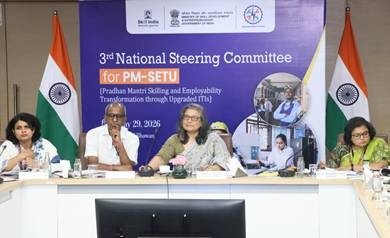
Recently, the PM-SETU Scheme National Steering Committee approved ₹735.70 crore in Strategic Investment Plans on September 8, 2026, to upgrade Industrial Training Institute (ITI) clusters.
What is PM-SETU Scheme?
- About: PM-SETU stands for Pradhan Mantri Skilling and Employability Transformation through Upgraded ITIs.
- It is a Centrally Sponsored Scheme designed to transform Government Industrial Training Institutes (ITIs) into modern, industry-responsive institutions.
- It combines infrastructure modernisation, industry participation, curriculum reform, new-age courses and employability-oriented training.
- The scheme seeks to create government-owned but industry-managed/industry-led aspirational ITIs through a cluster-based approach.
- Approval: The initiative emerged from the Union Budget 2024-25 and Budget 2025-26 announcements.
- The Union Cabinet approved the National Scheme for ITI Upgradation and establishment of five National Centres of Excellence on 7 May 2025.
- PM-SETU was launched on 4 October 2025 at Vigyan Bhawan, New Delhi.
- Need: The need arises from persistent gaps between vocational training and industrial demand.
- Earlier schemes provided useful infrastructure support but often lacked sustained industry participation and adequate investment for capital-intensive modern trades.
- Nodal Ministry: The Ministry of Skill Development and Entrepreneurship (MSDE) is the nodal ministry.
- National Steering Committee (NSC) constituted as the apex body to guide this scheme.
- It is chaired by the Secretary of MSDE.
- The Directorate General of Training (DGT) is the principal technical and training authority for the ITI ecosystem.
- ITIs remain under the administrative and financial control of State Governments/UT administrations.
- National Steering Committee (NSC) constituted as the apex body to guide this scheme.
- Implementation: FY 2025-26 was treated as the preparatory phase.
- The scheme has a five-year implementation period.
- In July 2026, the National Steering Committee moved the programme from its pilot stage towards nationwide rollout across 200 ITI clusters.
- Budget: The scheme has a total estimated outlay of ₹60,000 crore: ₹30,000 crore Central share, ₹20,000 crore State share and ₹10,000 crore Industry share.
- 50% of the Central share is co-financed equally by the Asian Development Bank and World Bank through result-based financing.
- For FY 2026-27, the Budget Estimate for PM-SETU is ₹6,140.50 crore, compared with ₹3,000 crore in FY 2025-26.
- Implementation Model: PM-SETU uses an industry-led Special Purpose Vehicle (SPV).
- The selected Anchor Industry Partner (AIP) prepares a Strategic Investment Plan (SIP).
- State/UT authorities and the Ministry examine the proposal before implementation.
- This structure gives industry a sustained role in planning, investment, management and outcomes.
- Upgraded ITIs will be managed via SPVs, with industry partners holding 51% ownership and the government 49%.
- These industry partners can receive up to 83% government funding for infrastructure and training improvements.
- Hub-and-Spoke Architecture:
- Component I covers 1,000 Government ITIs: 200 Hub ITIs and 800 Spoke ITIs. A Hub functions as the stronger institutional centre, while Spokes form the surrounding network.
- This permits shared infrastructure, coordinated courses, common industry linkages and economies of scale.
- Component II provides capacity augmentation of five National Skill Training Institutes (NSTIs) at Bhubaneswar, Chennai, Hyderabad, Kanpur and Ludhiana.
- These institutions will host sector-specific National Centres of Excellence (NCoEs) and strengthen advanced Training of Trainers (ToT).
- Component I covers 1,000 Government ITIs: 200 Hub ITIs and 800 Spoke ITIs. A Hub functions as the stronger institutional centre, while Spokes form the surrounding network.
- Human-Resource Target: Over the five-year period, PM-SETU aims to skill approximately 20 lakh youth.
- It also envisages pre-service and in-service training for 50,000 trainers, strengthening the quality of instruction alongside physical infrastructure.
- New-Age Skills: The scheme supports new and emerging sectors, while also modernising traditional trades.
- India’s industrial transition requires skills in areas such as electronics, automotive, renewable energy, AI, IoT, advanced manufacturing and other Industry 4.0 domains.
- Latest Approval: On 8 September 2026, the 5th National Steering Committee (NSC) of PM-SETU approved three Strategic Investment Plans (SIP) with a combined project outlay of ₹735.70 crore.
- The projects cover ITI clusters in Rajasthan, Telangana and Uttar Pradesh.
- The latest approval takes total sanctioned investment under PM-SETU to ₹2,171 crore across nine ITI clusters.
- Rajasthan received approval for a ₹241 crore SIP submitted by H.G. Infra Engineering Limited (HGIEL) for the Bhiwadi ITI cluster. Government ITI Bhiwadi is the Hub, while Government ITIs at Alwar, Neemrana, Tijara and Kishangarh Bas are the Spokes.
- A major development was the signing of a Shareholders’ Agreement (SHA) among HGIEL, Government of Rajasthan and MSDE.
- Rajasthan thereby became the first State to execute an SHA under PM-SETU, formally commencing implementation of its Bhiwadi cluster.
- Telangana’s Medchal ITI cluster received approval for a ₹254.30 crore SIP submitted by ZEN Technologies Limited. Government ITI Medchal is the Hub, with Alwal, Shameerpet, Kukunoorpally and Siddipet functioning as Spokes.
- Uttar Pradesh received approval for a ₹240.40 crore SIP submitted by the National Skill Development Corporation (NSDC) for the Meerut ITI cluster. Government ITI Saket, Meerut is the Hub, supported by ITIs at Ghaziabad, Hapur, Gautam Buddha Nagar and Baghpat.
- The SIPs include new long-term and short-term courses, enabling clusters to respond more rapidly to local industrial demand.
- The projects cover ITI clusters in Rajasthan, Telangana and Uttar Pradesh.
- Significance: PM-SETU represents a shift from merely expanding ITI infrastructure towards industry-linked, demand-driven and employment-oriented vocational education.
- It supports the broader objectives of Skill India, Make in India, Viksit Bharat@2047, manufacturing competitiveness and demographic-dividend utilisation.
| Note: An Industrial training institute (ITI) is a post-secondary school in India that provides training in various engineering and non-engineering trades under the Directorate General of Training (DGT). It offers courses ranging from one to two years across trades like Electrician, Fitter, Welder, and Computer Operator and Programming Assistant (COPA). |
National Schemes or Initiatives for ITIs Upgradation
- Craftsmen Training Scheme (CTS): The Craftsmen Training Scheme was introduced in 1950 to create a steady supply of skilled workers for industry, and provide employment-oriented training.
- DGT implements CTS mainly through ITIs.
- As of 2025-26, training covered 169 trades through 14,688 ITIs, with 14.70 lakh trainees enrolled.
- Curriculum is periodically revised with industry and academic inputs.
- Upgradation of Existing ITIs: The Model ITI scheme aimed to upgrade selected Government ITIs into institutions demonstrating better infrastructure, equipment and training standards.
- 35 Government ITIs were targeted, with assistance of up to ₹10 crore per ITI for civil works and equipment.
- The scheme ended on 31 March 2024; official data reported 19 of 35 ITIs fully upgraded.
- STRIVE: Skills Strengthening for Industrial Value Enhancement (STRIVE) was a World Bank-assisted, outcome-focused project launched in 2017.
- It targeted improvement in ITI performance, State capacity, teaching-learning quality and apprenticeship.
- 500 ITIs and 90 industry clusters were selected. The project concluded on 31 May 2024, with ₹772.67 crore released and ₹711.68 crore utilised; around 27,500 officials/instructors received training.
- ESDI for North-Eastern States: Enhancing Skill Development Infrastructure in North-Eastern States (ESDI) addressed regional infrastructure deficits.
- It envisaged upgrading 22 existing ITIs, strengthening infrastructure in 28 ITIs, and establishing 34 new ITIs.
- It ended on 31 March 2024, after providing approximately ₹308.84 crore to North-Eastern States.
- Skill Development in LWE-Affected Districts: This initiative established ITIs in areas affected by Left-Wing Extremism, linking skill development with inclusive development and social stabilisation.
- 48 ITIs were supported across 48 districts. Data reports 46 operational ITIs, with 13,276 trainees enrolled since 2020; ₹308.35 crore had been utilised from the reported allocation.
- Dual System of Training (DST): DST strengthens the connection between ITI classroom learning and on-the-job industrial training.
- Its significance lies in combining institutional instruction with workplace exposure.
- Since inception, 1.87 lakh trainees have enrolled under DST, making it an important bridge between vocational education and actual industrial requirements.
- Flexi-MoU Scheme: The Flexi-MoU Scheme follows an employer-skill-development model in which industries participate more directly in training design and delivery.
- Government information reports 11 Flexi MoUs, more than 10,500 trainees certified and around 15,000 undergoing industry-led training, strengthening employer-linked vocational education.
- Craft Instructor Training Scheme (CITS): CITS strengthens the quality of ITI training by preparing instructors in both technical skills and training methodology.
- It is delivered through NSTIs and Institutes for Training of Trainers (IToTs).
- By 2025, the ecosystem had 33 NSTIs and 120 IToTs, with 17,475 sanctioned CITS seats, making trainer quality an important foundation.
- Integrated School Skill Labs: To foster technical skills early on, the national ITI scheme is structurally tethered to the rollout of 1,200 new Skill Labs inside Jawahar Navodaya Vidyalayas and Eklavya Model Residential Schools.
- These labs serve as feeder pipelines, exposing high schoolers to vocational training early and building a direct path toward advanced ITI trades.
Significance of ITIs Modernisation
- Expanding India’s Skilled-Workforce Base: ITI modernisation is important because ITIs remain a major institutional channel for long-term vocational education.
- The network expanded from 9,642 ITIs in 2014 to 13,856 in 2026, while seating capacity increased from 17.43 lakh to 20.08 lakh.
- This expansion strengthens India’s ability to supply technically trained workers to manufacturing and services.
- Improving Employability and Reducing Skill Mismatch: Modernisation can narrow the gap between what institutions teach and what employers require.
- As of March 2026, ITIs offered 169 CTS courses, with 14 new courses introduced and 22 existing courses revised during the previous three years.
- Regular curriculum updating helps workers remain relevant as occupations and technologies change.
- Preparing Workers for Industry 4.0: The modern workplace increasingly requires AI, IoT, automation, robotics, renewable energy and digital capabilities.
- DGT has developed 31 new-age/future-skills courses within the ITI ecosystem, including areas such as AI, IoT, renewable energy and 3D printing.
- This makes vocational education more responsive to technological transformation.
- Strengthening Industry–Training Linkages: Modern ITIs can become stronger bridges between education and employment through apprenticeships, industrial exposure and employer participation.
- Under NAPS, more than 54.41 lakh apprentices had been engaged since 2016 by March 2026, including around 12.35 lakh during FY2025-26.
- Such workplace exposure improves practical competence and facilitates smoother school-to-work transitions.
- Raising Productivity and Industrial Competitiveness: A modern vocational system can improve labour productivity, technology absorption and quality of production.
- Industry receives workers familiar with contemporary machinery and production practices, while workers gain capabilities that support higher-value occupations.
- Consequently, ITI modernisation can complement India’s objectives of manufacturing expansion, industrial competitiveness and technology adoption.
- Improving Quality Through Better Trainers: Modern equipment alone cannot deliver quality training without capable instructors.
- India’s NSTIs increased from 25 to 33, while Institutes for Training of Trainers rose from 11 to 120.
- The system now has 17,475 sanctioned CITS seats, strengthening the institutional pipeline for preparing and upgrading vocational instructors.
- Converting Demographic Potential into Human Capital: India’s large working-age population creates an opportunity only when people possess productive, market-relevant skills.
- ITI enrolment increased from 12.51 lakh in FY2022-23 to 14.70 lakh in FY2025-26.
- Modernisation can therefore support employment, entrepreneurship, social mobility and the demographic dividend, making vocational education a stronger pillar of India’s human-capital strategy.
Frequently Asked Questions (FAQs):
1. What is PM-SETU?
PM-SETU is a national scheme transforming Government ITIs through industry-led modernisation, upgraded infrastructure, courses and employability-focused training.
2. How much investment has been approved under PM-SETU?
The latest approvals add ₹735.70 crore, taking cumulative sanctioned investment to ₹2,171 crore across nine clusters.
3. What did the PM-SETU Steering Committee approve?
The 5th National Steering Committee approved three Strategic Investment Plans worth ₹735.70 crore for ITI clusters.
4. Which states will benefit from the ₹735.70 crore PM-SETU plans?
Rajasthan, Telangana and Uttar Pradesh will benefit from the latest PM-SETU Strategic Investment Plans.
5. How many ITI clusters are covered under the latest PM-SETU approvals?
The latest approvals cover three ITI clusters, taking the overall sanctioned coverage to nine clusters.
6. What is the objective of the PM-SETU scheme?
Its objective is to create industry-aligned, modern ITIs offering market-relevant skills, improving employability and strengthening India’s skilled workforce.
Disclaimer: Information in this article is based on official announcements and public records. Regulations and implementation details may evolve over time.
| Also Read: India Tech Hiring Slumps Amid Decline |