



Asia’s First Telecom Manufacturing Zone in Gwalior, Boosting India’s Electronics Manufacturing
| General Studies Paper III: Economic Development, Infrastructure, Science & Technology |
Why in News?
Recently, the Department of Telecommunications (DoT) organised an Investors’ Meet in Bengaluru to attract investment in Asia’s first Telecom Manufacturing Zone (TMZ) being established in Gwalior, Madhya Pradesh.
What is Gwalior Telecom Manufacturing Zone (TMZ)?
- About: The Telecom Manufacturing Zone (TMZ), Gwalior is an integrated, plug-and-play industrial cluster planned to bring telecom manufacturing, electronics, research, innovation and allied activities together.
- The government describes it as Asia’s first dedicated Telecom Manufacturing Zone.
- Location: The TMZ is being developed at Gwalior, Madhya Pradesh, around the Shrimant Madhavrao Scindia Counter Magnet City (SADA) and the Gwalior IT Park.
- SADA was conceived to promote Gwalior as an alternative industrial growth centre and a counter-magnet to Delhi.
- Objective: Its core objectives are to strengthen domestic telecom manufacturing, deepen domestic value chains, and reduce import dependence.
- It also intends to promote indigenous technology and design, attract investment, create employment, increase exports and develop capabilities in 5G/6G and advanced telecom technologies.
- It also supports the broader Aatmanirbhar Bharat objective in strategically important communications infrastructure.
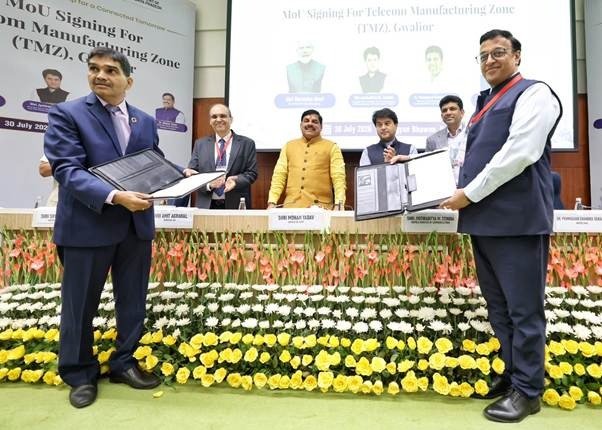
- Foundation: The institutional foundation was laid through an MoU signed on 30 July 2026 between the Department of Telecommunications (DoT), Ministry of Communications, and the Government of Madhya Pradesh.
- Implementation: The project is being implemented through a Special Purpose Vehicle (SPV) having 51% equity from Madhya Pradesh Government and 49% from DoT.
- Project Scale: The original MoU envisages a broader 350-acre integrated plug-and-play cluster.
- For Phase-I, approximately 170 acres have been identified: more than 90 acres in SADA and more than 70 acres in the Gwalior IT Park.
- Funding Pattern: The Central Government will provide 100% funding support of ₹493 crore for Phase-I core infrastructure, while Madhya Pradesh has provided approximately 170 acres of land free of cost, along with investor incentives.
- Investment: Companies have proposed approximately ₹5,500 crore of investment in the TMZ.
- As of September 2026, 24 companies have initiated the application process.
- Delhi and Mumbai investor engagements generated approximately ₹3,500 crore and ₹2,000 crore, respectively.
- The ecosystem is expected to comprise around 24–25 telecom manufacturing units and generate more than 18,000 direct and indirect employment opportunities.
- Integrated Manufacturing Ecosystem: The TMZ is intended to cover the entire telecom value chain.
- Proposed areas include mobile devices, optical fibre, telecom equipment, components, semiconductor-linked technologies and next-generation 5G/6G technologies.
- The project follows a plug-and-play model, intended to reduce the time and cost required for companies to establish manufacturing facilities.
- The TMZ is designed to integrate dedicated R&D centres, common testing laboratories and certification facilities.
- The ecosystem combines industrial land, common infrastructure, investor facilitation, connectivity, testing and certification facilities, R&D support and policy incentives.
- The proposed Common Testing Lab package is approximately ₹500 crore, aimed at strengthening product validation and standards compliance.
- It will include capital-investment support, employment assistance, skill-development support and export-related freight assistance, subject to eligibility.
- Connectivity: Gwalior’s connectivity is also being strengthened, including the approximately 120-km Agra–Gwalior High-Speed Corridor, improving access to Delhi and northern markets.
Significance of Gwalior Telecom Manufacturing Zone
- Telecom Equipment Manufacturing: The TMZ directly addresses India’s need to expand domestic production of routers, antennas, optical fibre, telecom equipment and associated components.
- Locating multiple manufacturers within one ecosystem can improve supplier linkages, and technology diffusion.
- Domestic Value Chains: Integration of components, manufacturing, testing, R&D and technology development can reduce dependence on imported inputs and strengthen resilience against global supply-chain disruptions.
- 5G and 6G Ecosystem: The proposed ecosystem includes next-generation 5G/6G technologies. Future telecommunications increasingly depend on advanced hardware.
- The TMZ therefore connects manufacturing policy with India’s future technology capabilities.
- National Security: Telecom networks constitute critical digital infrastructure. Greater domestic capability in telecom equipment and components can reduce strategic vulnerabilities associated with excessive dependence on external suppliers.
- Indigenous design, testing and certification can support trusted and secure communications infrastructure.
- Digital Connectivity: Domestic telecom manufacturing supports India’s expanding digital economy, broadband networks, 5G deployment and digital public infrastructure.
- Global Telecom Ambitions: It is designed to shift India from primarily being a telecom service provider towards a global telecom product-manufacturing.
- This can transform India to a global innovation hub under the vision of “Make in India, Make for the World” by increasing domestic value addition.
- Policy Convergence: The TMZ is designed to create synergies with major national programmes including the India Semiconductor Mission (ISM), Electronics Components Manufacturing Scheme (ECMS) and Telecom Technology Development Fund (TTDF).
India’s Electronics Manufacturing Push and Major Initiatives
- The National Policy on Electronics (NPE) 2019 established the broader policy framework for making India a global hub for Electronics System Design and Manufacturing (ESDM).
- It emphasises domestic manufacturing, component development, investment, exports and technological capabilities.
- The PLI scheme for Large-Scale Electronics Manufacturing provides performance-linked incentives based on incremental sales for eligible segments.
- Alongside PLI 2.0 for IT Hardware, it aims to expand manufacturing scale, attract investment, increase domestic value addition and strengthen India’s position in global electronics supply chains.
- By December 2025, electronics-sector PLI schemes had received about ₹15,554 crore in incentives.
- The Electronics Components Manufacturing Scheme (ECMS), notified in April 2025, targets deeper domestic manufacturing of components and materials.
- Its initial outlay of ₹22,919 crore was increased to ₹40,000 crore in Union Budget 2026–27.
- By August 2026, 106 projects across 15 States had been approved, involving approximately ₹69,548 crore investment and projected production of ₹5.34 lakh crore.
- The Electronics Manufacturing Clusters (EMC) and EMC 2.0 approach promotes shared industrial infrastructure and common facilities, including plug-and-play manufacturing capacity.
- Such clusters reduce infrastructure constraints and enable multiple firms to operate within interconnected electronics manufacturing ecosystems.
- The Scheme for Promotion of Manufacturing of Electronic Components and Semiconductors (SPECS) provided capital-expenditure incentives for electronic components, semiconductor/display fabrication, ATMP facilities, specialised sub-assemblies and related capital goods.
- The ₹76,000-crore Semicon India Programme, launched in 2021, aims to build India’s semiconductor and display ecosystem through support for fabs, packaging, testing, chip design, talent and research.
- It is strategically important because semiconductors underpin telecom, AI, automobiles, defence, space and digital infrastructure.
- The government’s semiconductor strategy has expanded through India Semiconductor Mission 2.0 (ISM 2.0), focusing on semiconductor equipment, materials, indigenous intellectual property, resilient supply chains, research, training and advanced manufacturing capabilities.
- India’s electronics production increased from approximately ₹1.9 lakh crore in 2014–15 to ₹13.11 lakh crore in 2025–26, while electronics exports rose from about ₹38,000 crore to ₹4.24 lakh crore.
Frequently Asked Questions (FAQs):
1. What is Gwalior Telecom Manufacturing Zone?
It is Asia’s first integrated Telecom Manufacturing Zone, designed as a plug-and-play ecosystem for telecom manufacturing, R&D, innovation and 5G/6G technologies.
2. Where will Asia’s first Telecom Manufacturing Zone be built?
It will be developed in Gwalior, Madhya Pradesh, across SADA and Gwalior IT Park during Phase-I.
3. How much investment is proposed for Gwalior Telecom Manufacturing Zone?
The latest investor commitments total approximately ₹5,500 crore, with further investment potentially attracted as the zone expands.
4. How many companies are investing in Gwalior Telecom Manufacturing Zone?
24 companies have initiated the application process to establish manufacturing units within the proposed Telecom Manufacturing Zone.
5. How many jobs will the Gwalior telecom zone create?
The proposed zone is expected to generate more than 18,000 direct and indirect employment opportunities.
6. Why is Gwalior becoming a telecom manufacturing hub?
Connectivity, skilled talent, industrial infrastructure, investor incentives and integrated manufacturing facilities are driving Gwalior’s emergence as a telecom hub.
Disclaimer: Information in this article is based on official announcements and public records. Details may evolve over time.
| Also Read: India Launches BSNL’s ‘Swadeshi-4G Network’ |