




DRDO 30kW Laser Weapon Project, Plans to Select Production Partner for Indigenous Development
| General Studies Paper III: Indigenization of Technology, Security Challenges & their Management |
Why in News?
Recently, Defence Research and Development Organisation (DRDO) initiated plans to select an industrial production partner within six months to manufacture its 30kW Laser Directed Energy Weapon.
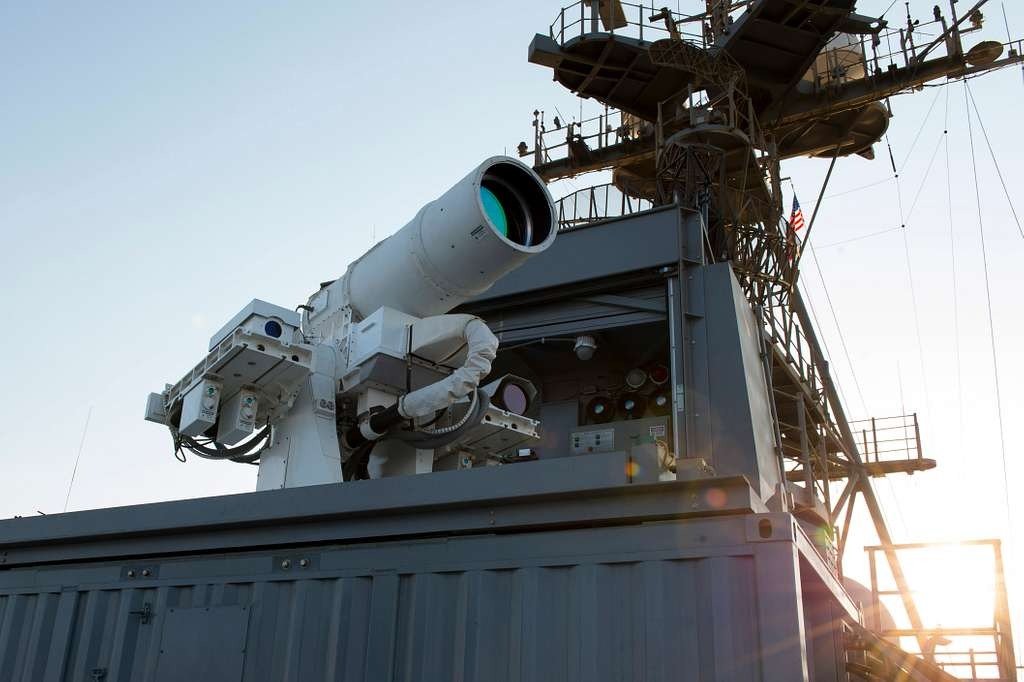
What is DRDO’s 30-kW Laser Weapon Project?
- About: DRDO’s 30-kW-class Laser Directed-Energy Weapon (DEW) is an indigenous, truck-mounted high-energy laser system developed primarily for counter-drone warfare.
- Its objective is to defeat fixed-wing UAVs, drone swarms and surveillance sensors by concentrating electromagnetic energy on vulnerable components.
- The system represents a shift towards non-kinetic air defence.
- DRDO is developing this under the Integrated Drone Detection and Interdiction System (IDD&IS) Mk-IIA.
- DevelopedBy: India’s DEW research has developed progressively through DRDO laboratories, including LASTEC and Centre for High Energy Systems and Sciences (CHESS).
- DRDO’s Electronics and Communication Systems (ECS) also develops laser sources, electro-optical sensors, radars and DEW technologies.
- DEW Technology: Directed-Energy Weapons transmit concentrated electromagnetic energy to damage or disable a target.
- It include high-energy lasers, high-power microwaves and other electromagnetic-energy systems.
- Laser DEWs can produce hard-kill effects by heating, damaging or structurally weakening a target, while electromagnetic systems can also create soft-kill effects by disrupting electronics or communications.
- The system first detects and tracks an aerial target using integrated sensing and tracking systems.
- The beam-control system then directs the laser towards a vulnerable point on the target.
- Concentrated energy produces rapid localised heating, potentially damaging structures, propulsion components, sensors or electronics.
- It include high-energy lasers, high-power microwaves and other electromagnetic-energy systems.
- Features:
- It achieves 30-kilowatt output by precision-converging six independent 5-kW laser beams into a single, high-intensity coherent beam.
- It features an advanced 360-degree Electro-Optical/Infrared (EO/IR) sensor suite paired with automated target tracking and real-time kill-assessment algorithms for pinpoint precision.
- The system is natively integrated with electronic warfare components capable of jamming communication networks and satellite signals.
- The weapon is capable of tracking, targeting, and neutralizing threats at operational ranges spanning 3.5 to 5 kilometers.
- It is explicitly engineered to counter low-Radar Cross Section (RCS) targets, notably swarm drones, fixed-wing unmanned aerial vehicles (UAVs), and low-flying helicopters.
- The primary land version is truck-mounted on a heavy-duty high-mobility vehicle, allowing rapid cross-country transportation via air, rail, or road networks.
- DRDO has also developed an Electro-Optical Tracking System (EOTS) for DEW applications.
- Successful Trials: A major public demonstration occurred at the National Open Air Range, Kurnool, Andhra Pradesh, in April 2025.
- DRDO’s CHESS demonstrated the vehicle-mounted Laser-DEW Mk-II(A) against fixed-wing UAVs and swarm drones and demonstrated effects against surveillance sensors and antennae.
- The system’s final trials concluded in August 2025, with technology proven.
- DRDO describes the Mk-II(A) as indigenously designed and developed.
- Industry Partnership: As of September 2026, DRDO plans to issue an Expression of Interest (EOI) within six months to select an Indian industry partner for the First-of-Production Model (FOPM).
- The technology has received clearance for Transfer of Technology (ToT) to Indian industry partners for indigenous deployment.
- The production partner would take the proven technology towards a production configuration, after which further testing would assess range and user requirements.
- Future Development: DRDO is also developing 50–100 kW high-power directed-energy weapon.
- The organisation is working on a 300 kW laser project codenamed Surya to boost the nation’s advanced defense capabilities.
Significance of DRDO 30kW Laser Weapon Project
- The 30-kW DEW directly addresses the growing challenge of low-cost unmanned aerial systems.
- Drone swarms can overwhelm conventional air-defence systems through numbers.
- A reusable laser weapon potentially allows defenders to engage multiple suitable targets without carrying a conventional missile for every engagement.
- One major attraction of laser weapons is the potentially low marginal cost of firing compared with conventional interceptors.
- A few seconds of laser firing could cost approximately the equivalent of a couple of litres of petrol. However, this should not be interpreted as the system having zero operating cost.
- A laser beam propagates at approximately the speed of light, eliminating the projectile flight time.
- Once a target is detected, tracked and the beam is correctly aligned, energy can be delivered extremely rapidly.
- This is particularly valuable against fast-moving or manoeuvring UAVs, although actual engagement time also depends on detection.
- The Mk-II(A) demonstration included swarm-drone engagement, making it relevant to the emerging problem of coordinated aerial attacks.
- This creates possibilities for defending critical military installations and strategic infrastructure against multiple aerial threats.
- The technology has potential relevance to the Army, Air Force and Navy, particularly for point defence and counter-UAS roles.
- The weapon is can become another layer within a multi-layered air-defence architecture alongside missiles, guns, electronic warfare and detection systems.
- DRDO’s August 2025 Integrated Air Defence Weapon System (IADWS) trials demonstrated a layered architecture incorporating QRSAM, VSHORADS and a high-power laser-based DEW, with multiple aerial targets successfully engaged.
- DEWs can contribute to both hard-kill and soft-kill concepts. The laser can physically damage a drone’s structure or critical components, while integrated electronic-warfare capabilities can support disruption of communications or other electronic functions.
- Indigenous DEW development strengthens India’s strategic autonomy by developing domestic expertise in high-power lasers and energy systems.
- It reduces dependence on foreign suppliers for an emerging class of defence technology and supports India’s broader Aatmanirbhar Bharat objective.
Technological Challenges
- Thermal Management and Cooling: Firing a high-energy laser generates extreme internal heat. Systems require advanced liquid or phase-change cooling mechanisms to prevent hardware damage and maintain operational readiness during continuous combat.
- Atmospheric Interference: Dust, humidity, smoke, rain, and turbulence scatter or absorb laser photons over distance. This “blooming” effect reduces beam intensity and lowers destructive capability at the maximum 5 km range.
- Beam Combining and Optics: Achieving 30 kW of power often requires fusing multiple smaller laser modules (such as six 5 kW emitters) into a single, cohesive beam using complex optoelectronics and lenses without losing focus or precision.
- Power Supply and Weight: High-power lasers demand massive, continuous electrical energy inputs. Designing compact, truck-mounted mobile power generators that do not overly restrict vehicle mobility or field deployment remains an engineering bottleneck.
- Tracking and Stabilization: Maintaining a pinpoint laser focus on a fast-moving, erratic drone or a swarm target over several kilometers requires ultra-fast 360-degree electro-optic/infrared (EO/IR) tracking and jitter-removal stabilization systems.
Frequently Asked Questions (FAQs):
1. What is DRDO’s 30kW Directed Energy Weapon?
A truck-mounted 30-kW laser DEW designed to destroy or disable drones, UAVs and surveillance sensors up to 5 km.
2. Why is DRDO seeking an industry partner?
DRDO seeks an industry partner to develop the First-of-Production Model (FOPM) and transition proven technology into production.
3. How does a 30kW laser weapon work?
It concentrates high-energy electromagnetic radiation onto targets, causing physical damage or sensor/electronics disruption through hard or soft kill.
4. What can DRDO’s 30kW laser weapon target?
It can engage drone swarms, fixed-wing UAVs and surveillance sensors, with reported engagement ranges of up to 5 km.
5. When will India’s 30kW Directed Energy Weapon be ready?
DRDO expects the First-of-Production Model within one year after selecting an industry partner, followed by further testing.
Disclaimer: Information in this article is based on official announcements and public records. Details may evolve over time.