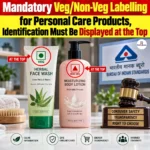




Mandatory Veg/Non-Veg Labelling for Personal Care Products, Identification Must Be Displayed at the Top
| General Studies Paper II: Government Policies and Interventions |
Why in News?
Recently, the Ministry of Consumer Affairs mandated prominent color-coded veg and non-veg labelling on personal care products under Legal Metrology (Packaged Commodities) Fourth Amendment Rules, 2026.

Mandatory Veg/Non-Veg Labelling Guidelines
- Notification: The Ministry of Consumer Affairs, Food and Public Distribution, through its Department of Consumer Affairs, notified the Legal Metrology (Packaged Commodities) Fourth Amendment Rules, 2026 on 21 September 2026.
- The notification mandated prominent color-coded veg and non-veg labelling on personal care products.
- Notification G.S.R. 826(E) was issued under powers derived from Section 52 of the Legal Metrology Act, 2009.
- The 2026 amendment is effective from 21 September 2026.
- Regulatory Changes: The amendment modifies Rule 6 of the Legal Metrology (Packaged Commodities) Rules, 2011.
- It inserts Rule 6(4A)(d) covering cosmetics and toiletries, prescribing the relevant colour-coded symbols and their location on the PDP.
- The amendment also omits Rule 6(8), which had earlier contained the specific mandatory requirement.
- Intervention: The regulatory history was examined by the Delhi High Court in Reckitt Benckiser (India) Ltd. v. Union of India, decided on 7 February 2026.
- The Court noted a conflict between the Legal Metrology Rules, which contained the labelling requirement, and the Drug Technical Advisory Board (DTAB) position, which had favoured voluntary labelling because India lacked a clear system for certifying vegetarian/non-vegetarian cosmetic ingredients.
- The Court directed the Director, Legal Metrology and DCGI to hold joint consultations with stakeholders and arrive at a comprehensive decision.
- Scope: The provision specifically covers soap, shampoo, toothpaste, other cosmetics and toiletries.
- The amendment applies only to products manufactured, packed, or imported for sale within India in packaged form.
- The cosmetics themselves remain subject to the Cosmetics Rules, 2020 and applicable BIS requirements.
- Labelling Requirement: Under the amended packaging rules, products of vegetarian origin must display a green dot, while items of non-vegetarian origin require a red or brown dot.
- Manufacturers must place these symbols at the top of the package’s principal display panel.
Significance of Mandatory Veg/Non-Veg Labelling
- Mandatory dietary labelling safeguards the fundamental rights of individuals by allowing them to make informed purchasing choices aligned with their religious sentiments, ethical beliefs, and personal preferences.
- The framework rests heavily on constitutional mandates. The Delhi High Court ruled that a failure to disclose the exact origin of ingredients directly violates Article 21 (Protection of life and liberty) and Article 25 (Freedom of religion).
- The measure extends a familiar food-labelling concept. This is significant because India’s beauty and personal-care market was valued at about US$31.2 billion in 2025, according to IMARC, indicating the large consumer ecosystem.
- India’s beauty and personal-care sector includes personal hygiene, skincare, cosmetics, haircare and oral-care products and is projected to continue expanding.
- Industry estimates cited by Statista indicate that the Indian BPC market could approach US$40 billion by 2030.
- Standardised origin marking could become an increasingly important packaging and compliance consideration as product volumes and variants expand.
India’s Regulatory and Policy Framework for Personal Care Products
- Legislative Framework:
- Drugs and Cosmetics Act, 1940: Serves as the foundational primary statute governing the import, manufacture, distribution, and sale of cosmetics and personal care items to prevent substandard or unsafe market entry.
- Cosmetics Rules, 2020: Provides a dedicated, standalone regulatory structure (replacing older provisions) covering manufacturing standards, testing protocols, registration, and strict labeling criteria.
- Its Rule 36 prohibits cosmetics from making false or misleading claims, linking product regulation with consumer protection.
- Legal Metrology Act, 2009 and Rules, 2011: Manages pre-packaged commodities declarations, governing consumer details like maximum retail price (MRP), net quantities, and origin information.
- The Legal Metrology Act, 2009 sets the legal rules for labeling packaged goods in India.
- The Legal Metrology (Packaged Commodities) Rules, 2011 regulate declarations appearing on packaged products.
- Regulatory Authorities:
- Central Drugs Standard Control Organization (CDSCO): Acts as the primary central regulator under the Ministry of Health and Family Welfare, handling import registrations and overall national compliance.
- Imported cosmetics require registration with the Central Licensing Authority, and products must meet prescribed safety and quality standards.
- It manages all international import registrations via its digitized SUGAM portal.
- State Drug Control / Licensing Authorities: Issue manufacturing licenses for domestic production facilities within respective states.
- Bureau of Indian Standards (BIS): Sets essential raw material and product safety benchmarks (such as heavy metal limits).
- BIS currently lists 30 Indian Standards for finished cosmetics referred to in government regulations, covering products such as toothpaste, shampoos, skin creams, hair dyes and lipsticks.
- IS 4707 Part 2:2025 also classifies generally unrecognised-as-safe and restricted cosmetic raw materials.
- Central Drugs Standard Control Organization (CDSCO): Acts as the primary central regulator under the Ministry of Health and Family Welfare, handling import registrations and overall national compliance.
- Compliance and Enforcement:
- All foreign-made cosmetics require prior registration certificates (such as Form 43 via the CDSCO portal) before entering the market.
- Animal testing for cosmetics is completely banned, and harmful chemical compounds containing lead, arsenic, or mercury are strictly restricted or prohibited.
- Under FSSAI guidelines, products must feature a solid green circle inside a square for vegetarian origin.
- Products containing milk, milk products, honey, beeswax, carnauba wax, or shellac are classified under the vegetarian green dot, while eggs are explicitly classified as non-vegetarian.
- Misbranding or omitting the correct labels on products is penalized under consumer-deception laws, carrying corporate fines of up to INR 3 Lakhs.
- The 2026 Legal Metrology reforms introduced Improvement Notices for specified first-time procedural or regulatory violations.
- Legal Metrology reforms also emphasise digitisation and e-Maap integration, alongside expansion of Government Approved Test Centres (GATCs).
- Jan Vishwas reform agenda seeks to reduce disproportionate criminal penalties for minor regulatory violations.
- In June 2026, the government stated that specified low-risk cosmetic violations, including certain labelling deficiencies, would move towards administrative penalties.
Frequently Asked Questions (FAQs):
1. What is the new Veg/Non-Veg labelling rule?
The September 2026 amendment mandates green, red or brown dots indicating vegetarian or non-vegetarian origin.
2. Which personal-care products require identification?
Soaps, shampoos, toothpastes, cosmetics and toiletries covered by the amended Legal Metrology rules require identification.
3. Where must the symbol be displayed?
The prescribed symbol must appear at the top of the principal display panel of the package.
4. Why is Veg/Non-Veg labelling being made mandatory?
The requirement provides consumers clear product-origin information, enabling informed choices based on personal preferences.
5. What does the symbol mean?
A green dot indicates vegetarian origin; a red or brown dot indicates non-vegetarian origin.
6. Will cosmetics and personal-care products need these labels?
Yes. The amended provision specifically includes other cosmetics and toiletries, besides soaps, shampoos and toothpastes.
7. What are the new product labelling requirements in India?
The amendment inserts Rule 6(4A)(d) and requires specified products to display origin symbols; Rule 6(8) is omitted.
Disclaimer: Information in this article is based on official announcements and public records. Details may evolve over time.