



Crisis in India’s Public Skilling Initiatives & Policy Reform for Workplace-Ready Workforce
| General Studies Paper III: Education & Human Resources, Employment |
Why in News?
A recent Gi Group Holding report revealed that India’s public skilling initiatives struggle with critical gaps in behavioral training and practical tool exposure, resulting in only 25% of trainees securing direct employment.
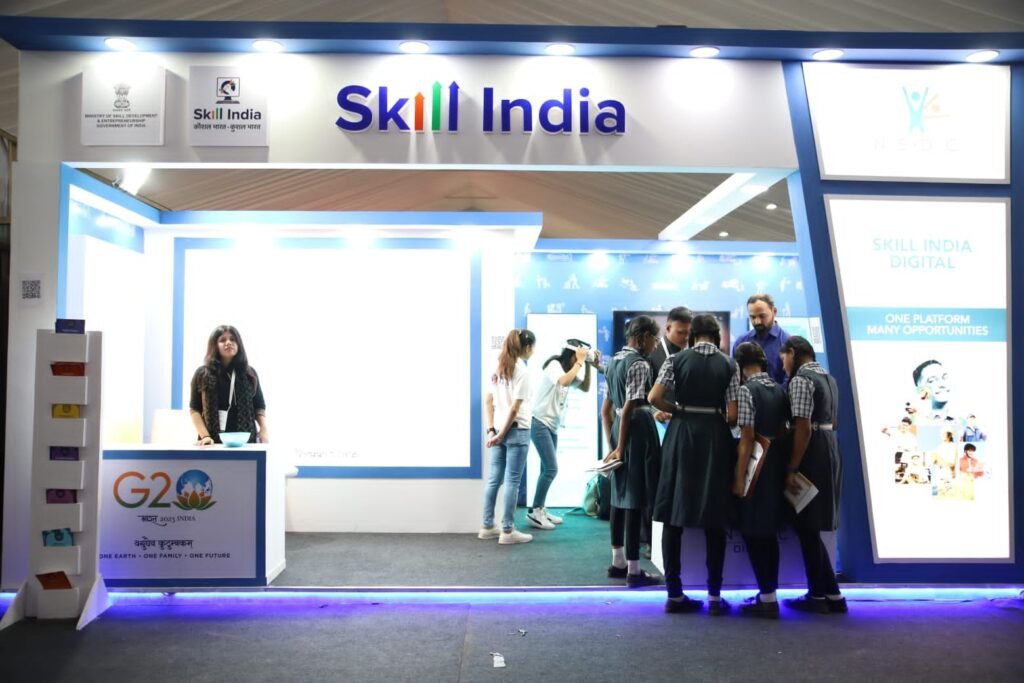
India’s Public Skilling Ecosystem and Major Government Initiatives
- Institutional Foundation: India’s public skilling architecture is anchored by the Skill India Mission, implemented principally through the Ministry of Skill Development and Entrepreneurship (MSDE).
- The ecosystem combines short-term training, long-term vocational education, apprenticeships, entrepreneurship, recognition of prior learning and international skill mobility.
- MSDE was established in 2014 to create a coordinated national framework for skill development.
- Flagship Short-Term Skilling:
- The Pradhan Mantri Kaushal Vikas Yojana (PMKVY) is the flagship short-term skilling programme.
- Under PMKVY 4.0, 27.08 lakh candidates had been trained by 7 December 2025, covering 38 sectors, 36 States and 732 districts.
- The programme introduced 77 customised courses and 102 future-skill job roles, including AI, Industry 4.0, green jobs and digital services.
- Industrial Training Institutes remain the backbone of long-duration vocational education.
- Between 2014 and 2025, ITIs increased from about 9,977 to over 14,682, while enrolment rose from around 9.5 lakh to over 14 lakh.
- The PM-SETU scheme, approved in 2025 with an estimated ₹60,000 crore outlay, seeks to upgrade 1,000 government ITIs through a hub-and-spoke model and stronger industry participation.
- The National Apprenticeship Promotion Scheme (NAPS) provides an important work-based learning pathway.
- More than 49.18 lakh apprentices had been engaged since 2016. Government contributes 25% of the stipend, up to ₹1,500 per month, through DBT.
- Women’s participation increased from 11.30% in FY2018–19 to 22.84% in FY2024–25, showing expanding female participation in apprenticeships.
- Jan Shikshan Sansthan (JSS) targets rural, tribal, women and disadvantaged communities.
- Between 2018 and December 2025, 33.55 lakh beneficiaries had been trained.
- Under the tribal convergence programme, skilling centres are being established in 30 tribal districts, targeting 1 lakh tribal beneficiaries between 2024–25 and 2028–29.
- PM Vishwakarma, launched in 2023, supports artisans across 18 traditional trades through training, certification, toolkits and credit linkages; over 23.66 lakh artisans had been formally trained by the end of 2025.
- The Pradhan Mantri Kaushal Vikas Yojana (PMKVY) is the flagship short-term skilling programme.
- Digital Public Infrastructure: The Skill India Digital Hub (SIDH) integrates training, assessment, certification and employment services.
- By September 2025, it had recorded 1.6 crore+ registrations, 1 crore+ e-KYC-verified candidates, 30,000+ training centres, and 10 lakh+ job/apprenticeship opportunities.
- India has also developed international skill partnerships covering countries such as Germany, Japan, Australia, UAE and Singapore, linking skilling with global labour mobility.
- Policy Direction: The policy direction is shifting from merely expanding enrolment toward industry relevance, employability, apprenticeships, digital skills and measurable outcomes.
- NITI Aayog’s 2026 report similarly argues for outcome-linked, industry-backed programmes rather than enrolment-driven skilling.
Why Skilling Programmes Struggle to Create Workplace-Ready Talent?
- Training–Employment Conversion Gap: The latest Gi Group Holding report, reported in September 2026, highlights a crucial distinction between training completion and workplace readiness.
- Only 25% of participants secured direct full-time employment at the organisation where they trained, while 33% used their certificates to seek employment elsewhere.
- This indicates that certification does not automatically translate into employer acceptance.
- Weak Employer Recognition of Certificates: Among surveyed employers, 47% said government skilling certificates carried no weight in hiring decisions, while only 11% said they prioritised or automatically shortlisted candidates holding such certificates.
- This exposes a credibility and signalling problem: employers often want demonstrated competence rather than evidence merely of course completion.
- Practical Exposure Deficit: The Economic Survey 2025–26 identifies limited practical exposure, outdated curricula and inadequately trained instructors as important TVET weaknesses.
- Certification can therefore coexist with insufficient ability to operate modern machinery, software or workplace processes.
- Learners generally face a steep learning drop-off, forgetting nearly 70% of information within 24 hours due to a lack of immediate practical reinforcement.
- Only 30% of acquired knowledge is ever successfully applied on the job, directly resulting in an average placement rate of just 42.8%.
- Behavioural and Soft-Skill Deficit: The latest report found behavioural agility to be the largest gap among candidates who failed to convert training into permanent employment, cited by 38%.
- This includes adaptability, communication, teamwork and the ability to function effectively in changing workplace environments.
- Outdated Technology and Equipment: 34% of candidates identified outdated equipment or software as a major barrier.
- This creates a technological lag between training centres and actual workplaces, particularly in sectors undergoing rapid automation and digitalisation.
- Foundational Skill Weakness: The Economic Survey cites weak foundational skills as one source of India’s skill mismatch.
- Communication, mathematics, digital literacy and problem-solving are prerequisites for learning advanced occupational skills.
- Consequently, simply adding more specialised courses cannot compensate for deficiencies in basic learning outcomes.
- Wage and Aspiration Mismatch: The Economic Survey notes that youth wage aspirations can exceed what firms offer, contributing to early turnover and limited adaptability.
- The latest Gi Group report similarly identified wage mismatch, cited by 13% of candidates who did not convert training into permanent employment.
- Employability depends not only on skills but also on realistic career counselling and labour-market information.
- Industry–Academia Disconnect: The 2025 National Skill Gap Study, cited by the Economic Survey 2025–26, identifies weak foundational skills, mismatch between industry requirements and training, and inadequate adaptation to emerging technologies as major causes of skill mismatch.
- The latest Gi Group study illustrates this transition. 76% of surveyed employers reportedly shortlisted candidates based on practical readiness, while academic merit drove shortlisting for only 6%.
- More than 80% of surveyed candidates said their colleges had not provided access to industry-standard tools or software.
- Nearly four in ten cited lack of local industry as a barrier to finding employment.
- The report found that 49% of Tier-2 and Tier-3 graduates felt completely unprepared when entering their first job, compared with 67% of Tier-1 graduates who reported feeling fully prepared. 74% found expected English communication standards difficult.
- Economic Survey 2025–26 data show that only 47% of schools offered skill-based courses at Grade IX and above, while participation stood at 29%, indicating substantial room for expansion.
- Artificial intelligence, automation, digital collaboration and green technologies are changing occupational requirements rapidly.
- The Government has established 36 Sector Skill Councils, led by industry representatives, to identify sectoral skill needs and competency standards.
- Geographic Unevenness: Rural learners often face weaker access to modern training infrastructure and nearby employers.
- The absence of local industry can make even technically trained candidates dependent on migration for employment.
- The latest employment-readiness report found that nearly four in ten candidates cited lack of local industry as a barrier to employment.
- 49% of Tier-2 and Tier-3 graduates surveyed by Gi Group felt completely unprepared for their first job, compared with 67% of Tier-1 graduates reporting full preparedness.
- More than 80% said their colleges lacked industry-standard tools or software.
- Gender-Based Participation: Women face barriers beyond training availability, including care responsibilities, safety concerns, mobility restrictions and workplace accessibility.
- The Economic Survey 2025–26 records an increase in India’s female labour-force participation rate from 23.3% in 2017–18 to 41.7% in 2023–24 but continue to face a substantial unpaid-care burden.
- Women’s participation in apprenticeships has improved substantially, increasing from 11.30% in FY2018–19 to 22.84% in FY2024–25. More than 10.01 lakh women apprentices had been engaged since 2016–17.
Reforms Needed for Industry-Aligned and Future-Ready Skilling
- GEES/Kaushal Tracks in Schools: Embed foundational vocational training and early career exposure directly into school curricula via programs like Samagra Shiksha.
- In alignment with the National Education Policy (NEP) 2020, vocational exposure must be institutionalized starting from Class 6, utilizing platforms like Atal Tinkering Labs to foster an early entrepreneurial mindset.
- Public-Private Partnerships (PPP): Integrate industry-designed curricula, assessments, and apprenticeships deeply into tertiary and higher education.
- Training modules must move away from rote learning and immediately incorporate next-generation trades like Artificial Intelligence (AI), Internet of Things (IoT), cybersecurity, advanced robotics, green technologies, and semiconductor manufacturing.
- Outcome-Linked Short-Term Programs: Shift funding and metrics toward verifiable job placements and wage enhancements rather than mere enrollment numbers.
- India must establish more international skilling hubs and formalize Government-to-Government (G2G) Mobility Partnerships.
- Mainstreamed Apprenticeships: Scale up workplace-based learning frameworks through enhanced pathways like the National Apprenticeship Promotion Scheme (NAPS).
- Multi-Channel Guidance: Establish robust career counseling systems to reduce information asymmetry for youth and NEET (Not in Education, Employment, or Training) segments.
- Digital Skills Passports: Deploy integrated verification tools like APAAR / Skills DX to create portable, transparent records of acquired competencies.
- National Credit Framework (NCrF): Operationalize seamless credit accumulation and transfer between general academic and vocational streams.
- The National Council for Vocational Education and Training (NCVET) must enforce strict multi-sector creditization.
- Infrastructure Upgradation: Modernize training capacity through initiatives like PM-SETU (Pradhan Mantri Skilling and Employability Transformation through Upgraded ITIs), backed by a ₹60,000 crore outlay to transform 1,000 Industrial Training Institutes (ITIs) into hub-and-spoke centers of excellence.
- The government must maximize the reach of the Skill India Digital Hub to establish an AI-powered marketplace.
- Inclusive & Skills-First Policies: Lower entry barriers for women, informal sector workers, and gig economy participants via targeted regional centers, flexible scheduling, and formal skill recognition.
- The future system should permit multi-entry, multi-exit, credit transfer and stackable credentials.
- Policies should integrate safe transport, childcare, flexible schedules, suitable workplaces, mentorship and local employment opportunities.
Frequently Asked Questions (FAQs):
1. Why are government skilling programmes struggling in India?
Weak practical exposure, outdated equipment, behavioural-skill gaps, wage mismatches and poor industry alignment limit workplace readiness.
2. What does the latest skilling report say about employability?
The Gi Group report finds employers increasingly prioritise practical readiness and demonstrated skills over formal qualifications.
3. How many skilling programme participants got full-time jobs?
25% secured direct full-time employment at the organisation where they trained, while 33% sought employment elsewhere using their certificates.
4. Why are Indian graduates not workplace ready?
Limited industry exposure, outdated tools, weak communication, behavioural gaps and insufficient practical training reduce graduates’ workplace preparedness.
5. What are the major skill gaps among Indian youth?
Major gaps include behavioural agility, practical skills, digital/software proficiency, communication, foundational abilities and adaptability to emerging technologies.
Disclaimer: Information in this article is based on official announcements and public records. Details may evolve over time.
| Also Read: Skill India Program |