


IIT Seat Growth 2026: Seat Capacity Rises 13.4%, Women-Only Seats Surge 141%
| General Studies Paper III: Education, Development & Infrastructure, Gender Equality |
Why in News?
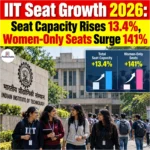
According to the JEE Advanced Joint Implementation Committee reports, total seat capacity across Indian Institutes of Technology (IITs) reached 18,826 seats in 2026, marking a 3.7% annual increase and a 13.4% growth since 2022.
IIT Seat Growth 2026 Latest Statistics
- Total Seat Capacity: According to the latest JEE Advanced 2026 seat matrix, the total baseline capacity across all 23 premier IITs has reached 18,826 seats. This marks a net increase of 666 seats compared to the 18,160 seats available in 2025.
- Official data demonstrates a 13.4% overall expansion in the total seat pool between 2022 and 2026, adding 2,228 seats across the system.
- The annual progression shows 16,598 seats in 2022, 17,385 in 2023, 17,760 in 2024, 18,160 in 2025, and finally 18,826 in 2026.
- Female Supernumerary Equilibrium: The expansion was largely driven by a sharp rise in female-only supernumerary seats, which more than doubled from 1,567 in 2022 to 3,776 seats in 2026, an increase of about 141%.
- JoSAA’s pre-counselling mathematical model has stabilized at a steady 20.05% female share of total capacity, preserving the separate gender-neutral pool.
- The number of female candidates allotted seats rose from 3,310 (19.90% share) in 2022 to 3,814 (20.22% share) in 2026.
- Top-Performing Institute Spikes: Prominent individual campuses led the latest intake surge, with IIT Jodhpur adding 140 seats (climbing from 610 to 750) and IIT Mandi adding 120 seats (climbing from 520 to 640).
- Notable expansion also occurred at IIT Indore and IIT Palakkad, which added 80 seats each.
- Academic Course Modernization: The structural seat jump incorporates 18 to 19 new modern programs weaving together core tracks with emerging technologies. These specializations focus on areas like Quantum Science, Engineering, Data Analytics, and sustainability fields.
- Under the unified JoSAA portal, overall available technical seats rose to 67,323 seats across 136 institutes. Crucially, IISc Bangalore entered JoSAA counselling for the first time, contributing an extra 125 B.Tech seats.
Recommendations and Policies for IIT Seat Expansion
- Nalini Ranjan Sarkar Committee: The historical foundation for seat expansion began with the Sarkar Committee report in 1946.
- It recommended creating high-tier technical institutions modeled after the Massachusetts Institute of Technology (MIT).
- This paved the way for the Institutes of Technology Act, 1961, establishing the initial footprint of the IIT network to structurally scale up technical seat capacity across India.
- Anil Kakodkar Committee: In 2011, the committee recommended a monumental roadmap to expand undergraduate and postgraduate intakes.
- It recommended increasing the student strength per IIT to 10,000 students, while scaling up the system to graduate 10,000 PhDs annually.
- IIT Council and Boards: The IIT Council, operating under the statutory framework governing IITs, provides coordination across the IIT system.
- Expansion involves decisions on academic programmes, institutional capacity and resources.
- The Joint Admission Board (JAB) constituted a committee chaired by the Director of IIT Mandi to address low female enrolment.
- Its recommendations were considered at the IIT Council’s 51st meeting in April 2017.
- Third-Generation (3G) Expansion: The primary driver of recent seat growth is the Ministry of Education‘s targeted expansion program for five newer IITs established after 2014: IIT Bhilai, IIT Dharwad, IIT Jammu, IIT Tirupati, and IIT Palakkad.
- Female Supernumerary Seat Allotment: To fix the severe gender imbalance, the government introduced female-only supernumerary seats in 2018. These additional seats are created over and above the regular seat pool, helping female representation.
- Infrastructure Outlays: The government approved a massive capital allocation of ₹11,828.79 crore spanning up to 2028-29. This funding accelerates Phase-B infrastructure expansion across five newer IITs: Tirupati, Palakkad, Bhilai, Jammu, and Dharwad.
- JoSAA Technical Over-Allotment Mitigation: The Joint Seat Allocation Authority (JoSAA) introduced a stabilization mechanism using provisional over-allotments.
- It ensures that premier engineering seats do not go vacant due to late withdrawals, maximizing the actual utilization of available infrastructure.
Significance of IIT Seat Expansion
- For decades, the IITs were criticized for an extreme supply-demand mismatch where less than 1% of applicants secured admission.
- Expanding the seat matrix directly satisfies the growing national demand for quality engineering education.
- Rather than filling into the existing open seats, female-only supernumerary seats additions were designed to correct a stark gender imbalance on campus.
- This has systematically diversified campus culture and created a more balanced pipeline of women leaders in STEM fields.
- Seat expansion coincides with the launch of 18 new academic programs blending engineering with cutting-edge tech.
- New campuses are introducing specialized courses in Artificial Intelligence, Data Science, and sustainability, shifting the focus from narrow engineering streams toward future-ready disciplines.
- A larger student body at the IITs creates a broader talent pool equipped to handle high-end research and development.
- A massive phase-wise addition of 6,576 seats at third-generation IITs (including Jammu, Bhilai, and Dharwad) ensures balanced regional outreach.
- Spreading infrastructure across states bridges geographical divides, allowing local students to access premier public education.
- The inclusion of five state-of-the-art research parks under this expansion framework significantly drives industry-academia collaboration.
- Increased enrollment in postgraduate and doctoral domains produces a larger workforce of researchers, driving innovations inside India’s growing semiconductor and tech sectors.
- By increasing graduate volumes, India expands its global footprint of technology leaders and startup founders.
- Providing premier education at a larger scale reinforces the nation’s position as a global hub for technical knowledge, directly lifting worldwide institutional rankings.
Challenges and Limitations
- Rapid seat growth directly exacerbates the acute shortage of qualified PhD faculty.
- Recruiting global-standard professors fails to match the surging student intake, distorting the ideal mentoring ratio, increasing workloads, and compromising individual student attention.
- Expanding batches place immense pressure on campus ecosystems. Institutions face severe deficits in hostel accommodation, smart classrooms, and advanced laboratories, often forcing quick, temporary infrastructure fixes that lag behind the elite standards expected of IITs.
- The influx of thousands of additional graduates creates fierce competition during campus drives.
- Amid shifting economic landscapes, maintaining 100% high-quality placements becomes difficult, leading to wider disparities in salary packages across newer vs. older IITs.
- Funding per student drops, directly impacting cutting-edge laboratory setups, international collaborations, and high-impact publications.
- The diverse preparation levels of expanded batches, combined with rigorous academic curricula, lead to severe peer pressure, anxiety, and alienation, demanding robust campus counseling frameworks.
- Newer institutes struggle heavily with niche stream choices, industry connectivity, and geographical disadvantages, preventing a uniform educational standard across the collective IIT system.
- Female supernumerary seats increased, yet women’s share of final IIT allotments was almost stable.
- This illustrates that additional seats alone cannot transform representation substantially.
- Stronger school-level STEM participation, career awareness and supportive campus environments remain important.
Frequently Asked Questions (FAQs):
1. How many seats are available across IITs in 2026?
IITs offered 18,826 seats for the 2026–27 academic session.
2. By what percentage has IIT seat capacity increased since 2022?
Total IIT seat capacity increased by approximately 13.42% between 2022 and 2026.
3. How many additional seats have IITs added since 2022?
IITs added 2,228 seats, increasing capacity from 16,598 in 2022 to 18,826 in 2026.
4. What are female supernumerary seats in IITs?
These are additional seats exclusively for female candidates, created separately from gender-neutral seats to improve gender balance.
5. How many female supernumerary seats are available in 2026?
IITs provided 3,776 female supernumerary seats in 2026, compared with 1,567 in 2022.
6. Why were additional seats introduced for female candidates at IITs?
They were introduced to address low female enrolment and achieve a target of at least 20% female representation in undergraduate programmes.
Disclaimer: Information in this article is based on official announcements and public records. Details may evolve over time.
| Also Read: IIT Bombay Exam Rules 2026 |