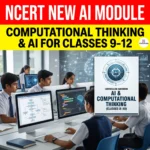


NCERT Computational Thinking and AI Module, Designed for Class 9–12 Students
| General Studies Paper II: Education, Artificial Intelligence |
Why in News?
Recently, the National Council of Educational Research and Training (NCERT) introduced Computational Thinking (CT) and Artificial Intelligence (AI) modules for Classes 9–12, fostering analytical reasoning.
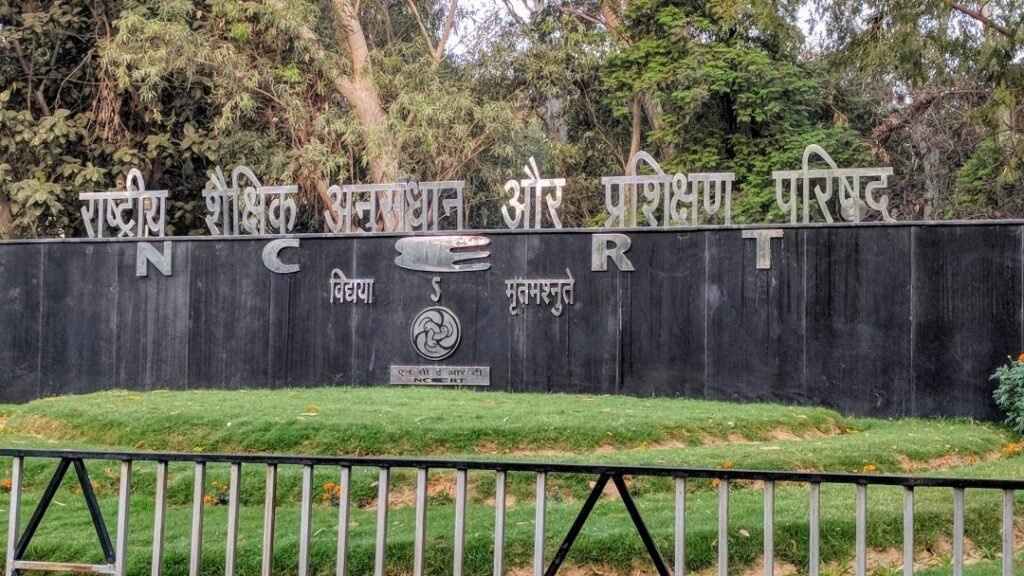
What is NCERT’s Computational Thinking and AI Module?
- About: NCERT’s Computational Thinking and AI Module is an introductory learning resource designed for studentsin Classes 9 to 12.
- It combines inclusive activity-based learning with safe, and ethical technology principles.
- Objectives: The module aims to help students grasp how AI functions, recognize its real-life applications, and identify its operational possibilities and limitations.
- It cultivates core mental competencies including critical thinking, creativity, systematic problem-solving, and assumes no prior knowledge of artificial intelligence.
- Framework: It is built in direct alignment with the National Education Policy 2020 and the National Curriculum Framework for School Education 2023.
- Concepts:
- The curriculum will introduce computational thinking as a structured approach built on decomposition, pattern recognition, abstraction, and algorithmic design.
- Students will build practical problem-solving capabilities by breaking down complex challenges into manageable segments, analyzing data, and performing troubleshooting.
- Learners will explore core AI mechanics including machine learning basics, pattern detection, data analysis, generative AI, human–AI interaction and the prediction of trends.
- The module will target future-ready skills by merging technical literacy with strong ethical awareness.
- Major focus areas will include data privacy, fairness, digital safety, mitigating misinformation, and the critical verification of AI-generated content.
- Significance: This curriculum anchors the Digital India initiative by transforming students’ interaction with modern technology.
- This framework accelerates the digital readiness of schools, seamlessly integrating technical literacy into mainstream school education.
- The program acts as a critical pipeline for building future-ready human capital capable of thriving in a technology-driven global economy.
- It focuses on cultivating an AI-ready workforce.
- By training students to recognize systemic biases, and counter algorithmic misinformation, the module shapes an informed citizenry.
- This approach bridges the structural digital divide between well-funded urban institutes and resource-constrained government schools.
- The initiative positions the nation to become a prominent global leader in AI and ML.
AI Education in India
- Policy: The National Education Policy (NEP) 2020 and the NCF 2023 drive integration of AI in India. It targets a Viksit Bharat 2047 vision by building a future-ready, technologically fluent student workforce.
- Integration: The Ministry of Education, through CBSE and NCERT, introduced a dedicated Computational Thinking and Artificial Intelligence Curriculum starting from Class III.
- CBSE provides a 15-hour skill module for Class VI and offers AI as an optional subject for Classes IX–XII.
- The University Grants Commission (UGC) and All India Council for Technical Education (AICTE) have mandated AI elements across technical portfolios.
- A major AICTE partnership with Perplexity AI offers advanced research capabilities to 40 million students across 14,000 institutions.
- Research Outlay: The IndiaAI Mission, backed by a ₹10,371.92 crore budget, funds computing infrastructure and indigenous Large Language Models (LLMs).
- A dedicated Centre of Excellence in AI for Education was established with a ₹500 crore allocation.
- It established the IndiaAI-Meta Center Srijan at IIT Jodhpur to develop open-source generative applications.
- Platforms: Digital infrastructure is scaled using Digital Infrastructure for Knowledge Sharing (DIKSHA) for personalized learning content and the SWAYAM portal, which hosts over 110 free AI courses from apex institutes like IITs and IISc.
- The Ministry of Skill Development and Entrepreneurship launched SOAR.
- The Skilling for AI Readiness (SOAR) initiative targets classes 6–12 students and features a comprehensive 45-hour “AI for Educators” module to enhance pedagogical AI literacy.
- Programs like YUVA AI For All and PMKVY 4.0 focus on demographic inclusion.
- The Ministry of Skill Development and Entrepreneurship launched SOAR.
Critical Bottlenecks & Structural Challenges
- Multi-Layered Digital Divide:
- Urban-Rural Gap: Higher education adoption stands at roughly 57% in urban centers versus just 22% in rural areas.
- Infrastructure Deficits: Unlike international models (e.g., Japan’s GIGA School project ensuring one high-spec device per student), many rural Indian schools rely on low-power, shared infrastructure that cannot process AI locally.
- Cognitive Atrophy & Rote 2.0: Over-reliance on generative platforms leads to “cognitive offloading”. If students delegate the critical process of essay composition or code logic to AI, the core neural pathways for critical analysis fail to develop.
- Massive Upskilling Deficit: India faces a monumental task in training over 1 crore primary and secondary educators to comfortably guide AI tools rather than view them as threats.
- Data Sovereignty & Algorithmic Bias: Educational algorithms trained primarily on Western datasets present cultural biases.
- Tracking students’ continuous performance data introduces deep privacy vulnerabilities.
Way Forward
- Deploy a Sovereign AI Cloud: Build an exclusive, secure state cloud ecosystem managed via the National Educational Technology Forum (NETF) to preserve data sovereignty and minimize vendor lock-in.
- Integrate AI tools with the government’s Bhashini AI platform (National Language Translation Mission).
- Implement “Unplugged” AI Pedagogies: For resource-deficient or low-connectivity regions, introduce foundational computational concepts via logical games, physical puzzles, and non-digital methods.
- Prioritize infrastructure delivery by converging the PM-WANI (Wi-Fi Access Network Interface) scheme and BharatNet to provide high-speed internet to rural schools.
- Mandatory AI Citizenship Courses: Embed basic algorithmic awareness, AI ethics, and data protection modules within the early stages of the school framework.
- Shift Assessments to Process, Not Product: Transition evaluation methods from traditional end-term memorization to formative, process-oriented examinations that measure how a student builds a solution using technology.
- Focus heavily on the 4Cs: Critical thinking, Creativity, Collaboration, and Communication, while introducing foundational data literacy.
Frequently Asked Questions (FAQs):
1. What is the new NCERT NCERT module on Computational Thinking and Artificial Intelligence?
An introductory educational module developing computational problem-solving, AI awareness, critical thinking, creativity and responsible technology use.
2. Which classes will study the new NCERT AI and Computational Thinking module?
The new module targets Classes IX–XII, introducing students to computational thinking and artificial intelligence.
3. What topics will be covered in the AI curriculum for students in Classes 9 to 12?
Problem-solving, AI concepts, practical applications, ethics, privacy, digital safety, misinformation and responsible AI use.
4. How will computational thinking and AI education benefit school students?
It strengthens logical reasoning, creativity, digital literacy, independent judgement and readiness for emerging technological careers.
Disclaimer: Information in this article is based on official announcements and public records. Details may evolve over time.
| Also Read: NCERT Class 8 Textbook Judiciary Controversy |