


Two Subterranean Fish Species Discovered in Assam: Gitchak nakana & Rakthamichthys anchi
| General Studies Paper I: Biodiversity, New Species in News |
Why in News?
Recently, researchers discovered two subterranean fish species, Gitchak nakana and Rakthamichthys anchi, in Assam’s Goalpara district.
Highlights of Two Subterranean Fish Species Discovered in Assam
- Identification: Scientists officially announced the two new-to-science Subterranean fish species on October 21, 2026.
- The first is Gitchak nakana, a completely new genus and species representing the first aquifer-dwelling (phreatobitic) fish.
- The second is Rakthamichthys anchi, which belongs to the Synbranchidae family of swamp eels.
- Their names blend Garo language terms (“Gitchak” for red, “nakana” for blind fish) and words denoting blood to reflect their striking physical features.
- Discovery: The discovery of two Subterranean fish species occurred in the Goalpara district of Assam, India.
- An international research collaboration, led by scientist Ralf Britz along with local researcher Wimarithy K. Marak collected the specimens from deep open dug-out concrete wells.
- The first species was initially spotted and photographed by Marak in March 2021, while the second was pulled up by a relative draining a well in May 2024.
- Features:
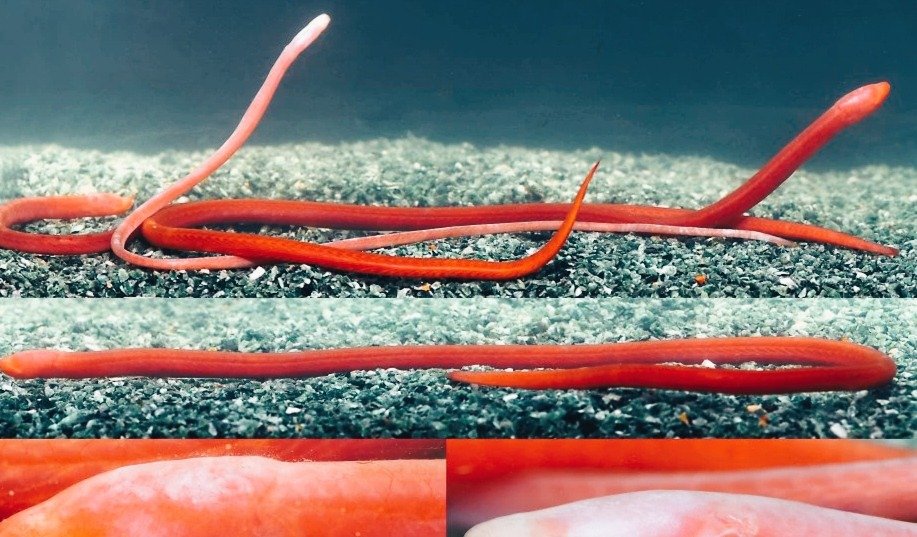
- Gitchak nakana is a miniature, transparent blind loach measuring roughly 2 centimeters in length.
- Its lack of skin pigment leaves its body translucent, displaying a blood-red appearance because its internal organs and blood vessels are visible from the outside.
- Rakthamichthys anchi is a much larger, slender, and highly elongated eel-like fish with a name-bearing holotype specimen measuring 310 millimeters.
- Living in complete darkness for an estimated 20 million years of isolated evolution, both species are completely blind and pigmentless.
- Advanced micro-computed tomography (micro-CT) scanning revealed that Gitchak nakana possesses an extraordinary anatomical anomaly: it lacks a skull roof, leaving its brain protected entirely by outer skin. It navigates and senses its environment using highly elongated whisker-like barbels covered in taste buds.
- Gitchak nakana is a miniature, transparent blind loach measuring roughly 2 centimeters in length.
- Food: Because their subterranean home receives absolutely no sunlight, light-dependent vegetation cannot grow, making it a highly resource-scarce environment.
- They rely entirely on tiny organic matter, microbes, or specialized subterranean micro-invertebrates that filter down into the aquifer layers.
- Threats: The primary threat to these ancient creatures is groundwater pollution and rapid habitat degradation.
- These specialized fish are highly vulnerable to chemical runoff and changes in water quality.
- Conservation: To protect them from ecological exploitation, researchers have deliberately withheld the exact collection locations.
- Officials have urged for stronger environmental governance to safeguard these fragile, newly exposed biomes.
About Subterranean Fishes
- Features: Subterranean fishes (also known as hypogean or troglobitic fish) are highly specialized aquatic vertebrates that spend their entire life cycles in underground waters.
- They exhibit troglomorphic traits, including a lack of pigment, reduced or absent eyes, and enhanced non-visual sensory systems like lateral lines to navigate and hunt.
- Types: Cypriniformes stands out with the highest number of underground species, particularly within families like Cobitidae (loaches) and Cyprinidae.
- Other significant classifications include Siluriformes (catfishes), Synbranchiformes (swamp eels), and Amblyopsidae (cavefishes).
- Worldwide, over 300 cavefish species span every continent except Antarctica, thriving heavily in karst regions of China, Mexico, and the US.
- Globally, researchers in Alabama, USA, discovered the “Demon Cavefish” (Demogorgonichthys arcanus), an entirely new eyeless genus faintly electric blue in life.
- In India, subterranean fish diversity is concentrated in two major biological hotspots: the Western Ghats (predominantly Kerala’s deep aquifers) and the northeastern karst caves and wells of Meghalaya and Assam.
- Key Indian species include the endangered cave loach Schistura sijuensis from Meghalaya, the blind catfish Horaglanis krishnai from Kerala, Neolissochilus pnar, a large subterranean fish from Meghalaya and the recently discovered Gollum snakehead (Aenigmachanna gollum).
- Worldwide, over 300 cavefish species span every continent except Antarctica, thriving heavily in karst regions of China, Mexico, and the US.
- Other significant classifications include Siluriformes (catfishes), Synbranchiformes (swamp eels), and Amblyopsidae (cavefishes).
- Ecological Significance: Subterranean fishes serve as crucial apex predators within underground food webs, controlling populations of stygobitic invertebrates.
- They act as vital biological indicators (canaries in a coal mine) for groundwater health; any decline in their population directly signals deep-aquifer contamination or ecosystem degradation.
Frequently Asked Questions (FAQs):
1. Which two subterranean fish species were discovered in Assam?
Gitchak nakana, a blind loach, and Rakthamichthys anchi, an eel-like swamp eel, were identified.
2. Where were Gitchak nakana and Rakthamichthys anchi discovered?
Both were discovered in wells in Goalpara district, western Assam, within groundwater aquifers in alluvial deposits.
3. What are subterranean fish, and how do they survive underground?
They inhabit underground waters, surviving through specialised sensory adaptations, low metabolism and feeding on limited organic matter and small organisms.
4. Why is Gitchak nakana described as a blind loach?
It belongs to the loach family Cobitidae and lacks eyes, pigmentation and a skull roof.
5. What makes Rakthamichthys anchi different from other underground fish?
It is a newly described synbranchid swamp eel, distinguished by anatomical features, vertebral counts and genetic differences from related species.
Disclaimer: Information in this article is based on official announcements and public records. Details may evolve over time.