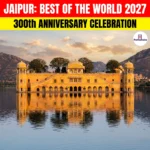



Jaipur Best of the World 2027, Marking 300th Anniversary
| General Studies Paper I: International Recognition, Tourism and Heritage |
Why in News?
Recently, Jaipur, the capital of Rajasthan, was named to National Geographic’s Best of the World 2027 list to celebrate its upcoming anniversary and major cultural milestones.
What is National Geographic Best of the World 2027 List?
- About: The National Geographic Best of the World 2027 list is an annually curated travel guide compiling the most exceptional locations globally.
- It represents a selective ranking created by a global community of travel experts, editors, photographers, and explorers.
- The 2027 edition marks the 15th anniversary of this highly consumer-friendly travel feature.
- Objective: The primary goal of the feature is to inspire travelers to discover the world with curiosity, discovery, and deep engagement.
- The selection explicitly targets places experiencing timely cultural revivals, major milestone celebrations, new itineraries, or substantial infrastructure openings.
- Locations: The list highlights 25 must-visit destinations meticulously selected after vetting hundreds of global nominations.
- These specified sites span across six different continents.
- The highly praised Vestland region in Norway leads the global selection as a premium destination for epic fjord and wellness travel.
- Prominent global cities and territories sharing the spotlight include Luxor (Egypt), Normandy (France), Chengdu (China), Penang (Malaysia), and Leipzig (Germany). Catalina Island in California secured the list’s unique “Readers’ Choice” award.
- Jaipur, the capital of Rajasthan, stands out as a focal point of global recognition on this list.
- It is celebrated as the only Indian destination to earn a coveted spot on the 2027 list.
- This award builds on its massive momentum from ranking 5th globally in Travel + Leisure’s World’s Best Cities survey.
- The selection is made because of its 300th anniversary in 2027. Editors highlighted its vibrant architectural fusion of Rajput and Mughal styles.
- It was also picked for anchoring major global events like the 20th edition of the Jaipur Literature Festival and the iconic Kite Festival.
Pink City of India: Jaipur
- Founder: The city of Jaipur was founded on November 18, 1727, by Maharaja Sawai Jai Singh II, the Kachwaha Rajput ruler of Amber.
- Jaipur stands as a premier example of indigenous town planning and cultural continuity in India.
- Developments:
- 1727–1734 (Foundational Phase): Principal construction of the grid-based walled city, fortifying walls, gates, and the core palace complex took place.
- Maharaja Jai Singh II, a passionate astronomer and scientist, collaborated with chief architect Vidyadhar Bhattacharya to design the city.
- The blueprint applies the principles of Vastu Shastra and Shilpa Shastra, integrated with Western and Central Asian geometric concepts.
- The city layout follows a gridiron grid pattern divided into nine distinct squares or Chowkris.
- This arrangement mirrors the Navagraha (nine planets) celestial layout, demonstrating an advanced synthesis of science, cosmology, and civil engineering.
- 1876 (Pink Transformation): Under Maharaja Sawai Ram Singh II, the entire city was painted terracotta pink to welcome Albert Edward, Prince of Wales. This established its enduring aesthetic brand.
- 1949 (Post-Independence Integration): Jaipur merged into the Indian Union, legally becoming the capital of the newly formed state of Rajasthan.
- 1727–1734 (Foundational Phase): Principal construction of the grid-based walled city, fortifying walls, gates, and the core palace complex took place.
- Architectural Heritage: Jaipur showcases a brilliant blend of Rajput, Mughal, and European architectural styles.
- The multi-storied Hawa Mahal (Palace of Winds) featured 953 small casements, allowing royal women to observe street processions without violating social customs.
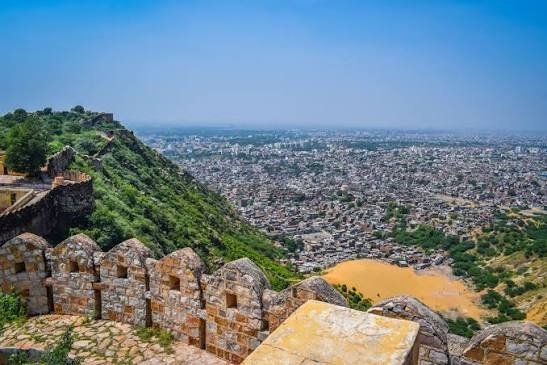
- The City Palace functioned as the administrative heart. Surrounding hilltops feature protective forts like Amer Fort, Jaigarh Fort, and Nahargarh Fort, creating a robust military defensive shield for the valley below.
- The Jantar Mantar observatory, inscribed as a UNESCO World Heritage Site in 2010, underscores Jaipur’s historical contribution to global science.
- Built by Jai Singh II, it features a collection of 19 architectural astronomical instruments.
- This includes the Vrihat Samrat Yantra, the world’s largest stone sundial.
- These instruments measure local time, track the positions of stars, and predict eclipses with astonishing accuracy.
- UNESCO World Heritage Status: In 2019, the Walled City of Jaipur was inscribed on the UNESCO World Heritage list under criteria designed for outstanding urban planning and living cultural traditions.
- It was recognized as a living heritage site where historic residential quarters, bustling traditional bazaars, and operational craft guilds remain functional.
- Cultural Icons: The Jal Mahal sits symmetrically in the center of the Man Sagar Lake, showcasing a stunning submerged palace design.
- The Albert Hall Museum, designed in the Indo-Saracenic style, serves as the oldest museum in the state.
- Iconic spiritual centers like the Govind Dev Ji Temple and the ancient Galtaji Temple (Monkey Temple) reflect the deep spiritual fabric and community traditions.
- Jaipur was ranked 18th globally in Time Out’s Best Cities for Art and Culture.
- Traditional Crafts: Jaipur operates as a world-renowned production center for traditional handicrafts.
- These include Blue Pottery, Kundan-Meenakari jewelry, gemstone cutting, and block printing (such as Sanganeri and Bagru styles).
- These crafts preserve intangible heritage, acting as vital engines for micro-entrepreneurship and exports.
- Cultural Events:
- Jaipur Literature Festival (JLF): Widely referred to as “the greatest literary show on Earth“, this massive annual event attracts roughly 400,000 attendees, including world-renowned authors, thinkers, and Nobel laureates.
- It was founded in 2006 by writers Namita Gokhale and William Dalrymple, and produced by Teamwork Arts.
- The 20th edition is scheduled for January 14–18, 2027.
- Jaipur International Film Festival (JIFF): Running annually in January since 2009, JIFF has evolved into a vital node on the global film calendar.
- It strengthens international artistic collaborations and promotes film tourism, aligned with India’s “Make in India” initiative.
- International Kite Festival: Held mid-January during Makar Sankranti, this festival transforms the skies above the Pink City into an artistic, competitive canvas.
- It is organized by the Department of Tourism, Government of Rajasthan across venues like the Jal Mahal and Jaipur Polo Ground.
- Jaipur Literature Festival (JLF): Widely referred to as “the greatest literary show on Earth“, this massive annual event attracts roughly 400,000 attendees, including world-renowned authors, thinkers, and Nobel laureates.
- Teej & Gangaur Festivals: Gangaur and Teej are two of the most vibrant, women-centric festivals celebrated in Rajasthan.
- Both festivals honor the divine union of Lord Shiva (Gan) and Goddess Parvati (Gauri), celebrating marital bliss, fertility, and the change of seasons.
- It is a vital corner of India’s famous Golden Triangle tourist circuit alongside Delhi and Agra.
- Both festivals honor the divine union of Lord Shiva (Gan) and Goddess Parvati (Gauri), celebrating marital bliss, fertility, and the change of seasons.
- Challenges: Rapid modernization poses severe threats to Jaipur’s historical integrity.
- The Walled City faces intense encroachments, illegal constructions, and commercial conversions of historic residential buildings (havelis).
- Aging sewage networks, exposed electrical wiring, and visual pollution from unapproved commercial signage degrade the historic landscape.
- The city battles rising traffic congestion, vehicular pollution, and inadequate solid waste management.
- Initiatives: To address such challenges, state and central agencies have launched targeted urban interventions.
- Under the Smart Cities Mission, significant funds are directed toward underground cabling, automated traffic management, and the restoration of heritage facades.
- The expansion of the Jaipur Metro project aims to offer eco-friendly public transit and lower carbon emissions.
- Strict building codes enforced by the Jaipur Municipal Corporation and the Heritage Development Committee seek to regulate new construction inside the Walled City.
- Jaipur’s designation as a Creative City for Crafts and Folk Art under UNESCO Creative Cities Network (UCCN) provides a multilateral framework for city-to-city cooperation.
Frequently Asked Questions (FAQs):
1. Why did National Geographic name Jaipur to its Best of the World 2027 list?
Jaipur’s 300th anniversary, historic palaces, traditional crafts and internationally renowned Jaipur Literature Festival make it especially appealing in 2027.
2. What makes Jaipur a top travel destination for 2027?
Its Rajput architecture, UNESCO-listed walled city, vibrant bazaars, gemstone jewellery, block-printing traditions and cultural celebrations offer diverse experiences.
3. How will Jaipur’s 300th anniversary be celebrated in 2027?
The anniversary falls in 2027, but a comprehensive official programme of celebrations has not been confirmed in the cited sources.
4. What are the top tourist attractions to visit in Jaipur?
Visit Amber Fort, Hawa Mahal, City Palace, Jantar Mantar, Jaigarh Fort, Nahargarh Fort, Jal Mahal and the historic bazaars.
5. Why is the Jaipur Literature Festival important for international travellers?
It attracts approximately 400,000 attendees annually, connecting international visitors with global authors, literature, politics, science, history and music.
Disclaimer: Information in this article is based on official announcements and public records. Details may evolve over time.
| Also Read: TIME World Greatest Places 2026 |