


UPSC 2025 Service Allocation Delay, Understand 958 Candidates OBC Creamy Layer Row
| General Studies Paper III: Issues Related to Development |
Why in News?
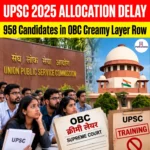
The Centre is awaiting Supreme Court directives to allocate services to 958 successful UPSC CSE 2025 candidates.
- UPSC 2025 Service Allocation delayed due to implementation challenges surrounding the court’s landmark March 11 judgment on the OBC creamy layer criteria.
What is OBC Creamy Layer?
- About: The Other Backward Classes (OBC) creamy layer refers to socially advanced sections within OBC communities that are excluded from OBC reservation benefits in central government employment and covered educational admissions.
- Articles 15(4), 15(5) and 16(4) enable specified measures for socially and educationally backward classes, including reservations in education and public employment.
- Its purpose is to ensure that affirmative action reaches comparatively disadvantaged sections.
- The backward community is bifurcated into the Creamy Layer (OBC-CL) and the Non-Creamy Layer (OBC-NCL).
- Candidates categorized under the Creamy Layer are treated like the General Category; they receive no quota advantages, age relaxations, or cut-off concessions.
- Only OBC-NCL candidates hold full eligibility rules for active reservations, provided they secure a valid certificate from a state authority.
- Origin: The OBC Reservation Policy grants a 27% quota in central government jobs and educational institutions to Socially and Educationally Backward Classes.
- Originating from the Mandal Commission recommendations, the Supreme Court of India upheld this quota in the landmark Indra Sawhney vs. Union of India (1992) case.
- The apex court introduced the Creamy Layer mechanism to exclude wealthy and socially advanced individuals, ensuring benefits target only the truly underprivileged.
- Total reservations under Article 16(4) cannot exceed 50%, except in rare or extraordinary circumstances.
- Economic status alone cannot define a backward class without a social and educational foundation.
- Threshold: For non-government occupations, the gross annual income limit to qualify for the Non-Creamy Layer is ₹8 lakh.
- This economic test evaluates the parents’ earnings over three consecutive financial years.
- Individuals are automatically placed into the Creamy Layer if their parents hold Constitutional posts, entered government service directly as Group A / Class I officers, or if both parents entered as Group B / Class II officers before turning 40.
- Wards of military officers holding the rank of Colonel and above are similarly barred from NCL benefits.
- The candidate’s personal income, as well as their spouse’s salary, is completely excluded from this calculation.
- This economic test evaluates the parents’ earnings over three consecutive financial years.
- Exclusion: Under the foundational 1993 Department of Personnel and Training (DoPT) guidelines, salary and agricultural income are explicitly excluded from the ₹8 lakh threshold test.
OBC Creamy Layer Issue and Judgment
- Issue: In 2004, a DoPT clarificatory letter altered the formula by including the raw salaries of Public Sector Undertaking (PSU), banking, and private sector employees in the income calculation while continuing to exclude regular government salaries.
- Candidates whose parents worked in these private organisations were denied OBC non-creamy-layer benefits because parental salary income exceeded the prescribed threshold.
- Challenge: Candidates who cleared the UPSC Civil Services Examination but were denied NCL status challenged these rules before Central Administrative Tribunals (CAT) and High Courts, which ruled in their favor.
- The Union of India appealed to the Supreme Court.
- Judgment: The Supreme Court ruled in Union of India v. Rohith Nathan on March 11, 2026, that determining OBC creamy layer status cannot rely solely on parental salary or income.
- Justices P.S. Narasimha and R. Mahadevan quashed the 2004 DoPT letter, stating that treating PSU/private sector employees differently from government servants amounts to hostile discrimination.
- The court dismissed the Union of India’s appeals, upholding the High Court and CAT decisions.
- Authorities must evaluate the status, category, and nature of the parent’s post alongside social and economic standing.
- The Supreme Court proceedings highlighted major violations of Article 14 (Right to Equality) and Article 16 (Equality of Opportunity in Public Employment).
- The Court directed authorities to re-examine affected candidates’ cases and create supernumerary posts (temporary extra posts used to adjust candidates without disturbing existing appointments) where needed.
- Deadlock: Following the verdict, the Centre filed a Miscellaneous Application seeking to apply the judgement prospectively, requesting a two-year window to formalize post-equivalence rules.
- The government argues that retrospective application would create administrative chaos across 3.7 lakh central recruitments since 2016.
UPSC CSE 2025 Service Allocation Delay
- The UPSC declared the Civil Services Examination 2025 results on 6 March 2026, five days before the Supreme Court delivered its judgment.
- According to reports published on 25 October 2026, the Central Government is awaiting Supreme Court directions before allocating services to 958 candidates recommended for CSE 2025.
- The Department of Personnel and Training (DoPT) has sought permission to proceed under the creamy-layer determination applied before the March judgment.
- On 24 August 2026, the DoPT filed a miscellaneous application seeking clarification and directions on implementing the judgment.
- The Government raised concerns about the implications for service allocation, cadre placement, existing seniority, earlier recruitment processes and the treatment of candidates whose cases were already settled.
- The Supreme Court reserved its order on this transition application on September 24, 2026. The Government is still awaiting directions.
- The mandatory Foundation Course at the Lal Bahadur Shastri National Academy of Administration (LBSNAA) in Mussoorie and other partner academies (which typically starts in August or September) has been postponed indefinitely.
- Civil services seniority is officially counted from the day the Foundation Course begins. The delay halts the joining schedule and pushes back long-term career progression for future IAS, IPS, and IFS officers.
- Candidates from the 2025 batch who took the CSE Mains again for rank/service improvement find their parallel training tracks (such as at the National Communications Academy-Finance) frozen.
Frequently Asked Questions (FAQs):
1. Why are 958 UPSC civil services candidates waiting for service allocation?
The Centre awaits Supreme Court clarification on applying the March 2026 OBC creamy-layer judgment to CSE 2025 service allocation.
2. What is the OBC creamy-layer controversy affecting UPSC candidates?
The dispute concerns whether parental salary alone can determine creamy-layer status, potentially excluding eligible OBC candidates from reservation benefits.
3. When was the creamy-layer concept introduced?
The Supreme Court established the principle in Indra Sawhney (1992); the Central Government formalised exclusion criteria through its Office Memorandum dated 8 September 1993.
4. What did the Supreme Court rule on OBC creamy-layer criteria in March 2026?
The Court ruled that parental salary alone cannot determine creamy-layer status; employment category and applicable criteria must also be considered.
5. Why has the Department of Personnel and Training approached the Supreme Court?
DoPT seeks clarification on implementing the judgment, including whether CSE 2025 service allocation can proceed under previously applied criteria.
Disclaimer: Information in this article is based on official announcements and public records. Details may evolve over time.
| Also Read: Maratha Reservation Movement |