



Indian Navy Srishti Patrol Vessel Launch, Strengthening India’s Maritime Security
| General Studies Paper III: Indigenisation of Technology and Maritime Security |
Why in News?
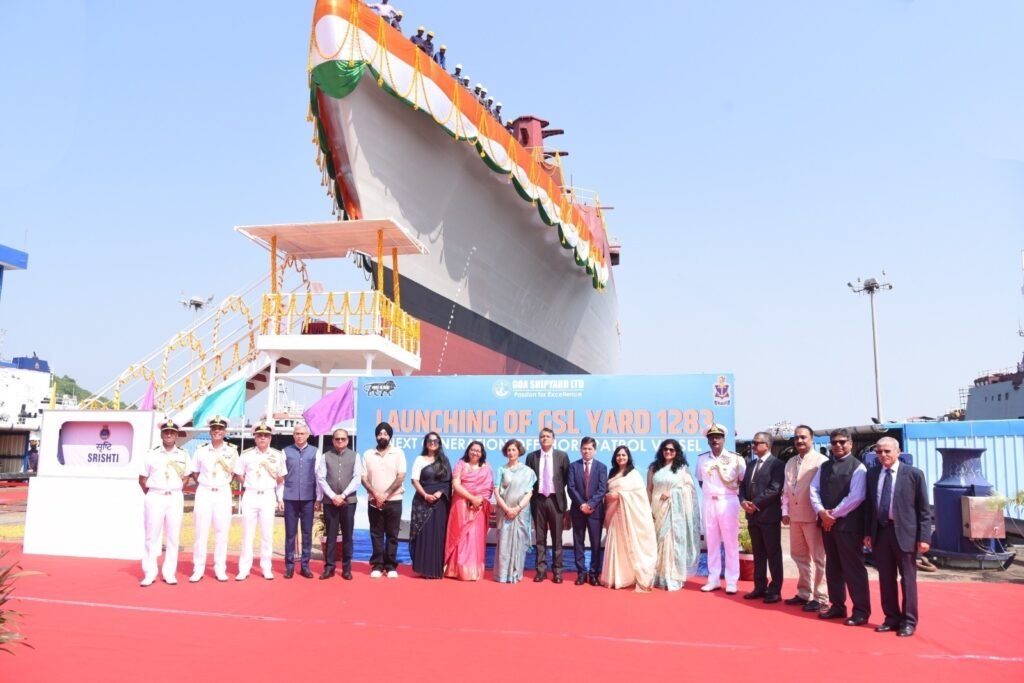
Recently, the Indian Navy launched its indigenous Next Generation Offshore Patrol Vessel, INS Srishti, at Goa Shipyard Limited, enhancing multi-domain maritime surveillance and Blue Water deterrence.
What is the INS Srishti?
- About: INS Srishti is an indigenously designedand built warship developed to augment the maritime security matrix of the Indian Navy.
- The vessel is named after the Sanskrit word meaning “creation” or “the act of creating”.
- Vessel Type: The ship is classified as a Next-Generation Offshore Patrol Vessel (NGOPV).
- Ship Class: It belongs to the Shachi-class patrol vessels.
- The entire class is structurally defined by an overall length of 113 meters, a beam width of 14.6 meters, and an operational draught spanning between 4 to 5 meters.
- Developed By: The warship has been developed and constructed by Goa Shipyard Limited (GSL), a prominent Defence Public Sector Undertaking operating directly under the Ministry of Defence.
- The ship construction was carried out under the unique shipyard designation Yard 1283.
- Project Details: The vessel is a part of the Indian Navy’s grand 11-ship NGOPV procurement project managed under the “Buy (Indian-IDDM)” classification.
- Launch Details: The keel of the vessel was laid on 9 June 2025. INS Srishti was officially launched into the water on 27 October 2026 at GSL’s Vaddem facility in Goa.
- The ceremonial launch was performed by Smt. Sandeepa Sahay in the presence of Chief Guest Shri Vishvajit Sahay, Secretary (Defence Finance).
- Features: The warship features an expansive structural profile with high displacement weight.
- The machinery configuration relies on a powerful arrangement of two diesel engines.
- This enables the patrol vessel to achieve maximum operational sprint speeds of up to 25 knots.
- The vessel is packed with cutting-edge radar suites to perform comprehensive oceanic monitoring.
- It actively tracks surface vessels and aircraft to provide continuous situational awareness.
- It is tailored with defensive armaments to safeguard critical infrastructure.
- This includes securing offshore oil rigs, deep-sea mining stations, and strategic maritime trade corridors.
- The interior layout features dedicated spaces configured for emergency response.
- The vessel incorporates specialized boarding facilities to tackle maritime crime.
- It deploys fast interception crafts and highly trained naval commandos to counter armed piracy and illegal smuggling attempts.
- The machinery configuration relies on a powerful arrangement of two diesel engines.
Significance of INS Srishti Launch
- INS Srishti stands as a hallmark for domestic defense production. It aligns directly with the Make in India initiative to minimize foreign equipment dependency.
- This project fosters a matured domestic industrial ecosystem by injecting capital into local supply chains and boosting GDP growth and high-skill job creation.
- INS Srishti plays a pivotal role in securing India’s 7,500 km coastline and its massive 2.3 million square kilometer Exclusive Economic Zone (EEZ).
- It protects vital Sea Lanes of Communication (SLOCs). The ship serves as a persistent monitor to counter non-traditional threats like piracy, smuggling, and maritime terrorism.
- The vessel acts as a flexible asset for Humanitarian Assistance and Disaster Relief (HADR) alongside Search and Rescue (SAR) missions.
- Such capabilities are relevant during maritime accidents, cyclones, evacuations and emergencies affecting coastal communities.
- By enforcing maritime laws, protecting offshore energy installations, and projecting soft power, it reinforces India’s role as a preferred security partner in the competitive Indian Ocean Region.
Next Generation Offshore Patrol Vessel (NGOPV) Acquisition Programme
- About: It is a major initiative by the Ministry of Defence to augment the Indian Navy’s ocean surveillance and combat capabilities.
- Formally contracted on March 30, 2023, the total acquisition value stands at ₹9,781 crore.
- This allocates a budgeted baseline unit production cost of approximately ₹889.18 crore per unit.
- Production: The contract outlines the simultaneous construction of 11 state-of-the-art warships split across two public sector shipyards. Goa Shipyard Limited (GSL) functions as the lead yard building 7 vessels, while Garden Reach Shipbuilders & Engineers (GRSE) serves as the follow yard building the remaining 4 vessels.
- The procurement falls under Buy (Indian-IDDM) category, prioritizing “Indigenously Designed, Developed and Manufactured” systems.
- Features:
- These vessels are classified as the Shachi-class. Each vessel has an overall length of 113 meters, a molded breadth of 14.6 meters, and a displacement of approximately 3,000 tonnes.
- Powered by dual diesel engines, they reach top speeds exceeding 23 knots with an impressive cruising range of 8,500 nautical miles.
- The fleet integrates advanced warfare systems, featuring a 76mm Oto Mellara main gun, two 30mm AK-630 CIWS, and VSHORADS.
- For multi-domain operations, they include a dedicated hangar for a 15-tonne helicopter alongside operational provisions for unmanned aerial vehicles (UAVs).
- 5 out of 11 vessels have been launched. Notable vessels include the premier INS Shachi (Yard 1280), followed by NGOPV Shruti (Yard 3037), NGOPV Sanghmitra, NGOPV Shreyas, and the recently launched INS Srishti (Yard 1283).
India’s 2026 Naval Expansion: Top Most Powerful New Warships
- INS Taragiri: The Indian Navy commissioned this massive 6,670-tonne stealth guided-missile frigate on April 3, 2026, at Visakhapatnam.
- Built by Mazagon Dock Shipbuilders Limited under Project 17A, the vessel possesses an advanced anti-submarine warfare suite, reduced radar cross-section, and supersonic BrahMos missiles.
- INS Dunagiri:;Prime Minister Narendra Modi led a historic tri-commissioning ceremony on June 21, 2026, at Kolkata to induct this elite Project 17A stealth frigate.
- Constructed by Garden Reach Shipbuilders & Engineers (GRSE), it strengthens surface warfare and air defense capabilities using BrahMos and Medium Range Surface-to-Air Missiles (MRSAM).
- INS Sanshodhak: Commissioned alongside Dunagiri in June 2026, this vessel stands as the fourth and final Survey Vessel Large (SVL) built by GRSE.
- It performs critical hydrographic and deep-water oceanographic surveys using autonomous underwater vehicles (AUVs) and side-scan sonars.
- INS Agray: Also joining the active fleet during the June 2026 tri-commissioning, this fourth Arnala-class corvette specializes in shallow-water anti-submarine operations.
- It uses specialized anti-submarine sonars, rocket launchers, and torpedoes to secure littoral waters against underwater threats.
- INS Samarthak: Commissioned on October 16, 2026, at Naval Base Karwar, this vessel represents the frontline of a new series of four Multi-Purpose Vessels (MPVs).
- Constructed by Larsen & Toubro (L&T), it serves as a flexible testing platform for unmanned autonomous maritime systems and tactical surveillance.
- INS Mangrol: Inducted into active service on October 12, 2026, at the Naval Dockyard in Mumbai, this platform is the third of eight Mahe-class anti-submarine shallow water crafts.
- Built by Cochin Shipyard, it replaces legacy corvettes to execute high-speed littoral patrols and hunter operations.
- INS Nipun: Commissioned on August 31, 2026, in Mumbai, this platform is the final Nistar-class diving support vessel constructed by Hindustan Shipyard.
- It functions as a core asset for deep-sea submarine rescue operations, salvage missions, and complex underwater military tasks.
- INS Anjadip: This lethal Arnala-class anti-submarine warfare craft officially joined the Indian Navy on February 27, 2026, during a ceremony in Chennai.
- Designed by the Warship Design Bureau, the vessel coordinates quick-strike operations against sub-surface threats in coastal zones.
- INS Surya: Entering the fleet as the lead ship of the massive Fleet Supply Ships (FSS) class, this 44,000-ton giant matches the displacement of an aircraft carrier.
- It provides continuous operational deployment capability by replenishing warships at sea with fuel, ammunition, water, and essential spares.
Frequently Asked Questions (FAQs):
1. What is Srishti, the Indian Navy’s Next Generation Offshore Patrol Vessel?
Srishti (Yard 1283) is an indigenously designed and built Next Generation Offshore Patrol Vessel (NGOPV) for the Indian Navy.
2. When and where was the Srishti patrol vessel launched?
Srishti was launched on 27 October 2026 at Goa Shipyard Limited, Goa.
3. Which shipyard is responsible for constructing Srishti?
Goa Shipyard Limited (GSL), a defence public sector undertaking under the Ministry of Defence, constructed Srishti.
4. What are the key features and capabilities of the Srishti patrol vessel?
Its intended missions include maritime surveillance, search and rescue, offshore asset protection, HADR and anti-piracy operations.
5. How will Srishti strengthen India’s maritime security and surveillance capabilities?
It will augment existing patrol vessels, supporting maritime monitoring, offshore infrastructure protection and responses to piracy and maritime emergencies.
Disclaimer: Information in this article is based on official announcements and public records. Details may evolve over time.