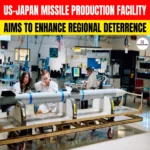



US-Japan Missile Production Facility, Aiming to Enhance Regional Deterrence
| General Studies Paper II: International Relations & Bilateral Alliances |
Why in News?
Recently, the United States and Japan agreed to establish a Japanese production facility for final assembly and inspection of AMRAAM missiles, reinforcing Indo-Pacific deterrence.
US–Japan Missile Production Facility Agreement
- About: The US–Japan Missile Production Facility Agreement is a bilateral defence-industrial arrangement to establish a facility in Japan for the final assembly and inspection (FACO) of AIM-120 Advanced Medium-Range Air-to-Air Missiles (AMRAAM).
- It aims to strengthen allied missile-production capacity and regional defence preparedness.
- Announcement: On 28 October 2026, Japanese Defence Minister Shinjiro Koizumi announced the agreement following discussions with US Defence Secretary Pete Hegseth on the sidelines of the ASEAN Defence Ministers’ Meeting in the Philippines.
- The initiative is associated with Operation Supercharge, aimed at expanding allied munitions production.
- The initiative emerged from discussions beginning in 2024, when Washington and Tokyo explored AMRAAM co-production.
- In April 2026, Mitsubishi Electric confirmed discussions of such an agreement.
- The initiative is associated with Operation Supercharge, aimed at expanding allied munitions production.
- Objective: The main objective is to scale up missile production, alleviate strained global military stockpiles, and reinforce Japan’s domestic defense industrial base.
- Details:
- The joint facility will be situated in Japan.
- Initial component manufacturing—such as electronic circuit boards—will be coordinated with Japanese firms like Mitsubishi Electric alongside U.S. contractor RTX (Raytheon).
- The agreement covers the local assembly of radar-guided AMRAAMs essential for fifth-generation F-35 Lightning II fighter jets, alongside technical data-sharing to boost production of Standard Missile-3 (SM-3) Block IIA ballistic missile interceptors.
What is AMRAAM Missile?
- About: The AIM-120 AMRAAM (Advanced Medium-Range Air-to-Air Missile) is an all-weather, beyond-visual-range (BVR) tactical weapon designed to intercept and destroy airborne threats.
- It operates during both day and night, succeeding the older semi-active radar-guided AIM-7 Sparrow missile.
- It provides complete air dominance and allows pilots to attack enemy aircraft from long distances before visual contact is made.
- Developed By: This lethal missile system was originally engineered by Hughes Aircraft Company.
- It is manufactured and continuously modernized by Raytheon Missiles & Defense (RTX).
- In February 2026, Raytheon entered a major US defence production arrangement valued at approximately $20.7 billion, targeting annual AMRAAM production of at least 1,900 missiles.
- It is manufactured and continuously modernized by Raytheon Missiles & Defense (RTX).
- Origin: The AMRAAM originated in the United States during the late 1970s as a joint U.S. Air Force and U.S. Navy program.
- It officially entered active military service in September 1991.
- Technology: The missile incorporates advanced active radar homing technology paired with an internal inertial reference unit and microcomputer.
- A two-way datalink enables mid-course navigation guidance updates directly from the host aircraft before its terminal seeker takes over.
- Variants:
- AIM-120A/B: Initial operational generations.
- AIM-120C: Improved design and compact control surfaces.
- AIM-120D: Advanced navigation, data-link and engagement capabilities.
- AMRAAM-ER: Extended-range variant developed for ground-based air defence.
- Features:
- Capabilities: It possesses a top speed exceeding Mach 4 and a dynamic operating range stretching up to 160 kilometers in its advanced AIM-120D variant.
- It is highly capable of executing multi-target simultaneous engagement, allowing a single jet to fire at several threats at once.
- Fire-and-Forget Autonomy: The integrated active radar seeker allows the pilot to disengage and perform evasive maneuvers immediately after launch while the missile guides itself to the final target intercept.
- Electronic Counter-Countermeasures: It features specialized software algorithms that enable home-on-jam capabilities, transitioning from active radar to tracking electronic warfare signals if the enemy tries to jam it.
- Compact Design Adaptability: Variants like the AIM-120C utilize clipped control wings specifically minimized to comfortably fit within the internal weapons bays of modern aircraft like the Eurofighter Typhoon, JAS 39 Gripen, F-22 Raptor and F-35 Lightning II.
- Defence Applications: The AMRAAM acts as a vital dual-role weapon system. It serves as the primary interceptor for the ground-based NASAMS (National Advanced Surface-to-Air Missile System) air defense network.
- Capabilities: It possesses a top speed exceeding Mach 4 and a dynamic operating range stretching up to 160 kilometers in its advanced AIM-120D variant.
- Role: The AMRAAM has secured over 13 air-to-air combat victories in prominent war zones, beginning with the Gulf War, followed by operations in Bosnia and Kosovo.
- In recent geopolitical conflicts like the Russo-Ukrainian War, surface-launched versions have played a major role in protecting critical civilian infrastructure from massive Russian drone and missile barrages.
US–Japan Defence Cooperation and Bilateral Security Agreements
- The US–Japan security partnership developed after the Second World War.
- The two countries signed their original security treaty in 1951, followed by the revised Treaty of Mutual Cooperation and Security in 1960.
- It establishes the foundation of their modern military alliance.
- It provides for mutual security cooperation, US military presence in Japan and joint responses to armed attacks against territories under Japanese administration, subject to constitutional provisions and each country’s legal processes.
- It grants the United States the authorization to station roughly 60,000 military personnel across strategic facilities in Japan. In exchange, the U.S. acts as a security guarantee, committing to defend Japan if it faces an armed attack on its territories.
- The two countries signed their original security treaty in 1951, followed by the revised Treaty of Mutual Cooperation and Security in 1960.
- US–Japan Status of Forces Agreement (SOFA), 1960: The SOFA establishes the legal and administrative framework governing US military personnel stationed in Japan.
- The United States transformed its regional command by upgrading U.S. Forces Japan (USFJ) to a Joint Force Headquarters with expanded operational power.
- This shift coordinates seamlessly with Japan’s newly formed Japan Joint Operations Command (JJOC) to unify cross-domain military activities.
- General Security of Military Information Agreement (GSOMIA), 2007: GSOMIA provides a framework for protecting and exchanging classified military information between the two countries.
- Guidelines for US–Japan Defence Cooperation (2015): Revised guidelines expanded alliance coordination, including cooperation in peacetime, grey-zone situations, regional contingencies and international security operations.
- Both countries cooperate in joint research, development, production, testing and evaluation of defence equipment.
- They also facilitate the exchange of components, maintenance services and military technologies.
- Defence Industrial Cooperation, Acquisition and Sustainment (DICAS): DICAS provides an institutional framework for strengthening defence-industrial collaboration, addressing supply-chain vulnerabilities and improving equipment maintenance.
- US–Japan Security Consultative Committee (2+2): The 2+2 mechanism brings together the US Secretaries of State and Defense and Japan’s Ministers of Foreign Affairs and Defense. It provides high-level policy coordination.
Significance of Japanese Production Facility
- The facility strengthens the US–Japan security partnership by expanding the availability of advanced air-to-air missiles.
- Improved ammunition preparedness enhances the ability of allied forces to respond to emerging regional security threats.
- China’s expanding military capabilities, naval modernisation and increasing activities in the East and South China Seas have intensified regional security concerns.
- It directly strengthens regional deterrence against China’s maritime assertiveness and naval maneuvers.
- Greater availability of AMRAAM missiles strengthens the operational readiness of advanced fighter aircraft, including the F-35.
- It improves allied air-defence capabilities and raises the potential costs of military aggression.
- The facility promotes geographical diversification of missile production. Distributed manufacturing reduces dependence on a single industrial location.
- It can improve supply-chain resilience during geopolitical crises, production disruptions and prolonged conflicts.
- The agreement provides opportunities for Japanese industries to participate in advanced missile manufacturing.
- It encourages technological collaboration, industrial investment, and skilled employment.
- This co-production model directly bypasses trans-Pacific logistics bottlenecks and lengthy industrial lead times, reducing Washington’s sole manufacturing burden.
- This manufacturing integration can reshape the security architecture of the Quadrilateral Security Dialogue (QUAD) by anchoring a highly resilient technology base in Asia.
- India maintains its traditional strategic autonomy and avoids formal military alliances, Tokyo’s latest defense policy explicitly labels India as an “extremely important country” for defense technology transfers.
- Driven by shared concerns over Chinese expansionism in the Indian Ocean, India and Japan have intensified their own bilateral maritime security cooperation.
- As Japan relaxes its pacifist export regulations, India gains a highly critical pathway to diversify its military hardware suppliers, fortify collective supply chain resilience across the Indo-Pacific maritime corridors.
Frequently Asked Questions (FAQs):
1. What is the new missile-production agreement between the United States and Japan?
The countries agreed to establish a Japanese facility for final assembly and inspection of AIM-120 AMRAAM missiles.
2. Where will the proposed joint missile-production facility be established?
The facility will be established in Japan, but its exact location has not yet been disclosed.
3. What is the main objective of the US-Japan missile-production initiative?
Its objective is to expand missile production, secure supplies, replenish stockpiles and strengthen allied defence preparedness.
4. How will the agreement strengthen defence cooperation between the US and Japan?
It will enhance defence-industrial collaboration, diversify manufacturing, strengthen supply chains and improve access to critical missiles.
5. Why is the joint missile-production facility significant for Indo-Pacific security?
It strengthens regional deterrence, improves military readiness and reinforces allied capabilities amid growing Indo-Pacific security challenges.
Disclaimer: Information in this article is based on official announcements and public records. Details may evolve over time.