


49th ASEAN Summit 2026: Highlights, India’s Outreach & Significance
| General Studies Paper II: International Relationship, Bilateral Groupings & Agreements |
Why in News?
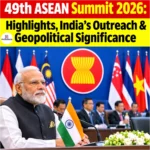
Philippines is hosting the 49th Association of Southeast Asian Nations (ASEAN) Summit in Manila from November 15 to 18, 2026.
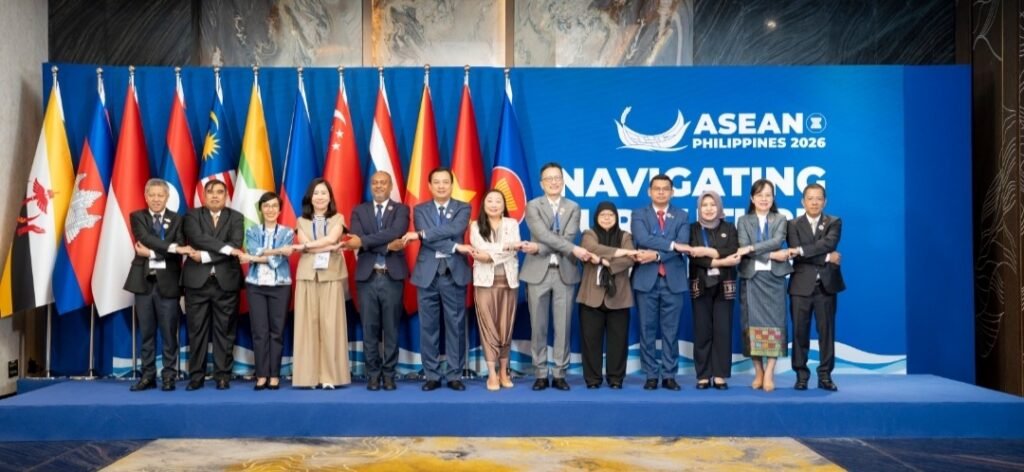
49th ASEAN Summit 2026 Highlights
- Venue: The 49th ASEAN Summit is being hosted by the Republic of the Philippines in Metro Manila, following preparatory ministerial sessions on November 14.
- Plenary sessions will take place primarily at the Philippine International Convention Center (PICC) in Pasay City, while leaders’ retreat sessions will convene at the Coconut Palace.
- Chairmanship: Summit is chaired by Philippine President Ferdinand Marcos Jr.
- The Philippines’ chairmanship coincides with the 50th anniversary of the Treaty of Amity and Cooperation (TAC) in Southeast Asia.
- Theme: It is guided by the theme “Navigating Our Future, Together,” the gathering prioritizes ASEAN Centrality, collective resilience, and unified diplomacy.
- Priorities and Agendas: Leaders are formalizing an 11-member institutional identity after Timor-Leste’s accession, marked by raising an updated ASEAN flag featuring 11 stalks of paddy.
- Core visions focus on advancing the Digital Economy Framework Agreement (DEFA), strengthening supply chain resilience, and accelerating green energy, food security, and artificial intelligence adoption for regional businesses.
- Security discussions center on accelerating negotiations for a binding Code of Conduct (CoC) in the South China Sea and establishing a dedicated ASEAN Maritime Centre to safeguard regional waters.
- Leaders are also reviewing the Five-Point Consensus on the ongoing Myanmar crisis, alongside joint action against transnational cyber-scam syndicates and transboundary haze.
- Engagements: The programme includes the ASEAN Leaders’ Plenary and Retreat, ASEAN+1 meetings with external partners, the ASEAN Plus Three Summit and the East Asia Summit.
- India’s Participation: Prime Minister Narendra Modi arrived in Manila on November 16 to attend the 23rd ASEAN–India Summit and the 21st East Asia Summit (EAS), marking his 13th summit participation.
- India is driving the 2026 ASEAN–India Year of Maritime Cooperation, reviewing the ASEAN–India Trade in Goods Agreement (AITIGA) to reduce trade deficits.
- ASEAN Prize 2026: Hla Hla Aung received the prestigious ASEAN Prize 2026 during the opening ceremony.
- Hla Hla Aung, a 79-year-old geologist, seismologist, educator, and honorary patron of the Myanmar Earthquake Committee.
- She is the ninth recipient of the award since its establishment in 2018.
- She was honored for her decades-long work bridging scientific earthquake research with grassroots disaster preparedness, community empowerment, and safety education across Myanmar and Southeast Asia.
- Handover: The Philippines is scheduled to hand over the rotating 2027 ASEAN Chairmanship to Singapore at the conclusion.
What is the ASEAN Summit?
- About: The ASEAN Summit is the supreme policy-making body of the Association of Southeast Asian Nations.
- Comprising the Heads of State or Government of its member countries, it meets biannually to deliberate on regional security, economic policy, and international diplomacy.
- Origin: ASEAN was established on August 8, 1967, via the Bangkok Declaration by five founding nations during Cold War tensions.
- The inaugural First ASEAN Summit convened in Bali, Indonesia, in February 1976, establishing formal regional treaties.
- Objectives: Its primary goal is accelerating economic growth, social progress, and cultural development while maintaining regional peace and stability.
- It upholds the United Nations Charter, mutual respect for sovereignty, and non-interference in domestic affairs.
- Member Countries: The bloc includes 11 member states: founding members Indonesia, Malaysia, Philippines, Singapore, and Thailand.
- Subsequent additions include Brunei (1984), Vietnam (1995), Laos (1997), Myanmar (1997), and Cambodia (1999).
- Timor-Leste joined as the eleventh member in October 2025.
- Structure: Supporting the supreme Summit are the ASEAN Coordinating Council (ACC) and the three Community Councils.
- Administrative coordination is managed by the ASEAN Secretariat in Jakarta, led by an appointed Secretary-General.
- Integration rests on three institutional pillars formalized by the 2007 ASEAN Charter.
- These are the ASEAN Political-Security Community (APSC), the ASEAN Economic Community (AEC) for a single market, and the ASEAN Socio-Cultural Community (ASCC).
- Decision-making relies on the “ASEAN Way”, emphasizing consultation, consensus, and non-interference.
- The Chairmanship rotates annually alphabetically among member states.
- Initiatives: Its key milestones include the 1976 Treaty of Amity and Cooperation (TAC), the Southeast Asian Nuclear-Weapon-Free Zone, and the Regional Comprehensive Economic Partnership (RCEP).
- It also anchors broader diplomacy via the East Asia Summit (EAS) and ASEAN Regional Forum (ARF).
- Advancing the ASEAN Digital Economy Framework, and transitioning to green energy.
- Challenges: ASEAN faces internal divisions over South China Sea territorial disputes and the ongoing political crisis in Myanmar.
- Economic disparities among members and US-China geopolitical rivalry test its consensus-driven centrality.
India–ASEAN Relations & Significance
- India–ASEAN relations are rooted in deep civilizational, cultural, and maritime trade links spanning over two millennia.
- Buddhism, Hindu traditions, trade networks, language and artistic exchanges created enduring historical links.
- Modern diplomatic engagement gained momentum after India launched its Look East Policy in 1991 alongside domestic economic liberalization.
- India’s institutional participation expanded steadily across three decades through major diplomatic milestones.
- India became a Sectoral Dialogue Partner in 1992, and upgraded to a Full Dialogue Partner in 1995.
- India joined the ASEAN Regional Forum (ARF) in 1996, and achieved Summit-level partnership in 2002.
- Ties elevated to a Strategic Partnership in 2012 and reached a Comprehensive Strategic Partnership (CSP) in 2022 during the 30th anniversary celebrations.
- India hosted ASEAN leaders as chief guests at its Republic Day celebrations in January 2018. The commemorative summit strengthened maritime cooperation under the theme Shared Values, Common Destiny.
- India–ASEAN cooperation spans trade, physical and digital connectivity, defense, and socio-cultural exchanges across more than thirty dialogue mechanisms.
- The ASEAN–India Trade in Goods Agreement (AITIGA) was signed in 2009 and entered into force in 2010.
- Bilateral trade reached USD 128.37 billion in FY 2025–26 under the ASEAN–India Free Trade Area (AIFTA), supported by ongoing reviews of the AITIGA goods pact.
- It positions ASEAN as one of India’s largest regional trading partners.
- Projects like the India–Myanmar–Thailand Trilateral Highway, Kaladan Multimodal Transit Transport Project, and Digital Public Infrastructure (UPI) integration strengthen regional bonds.
- ADMM-Plus defense forums, joint naval drills like ASEAN Maritime Forum (AIME), and educational scholarships strengthen regional bonds.
- India’s BrahMos supersonic cruise missile sales have expanded across ASEAN countries.
- Philippines became India’s first foreign customer in January 2022 through a $374.96 million deal for three shore-based anti-ship missile batteries.
- Vietnam finalized an agreement with India for BrahMos missile systems. Indonesia entered the export program.
- Upgrading the Look East Policy into the Act East Policy in 2014 shifted India’s approach from passive economic engagement to proactive strategic, security, and connectivity integration.
- This policy prioritizes developing Northeast India as a vital land bridge to Southeast Asia while balancing regional power dynamics and building resilient supply chains.
- India and ASEAN cooperate in space technology, information technology, digital transformation, cybersecurity, innovation and renewable energy.
- ASEAN Centrality forms the core pillar of India’s vision for a free, open, and rules-based Indo-Pacific.
- Close alignment between India’s Indo-Pacific Oceans Initiative (IPOI) and the ASEAN Outlook on the Indo-Pacific (AOIP) promotes maritime security, UNCLOS compliance in the South China Sea.
Frequently Asked Questions (FAQs):
1. What is the ASEAN Summit?
The ASEAN Summit is the organisation’s highest decision-making body, comprising heads of state or government of member countries.
2. Where is the 49th ASEAN Summit 2026 being held?
It is being held at the Philippine International Convention Center (PICC), Pasay City, Metro Manila.
3. Which country is hosting the ASEAN Summit in 2026?
The Philippines, under President Ferdinand R. Marcos Jr., is hosting the 49th ASEAN Summit.
4. What is the theme of the Philippines’ ASEAN Chairmanship 2026?
The theme is “Navigating Our Future, Together”, emphasising regional unity, resilience, integration and shared prosperity.
5. What are the major issues discussed at the 49th ASEAN Summit?
Key issues include Myanmar’s crisis, South China Sea disputes, food and energy security, transnational crime, online scams, migrant welfare and regional economic cooperation.
Disclaimer: Information in this article is based on official announcements and public records. Details may evolve over time.
| Also Read: New Delhi BRICS Declaration 2026 |