




SpaceX Starship Upper Stage Catch: Highlights & Global Implications
| General Studies Paper III: Space Technology, Science and Technology |
Why in News?
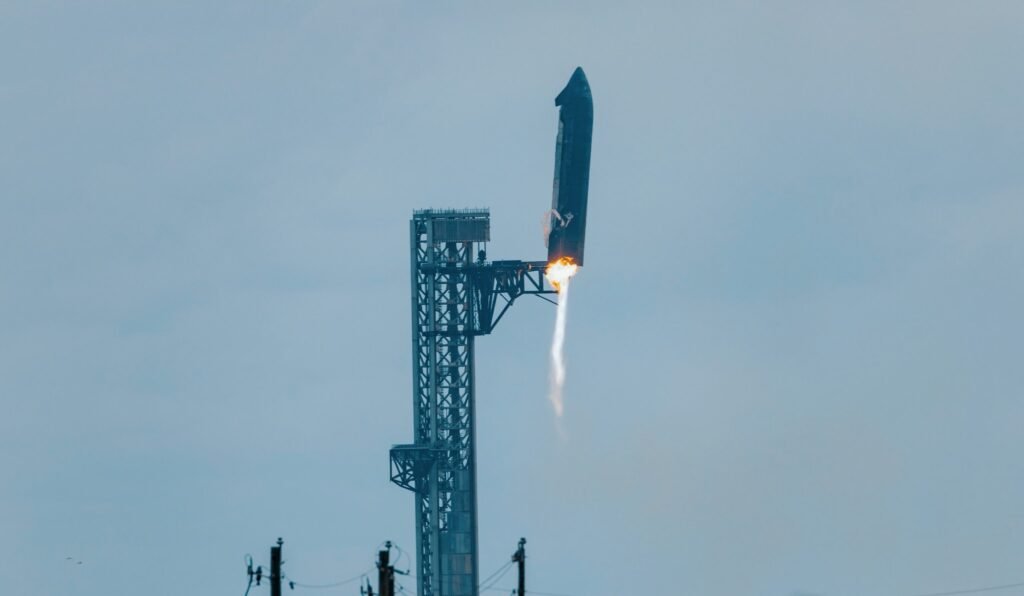
Recently, SpaceX caught Starship Flight 15 rocket’s orbital upper stage using mechanical arms at its launch tower in Texas, proving full rocket reusability.
Starship Upper Stage Catch Mission Highlights
- Achievement; Starship Integrated Flight Test 15 (IFT-15) marks the historic first midair capture of an orbital upper-stage spacecraft, known as Ship 42, using launch tower Mechazilla mechanical arms.
- It was the first attempt to catch both the Starship booster and upper stage during a single mission.
- Location: Starship was launched on November 13, 2026, from SpaceX Starbase in Boca Chica, Texas.
- Details: The 124-meter (407-foot) megarocket aimed to recover both stages simultaneously.
- Following liftoff at 4:47 p.m. CST on November 13, the stacked vehicle passed Max Q before stage separation.
- The attempt to catch the booster during the initial phase failed. Its Booster 22 diverted to the Gulf of Mexico due to a low-fuel alarm.
- It completed 14 Earth orbits at a 265-kilometer altitude and deployed 26 Starlink V3 satellites.
- It performed a deorbit burn, plunging through the atmosphere at 17,000 mph using its belly-flop aerodynamic glide.
- On November 14, 2026, after 22.5 hours in space, the upper stage returned to Launch Pad 2, proving full upper-stage reusability.
- Mechazilla Technology: Mechazilla is SpaceX’s massive steel launch and catch tower equipped with two giant articulated mechanical arms nicknamed chopsticks.
- It is engineered to eliminate heavy, payload-reducing landing legs.
- The system uses precision hydraulic winches and heavy-duty structural hardpoints located beneath Starship’s forward aerodynamic flaps.
- During capture, the arms absorb immense kinetic energy as the spacecraft hovers.
- It helps to cradling the vehicle smoothly before lowering it onto the launch mount for rapid refurbishment and restacking.
- Technical Upgrades: Recovering an orbital spacecraft presents far greater challenges. Ship 42 re-enters from higher altitudes and extreme hypersonic velocities.
- Engineers upgraded Starship’s thermal protection system with durable heat shield tiles to prevent burn-through during peak plasma heating.
- Autonomous guidance and navigation algorithms continuously adjusted aerodynamic flaps and engine gimbaling against shifting atmospheric winds to achieve millimeter-level alignment with the tower.
Reusable Rocket Launching System
- A reusable rocket relies on multi-stage architecture to escape Earth’s gravity.
- The first stage acts as the heavy lifter that propels the vehicle through the thick lower atmosphere, while the second stage continues into orbit.
- Separating these stages allows the massive lower booster to return to Earth while the smaller upper stage finishes the mission.
- During liftoff, rocket engines burn liquid propellants like liquid oxygen and refined kerosene or methane to generate massive thrust.
- The flight computer reserves a specific portion of propellant rather than burning all of it during ascent.
- This fuel reserve is critical for powering the booster’s controlled descent and landing back on Earth.
- The flight computer reserves a specific portion of propellant rather than burning all of it during ascent.
- Once the booster reaches a predetermined altitude and speed, it performs Main Engine Cutoff (MECO). Pneumatic pushers or mechanical latches then safely separate the first stage from the second stage.
- While the upper stage ignites its engine to reach orbit, the spent booster begins its journey back home.
- After separation, the booster uses cold gas thrusters to flip itself around so its engines face the direction of travel.
- It then performs a boostback burn to cancel its forward momentum and steer toward the landing zone or ocean drone ship.
- These thrusters also keep the rocket stable in the near-vacuum of space where air fins do not work.
- As the booster falls back into Earth’s atmosphere, extreme air friction generates intense heat and aerodynamic stress.
- Engineers equip the rocket base with a Thermal Protection System (TPS), heat-resistant alloys, and engine cooling techniques to prevent melting.
- An entry burn is also fired to slow the rocket down and create a protective shield of exhaust gas against the rushing air.
- Once inside the thicker lower atmosphere, the rocket deploys titanium grid fins near the top of the booster.
- These waffle-like control surfaces tilt and rotate to catch the wind, steering the falling rocket with pinpoint accuracy.
- Working alongside flight computers and GPS guidance, the grid fins guide the vehicle directly toward its target pad.
- Seconds before touching the ground, the booster ignites its center engine for a final landing burn to decelerate from supersonic speeds to zero.
- Right before touchdown, deployable landing legs unfold from the base of the rocket to absorb the impact.
- Using a hoverslam maneuver, the engine shuts off at the exact millisecond the legs touch the surface.
- Modern reusable systems also recover the payload fairing, which is the nose cone that protects satellites during ascent.
- After separating in space, the two fairing halves use cold gas thrusters and steerable parafoils to glide gently down to Earth.
- After landing, ground crews transport the booster back to the hangar for post-flight inspection and refurbishment.
- Rockets like SpaceX’s Falcon 9 demonstrate partial reusability by recovering first-stage boosters over 30 times and retrieving ocean-splashed fairings, while its upper stage burns up after deployment.
Significance of Historic Orbital Upper Stage Catch
- Full reusability can transform rockets from single-use expendable hardware into commercial aviation-style assets.
- Recovering both the booster and upper stage preserves expensive Raptor engines, thermal protection tiles, and airframes, potentially slashing per-launch costs by up to 70 percent.
- Eliminating heavy landing legs increases payload capacity to Low Earth Orbit (LEO), while rapid pad-to-pad turnaround times enable unprecedented launch cadence.
- Lower launch costs democratize access for commercial satellite mega-constellations, space-based manufacturing, and orbital data centers.
- It unlocks sustained deep space exploration and cis-lunar dominance. High-frequency, low-cost heavy lift is vital for orbital propellant transfer.
- This architecture lays the logistical foundation for human Mars colonization.
- Rapid-response orbital recovery enhances space domain awareness, resilient satellite replenishment, and strategic dual-use capabilities.
- Full reusability is essential for NASA’s Artemis program, where a Starship lunar lander will transport astronauts to the Moon.
- It enable orbital propellant transfer, which is required to send heavy cargo and human crews toward Mars.
- In the intensifying global space race, SpaceX’s breakthrough creates intense competitive pressure on ISRO and NewSpace India Limited (NSIL) in the commercial launch market.
- It offer Indian startups cheaper access to orbit for deploying indigenous constellations and supporting the Bharatiya Antariksh Station by 2035.
- To stay competitive, India is planning accelerating its Next Generation Launch Vehicle (NGLV / Project Soorya) featuring a 30-tonne LEO capacity and a reusable first stage, alongside the winged RLV-TD (Pushpak) advancing toward Orbital Re-entry Experiments (OREX).
- Capturing a returning orbital craft requires millimeter-precise autonomous guidance.
- Environmentally, full recovery drastically reduces orbital space debris and eliminates discarded rocket stages from polluting ocean ecosystems.
- However, ultra-high launch frequencies raise regulatory concerns regarding upper-atmospheric emissions, airspace congestion, and sonic booms over coastal communities, requiring balanced international space governance.
Frequently Asked Questions (FAQs):
1. What is SpaceX’s Starship rocket?
Starship is SpaceX’s fully reusable, two-stage launch vehicle, comprising the Super Heavy booster and Starship upper spacecraft.
2. How did SpaceX catch the Starship upper stage?
The launch tower’s mechanical arms captured the returning Starship upper stage during its controlled landing manoeuvre.
3. What are the Mechazilla chopstick arms?
Mechazilla’s chopstick arms are giant mechanical structures designed to catch and support returning rocket stages.
4. Why is the successful Starship catch considered historic?
It demonstrated the feasibility of capturing an orbital spacecraft returning from space using launch-tower mechanical arms.
5. Did SpaceX successfully recover both stages of the Starship rocket?
No. The upper stage was caught successfully, but the Super Heavy booster recovery was unsuccessful.
Disclaimer: Information in this article is based on official announcements and public records. Details may evolve over time.
| Also Read: Japan Reusable Rocket Completes Test Flight |