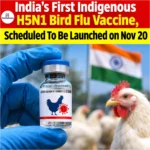



India’s First Indigenous H5N1 Bird Flu Vaccine, Scheduled To Be Launched on Nov 20
| General Studies Paper III: Public Health & Science |
Why in News?
India’s first indigenous developed H5N1 Bird Flu vaccine is scheduled to be launched on November 20.
Highlights of India’s First Indigenous H5N1 Vaccine
- Vaccine Development: India has developed its first indigenous inactivated H5N1 vaccine for chickens, targeting Highly Pathogenic Avian Influenza (HPAI).
- Developing Institution: The vaccine was developed by the ICAR–National Institute of High Security Animal Diseases (ICAR-NIHSAD), located in Bhopal, Madhya Pradesh.
- It is an important achievement in India’s indigenous veterinary biotechnology research.
- Vaccine Technology: It uses an inactivated-virus approach, meaning the vaccine contains virus material rendered non-infectious.
- Such vaccines aim to stimulate protective immunity without causing the disease through replication of the vaccine virus.
- Targeted Viral Strain: Its principal target is H5N1 Clade 2.3.2.1a, identified as responsible for most chicken bird-flu outbreaks in India.
- The strain has also been detected in other animal species, including mammals.
- Viral clades represent genetically related groups within a virus subtype.
- ICAR-NIHSAD analysed Indian H5Nx viruses using HA gene sequences. Researchers examined 73 sequences covering H5N1 and H5N8 viruses from different clades.
- Effectiveness: A single dose offers up to six months of protection, suiting long-cycle layer and breeder chickens.
- Since there is no vaccine for this strain yet, this scientific milestone is a huge step forward.
- Launch: Union Agriculture and Farmers Welfare Minister Shivraj Singh Chouhan is scheduled to dedicate the vaccine to the nation on 20 November 2026 at ICAR-NIHSAD, Bhopal.
What is H5N1 Avian Influenza?
- About: H5N1 Avian Influenza (Bird Flu) is a Highly Pathogenic Avian Influenza (HPAI) subtype of the Influenza A virus, characterized by its segmented single-stranded RNA genome.
- The virus is named after two surface glycoproteins: Hemagglutinin (H5), which facilitates host cell entry, and Neuraminidase (N1), which enables viral release.
- First isolated from a domestic goose in Guangdong, China (1996), it undergoes rapid antigenic drift and antigenic shift, generating virulent lineages like Clade 2.3.4.4b globally and Clade 2.3.2.1a in South Asia.
- Human infections were first reported during a poultry outbreak in Hong Kong in 1997. Since 2003, the virus has spread internationally.
- Transmission: Migratory waterfowl, particularly wild ducks, act as natural asymptomatic reservoirs that transmit the virus to domestic poultry.
- Human infection occurs primarily through direct contact with infected birds, bodily secretions, or contaminated environments.
- While human-to-human transmission remains exceedingly rare and non-sustained, recent zoonotic spillovers into mammals—including marine lions, minks, and dairy cattle.
- Diagnosis and Therapeutics: In humans, H5N1 presents an incubation period of 2 to 8 days, progressing from mild conjunctivitis and upper respiratory symptoms to severe viral pneumonia, Acute Respiratory Distress Syndrome (ARDS), and multi-organ failure.
- It carries a severe case fatality rate exceeding 50%. Diagnosis relies on RT-PCR assays.
- Due to widespread resistance against M2 inhibitors like amantadine, neuraminidase inhibitors such as oseltamivir (Tamiflu) and zanamivir serve as frontline antiviral treatments.
- Impact: Critically endangered California condors lost roughly 7% of their wild population during H5N1 outbreak waves.
- Other affected birds include Dalmatian pelicans, griffon vultures, great skuas, barnacle geese, and albatrosses.
- The virus has spilled over into sea lions, seals, dolphins, foxes, pumas, skunks, and livestock such as dairy cattle.
- Outbreaks inflict devastating losses on India’s poultry economy, food security, and biodiversity.
- India experienced its first H5N1 avian influenza outbreak in 2006 in Navapur, Nandurbar district, Maharashtra, among poultry.
Significance of Indigenous H5N1 Bird Flu Vaccine
- Poultry Industry: H5N1 outbreaks can cause nearly 100% mortality in chickens, with over 500 combined H5N1 and H5N8 outbreaks recorded since 2006.
- This indigenous vaccine shields commercial and backyard flocks against locally circulating strains, reduces reliance on mass culling and movement restrictions, and builds domestic self-reliance alongside biosecurity and surveillance.
- Public Health: Globally, the WHO has recorded 1,003 human H5N1 cases and 479 deaths across 25 countries since 2003.
- Cutting viral circulation in poultry strengthens One Health security by lowering spillover risks to mammals and humans.
- The development strengthens Atmanirbhar Bharat, veterinary research capabilities, and domestic disease preparedness.
- Economic Implications: A major outbreak could cut India’s GDP growth by up to 1.5% and endanger over 20% of the poultry population.
- Past outbreaks cost ₹2,200–3,000 crore in 2006 and 0.5% of Manipur’s GDP.
- Domestic vaccination helps protect farmer incomes, stabilize poultry prices, and limit trade disruptions.
India’s Biosecurity Strategy and One Health Preparedness
- National Disease-Control Framework: India follows a coordinated approach to preventing and controlling avian influenza through the Department of Animal Husbandry and Dairying (DAHD), state animal-husbandry departments and veterinary institutions.
- National One Health Mission (NOHM). It is anchored by the Office of the Principal Scientific Adviser (PSA) and operated by the Indian Council of Medical Research (ICMR).
- NOHM integrates 13 ministries and departments (including Health, Animal Husbandry, Environment, Defence, and Biotechnology).
- Its core hub is the National Institute for One Health (NIO) in Nagpur.
- Infectious Disease Research and Diagnostic Laboratories (IRDL). Under NOHM, ICMR is establishing a nationwide network of advanced laboratories equipped with BSL-3/BSL-4 containment, Next-Generation Sequencing (NGS), and metagenomic surveillance tools.
- National One Health Programme for Prevention and Control of Zoonoses (NOHP-PCZ). Managed by the National Centre for Disease Control (NCDC), this scheme institutionalizes surveillance down to the grassroots through State and District Zoonoses Committees (SLZC/DLZC).
- Integrated Disease Surveillance Programme (IDSP) & IHIP. Operated by NCDC, IDSP uses the Integrated Health Information Platform (IHIP) to provide real-time, geo-tagged, case-based surveillance across India for early outbreak detection.
- Action Plan for Avian Influenza: The government has a revised Action Plan for Prevention, Control and Containment of Avian Influenza (2021).
- It provides operational guidance for surveillance, outbreak investigation, containment and disease management.
Frequently Asked Questions (FAQs)
1. Which institution developed India’s first indigenous H5N1 vaccine?
ICAR–NIHSAD, Bhopal, developed India’s first indigenous inactivated H5N1 vaccine for chickens.
2. Which H5N1 viral strain does the vaccine target?
It targets H5N1 Clade 2.3.2.1a, associated with major poultry outbreaks in India.
3. What technology is used in India’s indigenous H5N1 vaccine?
It uses inactivated-virus technology, stimulating protective immunity without using a replicating infectious vaccine virus.
4. What is the significance of ICAR-NIHSAD in vaccine development?
ICAR-NIHSAD strengthens indigenous veterinary biotechnology through high-security animal disease research, diagnostics, pathogen characterisation and vaccine development.
5. When is India’s first indigenous H5N1 vaccine scheduled for launch?
It is scheduled for dedication to the nation on 20 November 2026, at ICAR-NIHSAD, Bhopal.
Disclaimer: Information in this article is based on official announcements and public records. Details may evolve over time.
| Also Read: First Human Case of Shamonda Virus in France |