


NASA’s Voyager 1 Reaches One Light-Day from Earth: Key Facts and Significance
| General Studies Paper III: Space Achievements, Space Technology |
Why in News?
Recently, NASA’s Voyager 1 became the first human-made object to reach one light-day from Earth, covering 25.9 billion kilometres after nearly 50 years.
What is NASA’s Voyager 1?
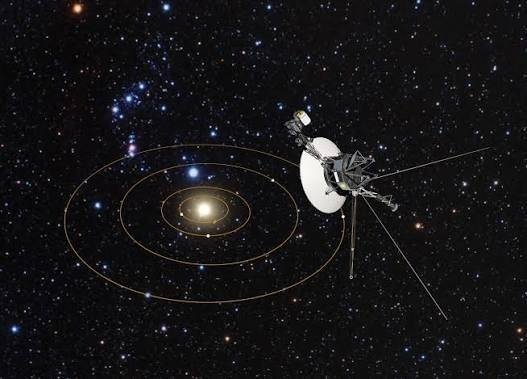
- About: Voyager 1 is an uncrewed space probe managed by NASA and the Jet Propulsion Laboratory. It was designed to explore the outer planets before continuing into deep space beyond our solar system.
- It is the first spacecraft to enter interstellar space.
- Background: Built during the 1970s, the probe took advantage of a rare planetary alignment occurring once every 175 years to use gravity assists.
- Objective: Its primary objective was to conduct close flybys of Jupiter and Saturn, studying their atmospheres, moons, and magnetic fields.
- Launch: Voyager 1 launched on September 5, 1977, from Cape Canaveral, Florida, aboard a Titan IIIE-Centaur rocket.
- Originally built for a four-year mission, it has operated for over 49 years.
- Its mission expanded into the Voyager Interstellar Mission to study the region beyond the Sun’s magnetic bubble.
- Components: Weighing 721.9 kilograms, the spacecraft features a ten-sided aluminum bus housing flight computers, a 3.7-meter high-gain dish antenna, and a boom holding scientific sensors.
- Its electronics use radiation-hardened parts to survive intense planetary magnetic belts.
- It also carries the Golden Record, a gold-plated copper disc containing sounds and images of Earth.
- Golden Record: It contains 115 images, natural sounds, music and greetings in 55 languages, representing Earth’s cultural and scientific heritage.
- Energy Source: Because sunlight is too weak in deep space for solar panels, Voyager 1 uses three Multi-Hundred Watt Radioisotope Thermoelectric Generators (MHW-RTGs).
- These generators convert heat from decaying plutonium-238 into electricity, losing about four watts of power every year.
- Scientific Discoveries: Voyager 1 discovered active volcanoes on Io, a faint ring around Jupiter, and complex atmospheres on Saturn’s moon Titan, later capturing the iconic “Pale Blue Dot” portrait of Earth.
- It transmits daily interstellar magnetic field and plasma data to Earth via NASA’s Deep Space Network, taking 24 hours each way.
- Twin Spacecraft: Its twin, Voyager 2, launched 16 days earlier on a slower path to visit Uranus and Neptune, entering interstellar space in 2018.
- It remains the only spacecraft to have visited Uranus and Neptune.
- Future Mission: Voyager 1’s remaining science instruments will operate until its plutonium power.
- It is supposed to run out around the late 2020s or early 2030s, after which it will drift silently toward the star Gliese 445.
What is One Light-Day?
- About: A light-day is the distance travelled by light in a vacuum over 24 hours. It is a unit of astronomical distance, not a measurement of time.
- It helps scientists describe extremely large distances in space.
- Distance: One light-day equals approximately 25.9 billion kilometres or 16.1 billion miles.
- It is roughly 173 times the distance between Earth and the Sun, and over four times farther than Pluto’s average orbit.
- Light travels at approximately 299,792 kilometres per second in a vacuum.
- It is roughly 173 times the distance between Earth and the Sun, and over four times farther than Pluto’s average orbit.
- Communication Delay: At this distance, a radio signal requires approximately 24 hours for a one-way journey.
- Therefore, sending a command and receiving a response requires roughly 48 hours, excluding processing delays.
- Voyager 1’s Achievement:
- Voyager 1 reached the one-light-day milestone on 18 November 2026, at approximately 10:16 UTC, according to NASA’s trajectory calculations.
- This makes it the first human-made object to reach this distance from Earth.
- Voyager 1 travels at approximately 61,000 kilometres per hour, or around 17 kilometres per second, relative to the Sun. Its speed is much slower than light.
- The aging probe achieved this milestone after 49 years and two months.
- Its twin, Voyager 2, will reach this mark in 2035.
- Voyager 1 reached the one-light-day milestone on 18 November 2026, at approximately 10:16 UTC, according to NASA’s trajectory calculations.
| Note: A light-year measures the distance light travels in one year. One light-year is approximately 365.25 light-days. |
Interstellar Space: Journey Beyond the Solar System
- About: Interstellar space is the vast region of our galaxy located outside the Sun’s protective magnetic bubble.
- Our star blows a constant stream of charged particles called the solar wind.
- This wind carves out a giant cavity known as the heliosphere. The exact edge where this solar wind weakens and stops against outer galactic pressure is the heliopause.
- Located roughly 122 Astronomical Units (about 11 billion miles) from the Sun, crossing this threshold marks entry into the cosmic ocean between stars.
- Interstellar Medium: The space between stars is not completely empty.
- It contains a sparse mixture of matter and energy called the interstellar medium.
- This environment consists of roughly 99% gas—mostly hydrogen and helium—and 1% microscopic cosmic dust forged by ancient exploding stars.
- Strong magnetic fields and high-energy galactic cosmic rays constantly sweep through this cold, low-density vacuum.
- Gravitational Edge: Entering interstellar space does not mean leaving the solar system entirely. The Sun’s gravity still dominates the Oort Cloud, a massive shell of icy comets orbiting far beyond the heliopause.
- Traveling at roughly 38,000 miles per hour, Voyager 1 will need another 300 years just to reach the inner edge of this icy cloud, and tens of thousands of years to pass another star.
- Future concepts like laser sails and nuclear fusion aim to bridge these immense light-year gaps much faster.
Significance of Voyager 1 Milestone
- Voyager 1’s extraordinary achievement demonstrates humanity’s ability to design spacecraft capable of operating across enormous distances for decades.
- The mission demonstrates progress in robotic engineering, autonomous navigation, spacecraft electronics, radio communication and nuclear power generation.
- Voyager’s measurements help scientists understand the heliosphere, interstellar plasma, cosmic rays and magnetic fields. Its long operational life provides important lessons for future deep-space missions.
Frequently Asked Questions (FAQs):
1. What is the primary objective of NASA’s Voyager 1 mission?
To explore outer planets, study the heliosphere and investigate the interstellar medium beyond the Solar System.
2. What is the significance of Voyager 1 reaching One Light-Day from Earth?
It marks an unprecedented distance milestone, demonstrating nearly five decades of sustained human-made space exploration.
3. What does One Light-Day mean?
One light-day represents the distance light travels in 24 hours, approximately 25.9 billion kilometres.
4. When did Voyager 1 enter Interstellar Space?
Voyager 1 crossed the heliopause on 25 August 2012, becoming the first spacecraft to enter interstellar space.
5. What is the Energy Source of Voyager 1?
It uses Radioisotope Thermoelectric Generators (RTGs), which convert heat from plutonium-238 decay into electrical energy.
6. What is the Golden Record carried by Voyager 1?
The Golden Record is a gold-plated copper disc containing Earth’s sounds, images, music and greetings for potential extraterrestrial discoverers.
Disclaimer: Information in this article is based on official announcements and public records. Details may evolve over time.