


India-Japan 2+2 Dialogue Opening Indian Firing Ranges for Japanese Missile Tests
| General Studies Paper III: International Relations, Security & Defence |
Why in News?
India and Japan signed a Letter of Intent during the fourth 2+2 Dialogue (November 2026), enabling the Japanese Japan Self-Defence Forces (JSDF) first live-fire missile training at Indian ranges, strengthening India-Japan defence cooperation.
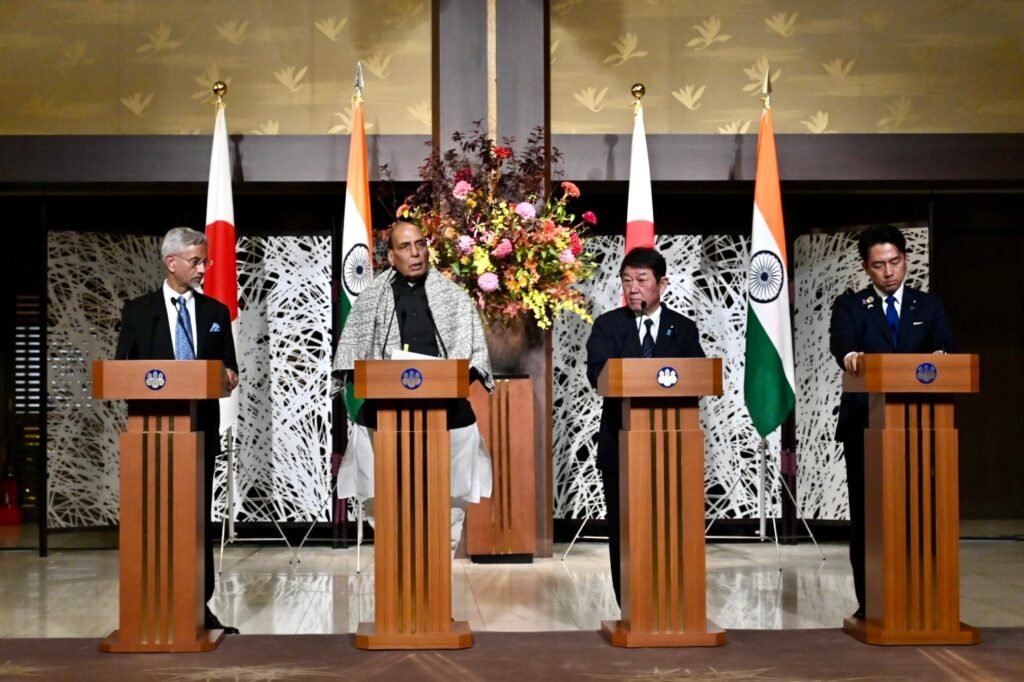
November 2026 India–Japan 2+2 Dialogue Highlights
- Venue: The Fourth India–Japan 2+2 Foreign and Defence Ministerial Dialogue was held on 19 November 2026 in Tokyo, Japan.
- The meeting lasted approximately 90 minutes and reviewed the expanding strategic partnership.
- Participation: The Indian delegation comprised Defence Minister Rajnath Singh and External Affairs Minister Dr S. Jaishankar.
- Japan was represented by Foreign Minister Toshimitsu Motegi and Defence Minister Shinjiro Koizumi.
- Background: A 2+2 Dialogue is a strategic diplomatic mechanism involving the Foreign and DefenceMinisters of two countries.
- It integrates foreign policy, national security and defence cooperation into a single consultation platform.
- India and Japan announced this ministerial mechanism in October 2018, and held their first meeting in November 2019 in New Delhi.
- Outcomes:
- Military Cooperation: Signed a Letter of Intent (LOI) on Japanese use of Indian firing ranges.
- UNICORN Antenna & Firing Ranges: Progress was made on transferring the Unified Complex Radio Antenna (UNICORN) system and arranging for Japan Self-Defense Forces (JSDF) to utilize firing ranges in India.
- Exercises and Industry: The talks emphasized continued joint drills like Veer Guardian 26 and built upon outcomes from the October 2026 Defence Industries Forum.
- Operational Coordination: Building on the August 2026 Maritime Security Cooperation pact, both navies will strengthen information sharing, Search and Rescue (SAR), and Humanitarian Assistance and Disaster Relief (HADR).
- Shipbuilding and Summits: Plans include exploring joint naval shipbuilding, enhancing mine countermeasures, and preparing for the 5th Coast Guard Global Summit (CGGS) in India in February 2027.
- Global Security & UN Reforms: Discussions spanned emerging domains (space, cyber, AI), regional consultations, and mutual support for UN Security Council reforms and respective non-permanent seat bids for 2028–29 and 2033–34.
- Year of Shared Horizons: The upcoming 75th anniversary of diplomatic relations in 2027 will be designated as the Japan-India Year of Shared Horizons.
- Future Dialogue: The fifth 2+2 meeting is scheduled to be hosted in India.
Opening Indian Firing Ranges for Japanese Missile Testing
- India and Japan signed a Letter of Intent (LOI) allowing Japan Self-Defence Forces (JSDF) to conduct live-fire training at Indian firing ranges for the first time. Live-fire drills are slated to begin in 2027.
- Japan will gain access to suitable Indian military training facilities, reducing its dependence on limited domestic training space.
- India will provide an opportunity for Japanese forces to practise weapon deployment under realistic training conditions.
- The proposed training includes surface-to-ship missiles, marking a significant expansion beyond conventional military exercises.
- Training may include long-range surface-to-ship missiles—such as the Type 25 (around 1,000 km range) and Type 12 systems—as well as potential coordination around small attack drones.
- Indian coastal facilities along the Bay of Bengal—such as the Integrated Test Range at Chandipur or Dr. APJ Abdul Kalam Island in Odisha—have been cited in reports as key possibilities following earlier Japanese site inspections in October 2026.
India–Japan Defence Cooperation and Military Interoperability
- Official diplomatic ties began with the 1952 Peace Treaty, where India waived war reparations.
- Ties rose to a Global Partnership in 2000, a Strategic and Global Partnership in 2006, and a Special Strategic and Global Partnership in 2014.
- Security cooperation gained momentum through the 2008 Joint Declaration on Security Cooperation.
- Both sides now focus on a free, open Indo-Pacific, naval shipbuilding, and 75th anniversary milestones in 2027.
- Japan eased arms export limits in 2014, leading to the 2015 Defence Equipment and Technology and Classified Information pacts.
- Key steps include the 2016 Civil Nuclear Agreement (operational in 2017), the 2020 Reciprocal Provision of Supplies and Services (RPSS/ACSA) (operational in 2022), the August 2025 Joint Declaration on Security Cooperation, and a Maritime Security arrangement.
- The flagship UNICORN (Unified Complex Radio Antenna) stealth naval mast is moving forward via NEC Corporation and Bharat Electronics Limited (BEL) after July 2026 agreements.
- India is also exploring Mogami-class frigate design and transfer of technology under “Design with Japan, Make in India,” alongside DRDO–ATLA R&D, underwater and missile tech, and ISRO–JAXA space ties.
- Broader bilateral trade reached USD 27.48 billion in FY25–26, anchored by projects like the Mumbai–Ahmedabad High-Speed Rail, semiconductor and critical mineral supply chains, and JWG-DETC and Defence Industry Forum talks.
- The third India-Japan Defence Industries Forum met in Tokyo in October 2026 to boost joint manufacturing and technology transfers.
- Regular drills—including JIMEX/JAIMEX, MALABAR, MILAN, Dharma Guardian, Shinyuu Maitri, and Veer Guardian—boost joint readiness.
- Naval drills (JAIMEX, MALABAR, MILAN), army drills (Dharma Guardian), and air exercises (Veer Guardian, Shinyuu Maitri).
- In Veer Guardian 2026, Japanese fighter aircraft visited India for the first time, alongside RPSS logistics, naval cross-deck and repair access, and mine countermeasures.
Significance of India-Japan Defence Cooperation
- India and Japan are important maritime powers in the Indo-Pacific region.
- Their geographical positions provide strategic influence over vital sea routes connecting the Indian Ocean and Pacific Ocean.
- Defence cooperation, missile training and naval exercises strengthen collective preparedness against maritime threats.
- Both countries support a Free, Open and Inclusive Indo-Pacific, based on international law, freedom of navigation and respect for sovereignty.
- The QUAD comprises India, Japan, the United States and Australia. It is a diplomatic and strategic partnership. India–Japan defence cooperation complements QUAD priorities through: Maritime security, Critical technologies, Economic security and Regional stability.
- Hosting live-fire weapons training on Indian soil underscores mutual confidence amid evolving regional security challenges and Japan’s ongoing defence buildup and policy shifts.
- China’s growing military capabilities, maritime expansion and regional assertiveness influence the strategic calculations of both countries.
- India faces security challenges along its Himalayan border and in the Indian Ocean, while Japan faces tensions in the East China Sea and around the Senkaku Islands, administered by Japan but claimed by China.
Frequently Asked Questions (FAQs):
1. What is the India–Japan 2+2 Dialogue?
It is a ministerial mechanism involving both countries’ Foreign and Defence Ministers to discuss strategic, diplomatic and security cooperation.
2. When was the first India–Japan 2+2 Dialogue held?
The first ministerial 2+2 Dialogue was held in November 2019 in New Delhi.
3. What is the significance of opening Indian firing ranges for Japan?
It enables Japanese forces to undertake live-fire training in India, strengthening military interoperability and defence cooperation.
4. What is the ACSA agreement between India and Japan?
Signed in 2020, ACSA facilitates reciprocal logistical support, including supplies and services for authorised military activities.
5. How does India–Japan defence cooperation strengthen the QUAD?
It enhances maritime security, military coordination and regional resilience, supporting a free, open and inclusive Indo-Pacific.
Disclaimer: Information in this article is based on official announcements and public records. Details may evolve over time.
| Also Read: Japan-India UNICORN Naval Radar Agreement |