


Delimitation Bill 2026: Key Reforms and Constitutional Implications
| General Studies Paper II: Polity & Governance |
Why in News?
On November 27, 2026, the Union Cabinet chaired by the Prime Minister approved amendments to the Delimitation Bill 2026 linked to women’s reservation.
Delimitation Bill 2026 and Its Proposals
- On April 16, 2026, the government introduced the Delimitation Bill, 2026, the Constitution (131st Amendment) Bill, 2026, and the Union Territories Laws (Amendment) Bill, 2026 in the Lok Sabha.
- These proposals sought to raise the Lok Sabha seat limit from 550 to 850 seats, allocating 815 seats to states and 35 to Union Territories.
- The proposal authorized a Delimitation Commission to redraw constituencies using the 2011 Census.
- Use the 2011 Census to decide both how many seats each state gets and internal boundaries.
- It also removed the post-census trigger under Article 334A to implement one-third women’s reservation before 2029.
- On April 17, 2026, the Constitution (131st Amendment) Bill, 2026 failed to pass in the Lok Sabha.
- Under Article 368, the amendment required a two-thirds majority of members present and voting, which meant 352 votes out of 528 participating members.
- The bill secured only 298 votes, falling short by 54 votes.
- Opposition parties opposed the proposal over federal equity concerns.
- Following this, the government withdrew the companion Delimitation Bill, 2026 and Union Territories bill.
- On November 27, 2026, the Union Cabinet approved key amendments to revive the legislation ahead of a special Parliament sitting scheduled from November 30 to December 3, 2026.
- To resolve regional disputes, the revised proposal introduces a uniform 50 percent increase in Lok Sabha seats across all states, expanding current seats from 543 to 816 seats (under an 850 ceiling).
- It extends the freeze on inter-state seat ratios based on the 1971 Census for another 25 years until 2051.
- It proposes to replace the 2001 Constitutional Amendment formula.
- Under the revised framework, the 2011 Census will be used strictly to redraw internal constituency boundaries and reserve Scheduled Caste and Scheduled Tribe seats within each state, without changing a state’s total seat share.
- It will preserve each state’s existing proportional share in Parliament and protect southern representation.
- The amendments remove the earlier requirement of waiting for a post-2026 census to implement the 106th Amendment (2023).
- By delinking the quota from future census delays, the bill enables one-third reservation for women (including SC and ST women) in the Lok Sabha and state assemblies before the 2029 general elections.
What is Delimitation?
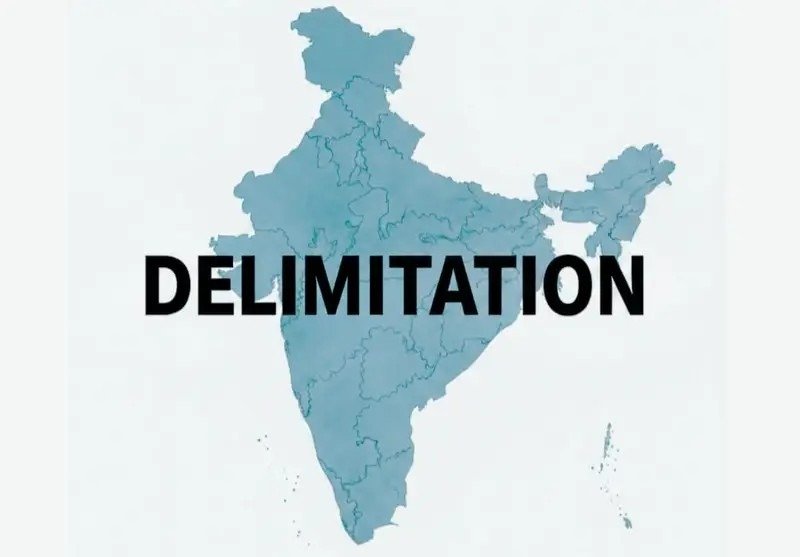
- About: Delimitation means fixing or redrawing the boundaries of Lok Sabha and State Assembly constituencies.
- It matches representation with population shifts to uphold “one vote, one value“.
- It also identifies seats reserved for Scheduled Castes (SC) and Scheduled Tribes (ST).
- Constitutional Provisions: Article 82 requires readjusting Lok Sabha seats and constituency boundaries after every Census.
- Article 170 sets the same rule for State Legislative Assemblies. Articles 330 and 332 govern SC and ST seat allocations.
- Article 329(a) bars courts from questioning delimitation laws or seat allotments.
- Delimitation Commission: According to Article 82, Parliament to enact a Delimitation Act after each census. The Union Government forms an independent Delimitation Commission to perform a delimitation process.
- The Commission includes a retired Supreme Court judge, the Chief Election Commissioner (or nominee), and concerned State Election Commissioners.
- The Commission uses Census data to keep constituency populations roughly equal within a state.
- It marks SC and ST reserved seats based on population shares.
- It publishes draft proposals, holds public hearings, and issues final orders effective on a Presidential date.
- Its orders have the force of law, cannot be challenged in court, and cannot be modified by Parliament or State Assemblies.
- In Kishorchandra Chhanganlal Rathod v. Union of India & Ors. (2024), the Supreme Court held that Delimitation Commission orders are not completely immune from judicial review under Article 226.
- Background & Evolution:
- In 1950–51, the first delimitation was done. Parliament set up Delimitation Commissions four times: in 1952 (1951 Census), 1963 (1961 Census), 1973 (1971 Census, raising Lok Sabha seats to 543), and 2002 (2001 Census, implemented in 2008 without changing state seat totals).
- In 1976, the 42nd Amendment froze seat totals until after 2000 to support family planning.
- In 2001, the 84th Amendment extended the interstate seat freeze until the first Census after 2026.
- No commissions formed after the 1981 and 1991 Censuses due to the freeze.
- Jammu & Kashmir was delimited (order finalized in 2022 under its 2019 Reorganization Act), Assam’s delimitation order came in August 2023.
Delimitation Challenges in India
- Southern states like Tamil Nadu and Kerala achieved low Total Fertility Rates through effective social policies.
- Meanwhile, northern states like Uttar Pradesh and Bihar experienced rapid population growth.
- Reallocating Lok Sabha seats purely by current population rewards higher fertility while penalizing states that stabilized growth, reducing the southern share of parliamentary power.
- Southern and western states contribute disproportionately high direct tax revenues to the central pool.
- A reduced seat share weakens their bargaining power in Parliament and influences Finance Commission tax devolution formulas.
- These states fear losing both political agency and fair financial returns while subsidizing faster-growing regions.
- Today, one MP represents over 2.5 million voters in populous northern states versus under 1 million in smaller states.
- Fixing this malapportionment restores equal vote weight, yet it rewards slower population stabilization while reducing the political voice of high-performing states.
- The 106th Constitutional Amendment (Nari Shakti Vandan Adhiniyam) rollout legally depends on completing the post-2026 delimitation.
- Delays in the decennial Census and political consensus directly stall gender representation.
- Internal migration and rapid urbanization complicate the reallocation of Scheduled Caste (SC) and Scheduled Tribe (ST) seats under Articles 330 and 332.
- Shifting constituency borders disrupts established grassroots leadership, creates local friction, and sparks disputes over fair minority representation.
Frequently Asked Questions (FAQs):
1. What is delimitation in India?
Delimitation is the process of redrawing electoral constituency boundaries to ensure fair representation based on population and constitutional principles.
2. Which constitutional Articles govern delimitation?
Articles 81, 82, 170, 327 and 329 primarily govern parliamentary and State Assembly delimitation.
3. How many Delimitation Commissions have been constituted in India?
Four national Delimitation Commissions were constituted in 1952, 1963, 1972 and 2002.
4. Why is delimitation controversial between northern and southern states?
Population-based seat redistribution may increase northern states’ parliamentary influence while relatively reducing southern states’ representation despite their population-control achievements.
5. How is women’s reservation linked to delimitation?
The 106th Constitutional Amendment, 2023, links implementing one-third women’s reservation in legislatures to a future Census and delimitation exercise under Article 334A.
Disclaimer: Information in this article is based on official announcements and public records. Details may evolve over time.