




Southern States Unite Against Delimitation Exercise
|
General Studies Paper II: Indian Constitution and Statutory Bodies |
Why in News?
Recently, southern Indian states have united against the proposed delimitation exercise, fearing reduced parliamentary representation as seat allocation based on population may favor northern states.
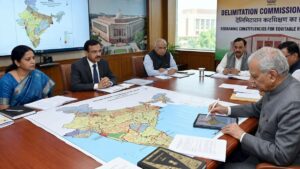
What is Delimitation?
- About: Delimitation refers to the process of fixing the boundaries and number of territorial constituencies for legislative bodies such as the Lok Sabha and State Assemblies.
- Objective: The primary objective is to ensure the principle of “one person, one vote, one value” by equalizing population across constituencies.
- It adjusts representation according to demographic changes and migration patterns over time.
- It is crucial for maintaining electoral fairness, balanced representation, and legitimacy of democratic institutions.
- Constitutional Basis: Delimitation in India is governed by Article 82 and Article 170, which mandate readjustment of constituencies after every Census.
- Parliament enacts a Delimitation Act, after which the Union government sets up a Delimitation Commission to carry out the exercise.
- The commission uses census data, consults stakeholders, publishes draft proposals, and finalizes boundaries through official gazette notifications.
- Delimitation Commission: The Delimitation Commission is a high-powered, independent statutory body responsible for redrawing constituency boundaries.
- It comprises two judges (serving or retired from the Supreme Court or a High Court) and the Chief Election Commissioner (CEC) as an ex-officio member.
- Under Article 82, orders of the Delimitation Commission have the force of law and cannot be questioned in any court.
- It acts as a judicial body with the powers of a civil court regarding the conduction of its business.
- Its orders are laid before the Lok Sabha and State Legislative Assemblies, but they cannot be modified.
- In the 2024 Kishorchandra Chhanganlal Rathod case, the Supreme Court ruled that commission orders are not immune from judicial review if found manifestly arbitrary or violative of constitutional values.
- Historical Evolution: India has conducted delimitation exercises four times—1952, 1963, 1973, and 2002 under different Delimitation Acts.
- The present boundaries are based largely on the 2001 Census, and the next nationwide exercise is expected after 2026.
- Seat Allocation: Delimitation also determines the number of seats allocated to each state and identifies constituencies reserved for Scheduled Castes and Scheduled Tribes, ensuring inclusive political representation.
- States are divided into territorial constituencies to ensure that the ratio between population and allotted seats remains consistent throughout the state.
- This system guarantees uniform representation, ensuring that every citizen’s vote carries equal weight across different states and various local districts.
- Freeze on Delimitation: Through constitutional amendments (notably 42nd, 84th, and 87th), delimitation of seats was frozen from 1976 to 2026 to encourage population control policies and prevent states with higher population growth from gaining disproportionate political advantage.
What is the Proposed Delimitation Exercise?
- Draft: The Centre has proposed a major delimitation exercise through the Constitution (131st Amendment) Bill, 2026 and the Delimitation Bill, 2026, aims to redraw electoral boundaries and increase the total number of seats in the Lok Sabha.
- Increase in Lok Sabha Seats: The total strength of the Lok Sabha is proposed to increase from 543 to 850 seats.
- This includes 815 seats for States and 35 for Union Territories.
- Use of 2011 Census Data: To fast-track the process, the Centre intends to use the 2011 Census as the base for redrawing boundaries and reallocating seats, rather than waiting for the results of the next decadal census.
- Operationalising Women’s Reservation: The exercise is directly linked to implementing the 33% reservation for women (Nari Shakti Vandan Adhiniyam).
- Out of the projected 850 seats, approximately 283 seats would be reserved for women.
- Pro-rata Seat Allocation: To address regional concerns, the government has suggested a uniform 50% increase in seats across all states.
- This “pro-rata” approach aims to maintain the current relative weightage of states and prevent southern states from losing their share of political power.
- Revised SC/ST Quotas: Delimitation initiatives to accommodate SC/ST reservation, the number of Lok Sabha seats reserved for Scheduled Castes (SC) is expected to rise from 84 to 136, and for Scheduled Tribes (ST) from 47 to 70.
- Targeting 2029 Elections: The goal is to complete the entire exercise—redrawing boundaries and reallocating seats—in time for the 2029 General Elections.
- For this, Delimitation Commission is expected to be established by June 2026 to redraw boundaries before the 2029 polls.
Southern States’ Key Concerns Over Delimitation
- Demographic Penalty: Southern states like Kerala (TFR 1.8) and Tamil Nadu (TFR 1.4) successfully reduced birth rates below the replacement level of 2.1. Using current population data “penalises” this success, while rewarding northern states like Bihar (TFR ~3.0) and Uttar Pradesh (TFR ~2.4) with greater political power.
- Representation Erosion: Projections suggest a dramatic seat redistribution. In a 543-seat House, Kerala could drop from 20 to 12 seats, and Tamil Nadu from 39 to 31. Conversely, Uttar Pradesh could gain up to 11 seats, significantly shifting the legislative balance toward the “Hindi heartland”.
- Fiscal Devolution Loss: The 15th Finance Commission shifted tax devolution weightage to the 2011 Census, causing Karnataka and Kerala to lose 0.49% and 0.25% of the divisible pool respectively. Future delimitation risks further reducing central grants, even though southern states contribute over 35% of India’s GDP.
- Federal Imbalance: There is a growing fear of a “democratic paradox” where a single party could secure a central majority solely through northern gains. This would allow the Union to pass policies—such as language or agricultural reforms—without needing a mandate from southern India.
- Performance Paradox: Southern leaders argue that “good governance” shouldn’t lead to “political irrelevance”. Higher literacy and healthcare standards in the south led to lower fertility, yet these developmental achievements are the very factors now threatening their parliamentary voice.
- Electoral Dilution: Even if the Lok Sabha expands to 850 seats, the south’s proportional share is expected to fall from 24.3% to 20.7%. While absolute numbers might increase slightly, their relative ability to influence national decision-making and Constitutional amendments will sharply decline.
Way Forward
- Hybrid Seat Formula: A “Federal Representation Index” or hybrid model is proposed by leaders like Telangana’s CM Revanth Reddy. This suggests allocating only 50% of new seats based on population, while the remaining 50% are distributed based on Gross State Domestic Product (GSDP). This rewards economic performance and governance rather than just birth rates.
- Rajya Sabha Reform: To provide a federal counterweight, the Rajya Sabha could be transformed into a Senate-style body with equal representation for all states, regardless of size.
- Strengthening its powers over Money Bills or reintroducing domicile requirements would ensure southern grievances are heard in a forum less dominated by numerical majorities.
- Weighted Devolution: The Finance Commission could further adjust tax devolution formulas to offset political loss with fiscal gain. By increasing the divisible pool to 50% and including cess and surcharges, the Centre can financially empower states that feel marginalised by population-centric delimitation.
- Multi-Stakeholder Consensus: Establishment of a Constitutional Review Panel or a “Charter of Federal Fairness” is essential to build consensus before implementation. Including academic experts and psephologists in the Delimitation Commission can help avoid gerrymandering and ensure the process is transparent and rational.
|
Also Read: Union Home Secretary Directs States to Freeze Delimitation Changes Until March 2027 |