



Project INROAD: What is INROAD Expanding Northeast Rubber Plantations?
| General Studies Paper III: Agricultural Resources, Inclusive Growth |
Why in News?
Recently, Project INROAD expanded 1.79 lakh hectares of rubber plantations across 113 districts in Northeast India and West Bengal, strengthening domestic rubber self-reliance.
What is Project INROAD?
- About: Project INROAD (Indian Natural Rubber Operations for Assisted Development) is a Public-Private Partnership (PPP) initiative to expand natural rubber cultivation in Northeast India and West Bengal.
- Launch: The project was launched in FY 2021–22 with an estimated ₹1,100 crore outlay.
- The duration of the projects is 5 years.
- Funding: It is implemented by the Rubber Board of India.
- It is financially supported through the Automotive Tyre Manufacturers’ Association (ATMA) by Apollo Tyres, CEAT, JK Tyre, and MRF.
- It is regarded as a first-of-its-kind industry-supported plantation initiative.
- Need: The Northeast possesses favourable rainfall, humidity, temperature, and available land for rubber cultivation.
- At present these states account for nearly 23% of the area and 15.7% of the production.
- To meet the increasing demand of natural rubber, the project is being facilitated.
- Coverage: The project targets 2 lakh hectares of new plantations across 113 districts in seven Northeastern states and West Bengal.
- By 15 July 2026, 1,79,376 hectares (about 1.8 lakh hectares) had been developed, achieving nearly 90% of the target despite COVID-19 disruptions.
- Components:
- Financial Inclusion: The project improves farmers’ access to institutional credit through interest subvention on eligible loans. It also assists in loan syndication, reducing financial constraints.
- Training and Skill Development: The project develops training infrastructure and conducts programmes for farmers, tappers, and other stakeholders on scientific cultivation, tapping techniques, and modern technologies.
- Quality and Productivity Enhancement: The project promotes high-yielding cultivation practices in all rubber-growing regions. It focuses on increasing latex yield.
- Primary Input Support: Farmers receive support for land preparation, irrigation, and other pre-planting activities. The programme supplies quality planting materials, fertilizers, fungicides, pesticides, and essential farm inputs.
- Natural Resource Conservation: The project integrates sustainable land and water management. Activities include constructing water conservation pits, gully plugging, and cover crop planting to reduce soil erosion.
- Post-Harvest Quality Improvement: To improve rubber quality, the project establishes Model Smoke Houses and upgrades existing smoke houses.
- These facilities enable scientific processing, producing higher-quality Ribbed Smoked Sheets (RSS) that fetch better market prices.
- Infrastructure Development: The project develops essential farm infrastructure, including crop-weighing facilities, farm fencing, access roads, and protective structures.
- Next Phase: The next phase, iSPEED (INROAD Skilling and Production Efficiency Enhancement Drive), has an outlay of ₹145 crore.
- It focuses on model smokehouses, post-harvest infrastructure, quality improvement, skilling, and digital farmer training to increase value addition.
- Benefits: More than 2 lakh beneficiaries, mainly small and marginal farmers, have benefited.
- Over 8.3 crore quality planting materials have been distributed.
- The project has also established 200+ nurseries supplying improved, high-yielding rubber clones suited to regional conditions.
- More than 3 crore trees have been planted so far under the project, benefiting 1.4 Lakh beneficiaries across 94 districts.
- Significance: India’s tyre industry consumes over 70% of natural rubber. INROAD seeks to reduce import dependence, improve raw material security, and enhance Atmanirbhar Bharat by increasing domestic production.
- After project completion, the region is expected to produce nearly 3 lakh tonnes of natural rubber and raise its national production share from about 15% to 40–45%.
- Rubber plantations increase green cover, supporting carbon sequestration, creating long-term rural employment, strengthening nursery infrastructure, and improving socio-economic conditions.
- It is estimated that by 2030, the country will require about 20 Lakh tonnes of natural rubber per year.
Natural Rubber Cultivation in India
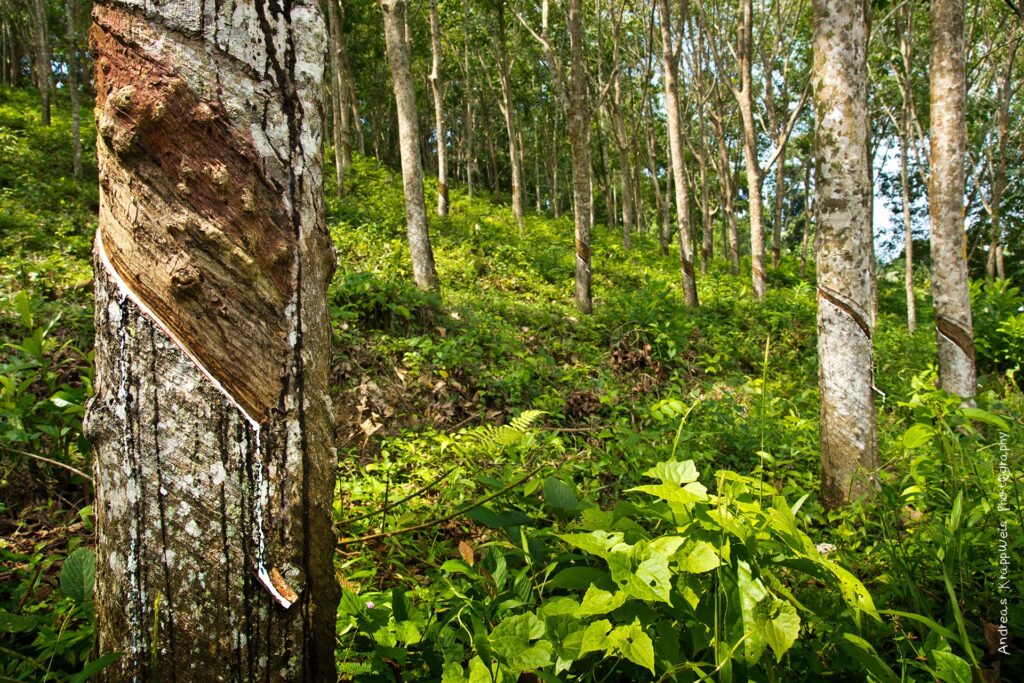
- Crop: Natural rubber is obtained from the latex of Hevea brasiliensis, a tropical plantation crop.
- It is derived from the latex or milky sap of these plant species.
- This latex is mainly composed of polyisoprene.
- It is a strategic raw material for the tyre, automobile, defence, healthcare, and manufacturing sectors.
- Climate: Rubber grows best in hot, humid tropical climates.
- It requires 25–35°C temperature, 2,000–3,000 mm annual rainfall, high humidity, and well-drained lateritic or loamy soils.
- Commercial tapping generally begins 6–7 years after planting, making it a long-gestation plantation crop.
- Production: India is the world’s second-largest producer and consumer of natural rubber.
- Kerala remains India’s largest producer, followed by Tripura, Karnataka, Assam, and Tamil Nadu.
- India produced about 8.75 lakh tonnes of natural rubber during 2024–25, registering 2.1% annual growth.
- Framework: The Rubber Act, 1947 is the principal legislation governing India’s natural rubber sector. The Act is administered by the Ministry of Commerce and Industry.
- The Rubber Board of India is the statutory body constituted under Section 4 of the Rubber Act, 1947.
- Headquartered at Kottayam, Kerala, it functions under the Department of Commerce.
- It is India’s apex institution for regulating and developing the natural rubber sector.
- The Board administers registration and licensing under the Rubber Rules, 1955.
- The Board promotes scientific research, develops high-yielding clones, controls major diseases, and disseminates improved technologies.
- The Rubber Board of India is the statutory body constituted under Section 4 of the Rubber Act, 1947.
- Initiatives:
- iSNR (Indian Sustainable Natural Rubber), launched to meet European Union Deforestation Regulation (EUDR) standards, provides free traceability certification and training for smallholders to verify sustainable, zero-deforestation practices.
- Scheme for Sustainable and Inclusive Development of Natural Rubber Sector, a scheme allocating hundreds of crores in financial assistance for replanting uneconomic trees, rain-guarding, and promoting good agricultural practices.
- INR Konnect, a platform designed to connect absentee landowners who have untapped rubber trees with adopters/tappers to maximize plantation productivity.
- mRube, the digital marketing and electronic trading platform of the Rubber Board designed to streamline and improve the efficiency of natural rubber trade.
- Challenges: The sector faces high production costs, labour shortages, price volatility, cheap imports, climate variability, fungal diseases, and the long immature period before economic returns begin.
FAQs:
1. What is Project INROAD?
Project INROAD is a Public-Private Partnership (PPP) expanding natural rubber plantations to increase domestic production and strengthen India’s rubber sector.
2. Why was Project INROAD launched?
It was launched to reduce rubber imports, improve farmer incomes, increase domestic production, and achieve self-reliance in natural rubber.
3. Which states are covered under Project INROAD?
The project covers Arunachal Pradesh, Assam, Manipur, Meghalaya, Mizoram, Nagaland, Tripura, and West Bengal.
4. How will Project INROAD benefit rubber farmers?
It provides quality planting materials, financial support, training, irrigation, infrastructure, and better productivity, increasing farmers’ long-term incomes.
5. What is the role of the Rubber Board of India in the project?
The Rubber Board implements the project, provides technical guidance, training, monitoring, quality planting materials, and overall coordination.
6. Why is natural rubber production important for India?
Natural rubber supports the tyre industry, reduces import dependence, strengthens manufacturing, creates rural employment, and improves economic self-reliance.
Disclaimer: Information in this article is based on official announcements and public records. Regulations and implementation details may evolve over time.