




Terafab AI Chip Manufacturing Project
| General Studies Paper III: AI & Computing, Growth & Development |
Why in News?
Recently, Elon Musk unveiled the Terafab AI chip manufacturing project to build a massive, vertically integrated semiconductor facility producing advanced chips for AI, aiming to meet growing demand and reduce reliance on global suppliers.
What is Terafab AI Chip Manufacturing Project?
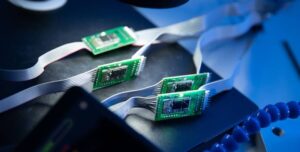
- About: The Terafab AI Chip Manufacturing Project is a planned mega semiconductor facility announced by Elon Musk in March 2026, aimed at producing advanced artificial intelligence (AI) chips at an unprecedented scale.
-
- Location: The facility will be located near Austin, Texas, adjacent to Tesla’s existing Gigafactory.
- Vision: The project’s vision is to generate over 1 terawatt (TW) of AI compute annually, far exceeding current global capacity.
- Musk envisions it as essential for enabling AI-driven economies, space computing, and even long-term multi-planetary civilization goals.
- Participating Companies: The initiative is a joint effort of Tesla, SpaceX, and xAI, integrating their technological ecosystems.
- Features:
- Vertical Integration Model: A defining feature is complete vertical integration, where chip design, fabrication, memory production, packaging, and testing occur within a single facility. This eliminates dependence on external suppliers.
- Semiconductor Technology: Terafab to use cutting-edge process nodes (around 2 nm), ensuring high efficiency and performance. This will support next-generation chips like Tesla’s AI5 processors, crucial for AI training.
-
- Production Scale: Terafab targets 2-nanometer chip technology with plans for 100,000 wafer starts per month initially, scaling up to 1 million wafers monthly.
- At full capacity, it could produce 100–200 billion AI chips annually, making it one of the largest fabs globally.
- Types of Chips: The facility will manufacture two key chip categories: Terrestrial AI chips for vehicles, robotics, and AI training and Space-hardened chips designed for satellites and orbital computing systems.
- Production Scale: Terafab targets 2-nanometer chip technology with plans for 100,000 wafer starts per month initially, scaling up to 1 million wafers monthly.
- Investment: The project is estimated to cost $20–25 billion or more, with pilot production expected around 2027 and full-scale output by 2028.
Significance of Terafab AI Chip Manufacturing Project
- Extreme Vertical Integration: Terafab introduces a one facility closed-loop ecosystem, which removes dependency on the global outsourced assembly and test (OSAT) market, which is currently 80% concentrated in Asia. By controlling the wafer-to-system pipeline, Musk can reduce the development cycle for Dojo and D3 chips by an estimated 40%, bypassing traditional foundry queues.
- Eradicating GPU Bottleneck: Current AI growth is throttled by a “compute crunch” where lead times for high-end H100/B200 chips exceed 26 weeks. Terafab aims for an internal output of 2 million units annually by 2028. This supply-side independence ensures that FSD (Full Self-Driving) updates will never be delayed by Nvidia’s allocation quotas.
- Energy-Compute Convergence: With a planned 1-gigawatt on-site solar and battery array, Terafab addresses the reality that AI chips now consume more power than small nations. By achieving a Power Usage Effectiveness (PUE) of 1.05, it sets a new industry benchmark for sustainable high-performance computing (HPC).
- Sovereign Silicon Security: By anchoring production in Texas, the project mitigates the geopolitical risk of the Taiwan Strait. This “onshoring” strategy aligns with the U.S. CHIPS Act objectives, securing critical infrastructure for SpaceX’s national security launches.
- Space-Hardened Compute Standards: Standard silicon fails in high-radiation environments. Terafab’s dedicated radiation-hardened (RadHard) line will produce processors capable of surviving 10+ years in Low Earth Orbit (LEO). This is essential for the Starlink v3 satellites.
- Economic Multiplication: The massive investment is projected to create over 15,000 high-tech jobs in the Austin “Silicon Hills” corridor. Beyond direct employment, it fosters a local secondary market for specialized chemicals, gases, and photomasks, potentially contributing $4.2 billion annually to the regional GDP.
- Petawatt Roadmap: Terafab is the blueprint for interplanetary industrialization. Musk views this facility as a “Version 1.0” for future lunar or Martian manufacturing. By mastering automated chip fabrication in a controlled environment, the project develops the robotics and AI-driven maintenance protocols required to build similar factories off-world.
India’s Ai Chip Manufacturing Status
|
| Also Read: World Largest Semiconductor Clean Room |