




Versova-Bhayandar Coastal Road Project
| General Studies Paper II: Government Policies and Interventions, Environmental Degradation |
Why in News?
Recently, the Supreme Court of India has allowed the Brihanmumbai Municipal Corporation (BMC) to remove over 45,000 mangrove trees for the Versova–Bhayandar coastal road project in Mumbai.
What is Versova–Bhayandar Coastal Road Project?
-
- About: The Versova–Bhayandar Coastal Road Project is a major urban transport infrastructure project forming the northern extension of the Mumbai Coastal Road.
- It is designed as a high-speed, multi-lane coastal corridor connecting Versova (Mumbai) to Bhayandar (Thane district) along the western coastline.
- About: The Versova–Bhayandar Coastal Road Project is a major urban transport infrastructure project forming the northern extension of the Mumbai Coastal Road.
- Objective: The key objective is to reduce travel time and congestion in Mumbai’s western suburbs.
- Agency: It is being implemented by the Brihanmumbai Municipal Corporation (BMC) under the broader coastal road master plan.
-
- Land Use: The project requires diversion of around 103 hectares of forest land, largely consisting of mangrove ecosystems.
- Cost: The project is estimated at around ₹18,263 crore, making it one of the costliest urban road projects in India.
- Features: The project involves a 26.3 km long coastal road (with total length 33.4 km including interchanges and connectors).
- It includes elevated roads, tunnels, cable-stayed bridges, and interchanges, passing through coastal and creek areas such as Charkop, Gorai, and Dahisar.
- The road is expected to cut travel time from nearly 2 hours to under 20 minutes and shorten the route distance significantly, improving connectivity.
- This project is part of the larger Mumbai Coastal Road corridor, which will eventually connect South Mumbai (Marine Drive) to Bhayandar and integrate with infrastructure like the Bandra-Worli Sea Link.
- The project will decongest the Western Express Highway that will reduce fuel consumption and pollution, and improve logistics efficiency and economic activity in the Mumbai Metropolitan Region (MMR).
- Timeline: It is expected to be completed around 2028, though timelines may vary due to legal and environmental challenges.
Environmental Concerns
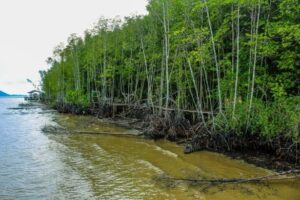
- Mangrove Loss: The project is expected to impact around 45,675 mangroves, with nearly 9,000 facing permanent removal and others affected through transplantation or disturbance. This triggered major environmental concerns due to its alignment through ecologically sensitive mangrove zones along Mumbai’s western coast.
- Mangroves are intertidal ecosystems forming a critical interface between land and sea, supporting coastal ecological balance. India alone has about 4,975 sq km of mangrove cover, highlighting their national significance.
- They regulate nutrient cycles, hydrology, and sediment flow, making them indispensable for coastal ecosystem stability.
- Loss of Natural Coastal: Mangroves act as natural bio-shields, reducing wave energy by 5–35% and lowering flood depth by up to 70% in some regions. Their destruction exposes coastlines to storm surges, cyclones, and erosion, increasing disaster vulnerability for coastal populations.
- Risk of Coastal Erosion: The dense root systems of mangroves stabilize shorelines and bind sediments. Their removal leads to accelerated coastal erosion, shoreline retreat, and loss of landmass, especially in low-lying coastal regions facing sea-level rise.
- Impact on Carbon Sequestration: Mangroves are powerful “blue carbon sinks”, storing about 394 tonnes of carbon per hectare and even up to 4 times more carbon than tropical forests. Destruction releases stored CO₂, contributing to climate change.
- Loss of Biodiversity: Mangrove ecosystems provide breeding and nursery habitats for fish, crustaceans, birds, and mammals. Their destruction disrupts food chains, reduces fish populations, and leads to biodiversity decline, affecting both marine ecology and fisheries economy.
- Decline in Livelihoods: Millions of coastal communities depend on mangroves for fisheries, fuelwood, and income. Their degradation leads to reduced fish catch, livelihood insecurity, and increased socio-economic vulnerability in coastal regions.
- Disruption of Water Quality: Mangroves act as natural filters, trapping pollutants and maintaining water quality. Their removal leads to increased coastal pollution, eutrophication, and degradation of marine ecosystems like coral reefs and seagrasses.
- Global Ecological Threat: Studies indicate that nearly 50% of global mangroves are at risk, primarily due to urbanization and coastal development. This highlights how projects involving large-scale mangrove removal can contribute to irreversible ecological damage if not managed sustainably.
Legal Timeline & Developments
- Petition: The BMC itself approached the Bombay High Court, seeking permission to fell 45,675 mangroves for the project. This reflects a unique case where the state agency becomes petitioner to comply with judicial safeguards.
- HC Order: The Bombay High Court allowed the project, recognizing “public interest” in infrastructure, but imposed strict conditions: 3× compensatory afforestation, plantation and transplantation of 36,000 mangroves.
- The High Court kept the matter pending for 10 years, mandating annual compliance reports, affidavits by senior officials, and warning that non-compliance would invite contempt of court.
- Opposition: Environmental NGOs like Vanashakti and others raised objections through legal notices and challenges, questioning forest clearance procedures, afforestation feasibility, and ecological loss, thus invoking public interest litigation (PIL) principles.
- Aggrieved parties challenged the High Court order before the Supreme Court of India, seeking a stay on mangrove cutting and stricter environmental scrutiny.
- SC Order: The Supreme Court refused to interfere with the High Court decision and allowed the project, permitting the cutting of over 45,000 mangroves for the ₹18,263 crore project, thereby clearing the final legal hurdle.
- The Court directed strict adherence to High Court conditions, including compensatory afforestation before or parallel to cutting and annual audits for 10 years, reinforcing accountability and rule of law.
- The judgment reflects application of “sustainable development”, balancing Article 21 (environmental rights) with public infrastructure needs, while respecting institutional competence of expert bodies.
| Also Read: Tribal Council Resists Land Surrender in Great Nicobar Project |