




UK Break-Up Referendum- Celtic Leaders Push Forward To Demand Nation Splits
| General Studies Paper II: Effect of Policies & Politics of Countries on India’s Interests |
Why in News?
Recently, leaders from Scotland, Wales, and Northern Ireland convened in Cardiff to sign a historic joint declaration demanding self-determination referendums, escalating systemic pressure on Westminster to decentralize sovereignty.
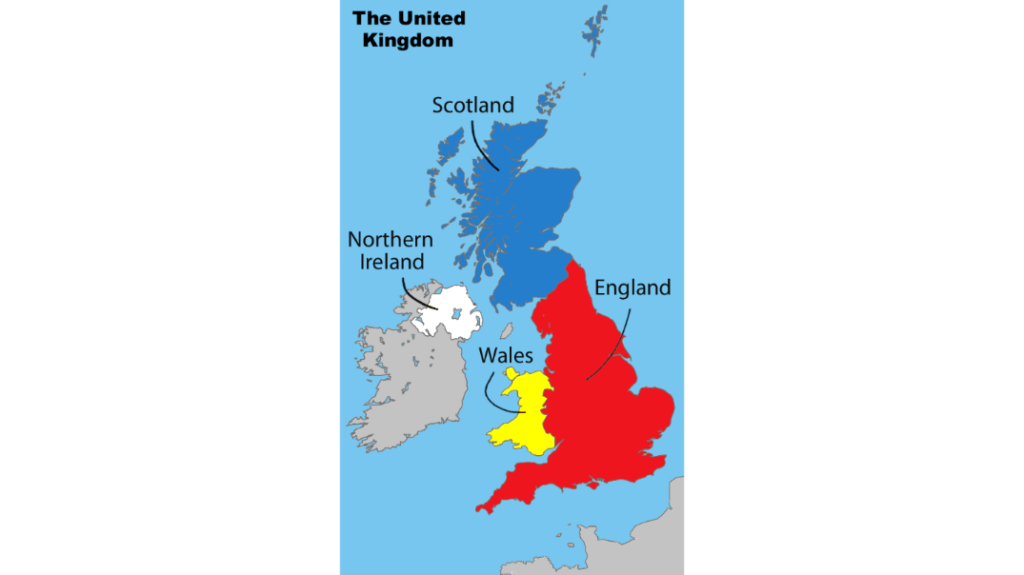
Origins and Evolution of Celtic Nationalism in the UK
- Origins: Celtic nationalism refers to political movements that emphasise the distinct historical, cultural, linguistic and national identities of peoples associated with Scotland, Wales and Ireland.
- The modern United Kingdom did not emerge through one single constitutional act.
- It developed gradually through different unions between historically distinct territories.
- This makes the UK a useful example of a multinational state.
- Scotland had been an independent kingdom before the 1707 Union.
- The Treaty of Union between Scotland and England came into force on 1 May 1707, creating the Kingdom of Great Britain and a single Parliament.
- Importantly, the Union preserved several distinctive Scottish institutions, especially the Scottish legal system, education traditions and established church arrangements.
- Thus, political union did not completely eliminate Scottish institutional identity.
- Wales followed a different historical trajectory. Welsh political and legal traditions predated incorporation into the English state.
- The Laws in Wales Acts of 1535 and 1542–43 integrated Wales into the Kingdom of England and extended English law and parliamentary arrangements to Wales.
- However, Welsh language, literature and cultural identity survived and later became important foundations for modern Welsh nationalism.
- The Irish experience became even more significant. The Act of Union 1800 created the United Kingdom of Great Britain and Ireland from 1801.
- During the nineteenth century, demands for Irish Home Rule grew.
- Home Rule initially sought self-government within the United Kingdom rather than complete independence.
- However, political conflict, the Easter Rising of 1916, the Irish War of Independence and subsequent negotiations transformed the constitutional question.
- The Government of Ireland Act 1920 divided Ireland into Northern Ireland and Southern Ireland, although only the Northern Irish parliament ultimately operated under that arrangement.
- The subsequent Anglo-Irish Treaty of 1921 led to the establishment of the Irish Free State in 1922, while Northern Ireland remained within the United Kingdom.
- Northern Ireland follows a substantially different model.
- The Good Friday Agreement of 1998 established the principle of consent.
- Northern Ireland remains part of the UK unless a majority of people in Northern Ireland support constitutional change towards a united Ireland.
- The Agreement also recognises the right of people in Northern Ireland to identify as British, Irish or both, and to hold British and Irish citizenship.
- Under the Northern Ireland Act 1998, the UK Secretary of State can call a border poll.
- The legislation also creates a duty to hold such a poll when it appears likely that a majority would support Irish unity.
- There is a seven-year minimum interval between border polls. Importantly, constitutional change would require support in both Northern Ireland and the Republic of Ireland under the Agreement’s framework.
- Nationalism:
- Modern Scottish nationalism developed politically through organisations including the Scottish National Party (SNP), founded in 1934.
- The movement gradually shifted from cultural nationalism towards demands for political autonomy and independence.
- The SNP argues that Scotland should have the democratic right to determine its own constitutional future.
- The Scottish Government has repeatedly described Scotland as a nation within a union and argues that its people should retain the ability to reconsider the constitutional settlement.
- The Scottish devolution campaign eventually produced the 1997 referendum, after which the Scottish Parliament was established in 1999 under the Scotland Act 1998.
- The movement gradually shifted from cultural nationalism towards demands for political autonomy and independence.
- In Wales, Plaid Cymru, founded in 1925, became the major political expression of Welsh nationalism.
- Welsh nationalism initially focused strongly on language and cultural preservation, but later incorporated demands for political autonomy and, for some supporters, independence.
- The Welsh devolution process began with the 1997 referendum and subsequently developed through further transfers of powers.
- A major constitutional transformation occurred through devolution during the late 1990s.
- Scotland, Wales and Northern Ireland received their own devolved institutions, although their powers and constitutional arrangements differ.
- Devolution therefore created a middle ground between complete centralisation and full independence.
- The 2014 Scottish independence referendum represented the most important modern test of Scottish nationalism.
- The referendum was legally authorised through an agreement between the UK and Scottish governments.
- 55.25% voted against independence, while 44.65% voted in favour, with an exceptionally high 84.6% turnout.
- The issue returned strongly after the 2016 Brexit referendum. Scotland voted by a clear majority to remain in the European Union, while the UK as a whole voted to leave.
- This created a new argument among Scottish nationalists that Scotland’s constitutional preferences could diverge significantly from those of the wider UK.
- Celtic nationalism has evolved from cultural preservation and historical identity into a modern debate about self-government, sovereignty, democratic consent and constitutional restructuring.
- Modern Scottish nationalism developed politically through organisations including the Scottish National Party (SNP), founded in 1934.
Constitutional and Legal Framework for Independence Referendums
- The United Kingdom does not have a single codified constitution. The legal mechanism for a nation like Scotland to achieve independence relies strictly on the foundational principle of Parliamentary Sovereignty at Westminster.
- Under the Scotland Act 1998, the power to alter the constitutional union of Great Britain is a strictly reserved matter exclusively held by the UK Parliament.
- This legal boundaries framework ensures that a devolved administration cannot unilaterally host a secession vote.
- The procedure to execute a lawful independence referendum involves ten consecutive steps:
- (1) Democratic Mandate Recognition, where a regional political party wins an election on an independence platform to trigger discussions;
- (2) Intergovernmental Negotiations, where regional and central state leaders formally meet to debate terms;
- (3) The Edinburgh Agreement Precedent, which requires both governments to formally consent to working together;
- (4) A Section 30 Order Request, which acts as the legal device under the Scotland Act 1998 to temporarily transfer legislative power from Westminster to the devolved parliament;
- (5) Supreme Court Judicial Review, ensuring absolute legal clarity that a unilateral referendum bill lacks legislative competence without central agreement;
- (6) Primary or Secondary Legislation Approval, requiring both Houses of the UK Parliament to formally pass the statutory instrument;
- (7) Electoral Commission Intelligibility Check, an independent body review to structure a fair, unambiguous, single-choice question;
- (8) Franchise and Conduct Bill Passage, where local regional acts explicitly define voting age boundaries and regulate public campaign spending limits;
- (9) Referendum Execution, performing a fair and legally secure public ballot across the territory; and
- (10) Post-Vote Separation Legislation, where a “Yes” victory forces Westminster to pass primary acts dissolving the ancient Acts of Union 1707 to legally recognize a new international sovereign state.
Implications of Potential UK Break-Up
- Macroeconomic Contraction and Gross Domestic Product Hit: A UK break-up would drastically shock economic growth, compounding the structural damage already left by Brexit.
- Economic research indicates that leaving a highly integrated economic union triggers severe trade friction; for context, post-Brexit macroeconomic data shows a 6% to 8% reduction in UK GDP per capita, illustrating the staggering scale of disruption when internal borders are raised.
- Fiscal Deficits and National Debt Allocation: Separating the countries requires dividing the massive national debt burden, which reached 102% of GDP in 2025.
- Scotland’s structural fiscal deficit historically hovers significantly higher than the UK average, meaning an independent Holyrood would face severe austerity or high borrowing costs to plug its financial shortfalls without Westminster’s block grants.
- Currency Volatility and Financial System Fragmentation: An independent Scotland plans to initially use the British pound sterling before transitioning to a new Scottish pound, which requires establishing an independent Central Bank.
- This transition threatens monetary stability; historical data from political shocks shows the pound sterling plunged 10% following the 2016 referendum, proving how sensitive currency values are to constitutional fractures.
- Trade Disruption and Internal Border Frictions: The remainder of the UK (rUK) is Scotland’s largest trading partner, absorbing over 60% of its exports.
- Erecting a hard regulatory border between Scotland and England would introduce severe non-tariff barriers, mirroring how post-Brexit border red tape caused a 14% drop in UK-EU goods exports.
- Diminished Global Influence and UN Security Council Status: The break-up would permanently shrink Britain’s global standing, soft power, and diplomatic leverage.
- A fractured nation would struggle to justify its permanent seat on the UN Security Council, altering the global balance of power and reducing the UK’s historical leverage in international trade and security treaties.
- Relocation of Financial Sector Assets and Capital Flight: The political instability of a separation would spark major capital flight from Edinburgh and London.
- This mimics the financial sector flight seen after 2016, where banking operations shifted away from Britain, relocating over $1 trillion in financial assets to continental European hubs like Dublin, Paris, and Frankfurt.
- Relocation of the Strategic Nuclear Deterrent: The UK’s entire nuclear deterrent, the Trident submarine fleet, is stationed at HMNB Clyde (Faslane) in Scotland.
- Because the Scottish National Party (SNP) demands a nuclear-free nation, the rUK would be forced to relocate this infrastructure to England at an estimated, staggering cost of tens of billions of pounds, severely threatening military readiness.
- Weakening of NATO’s Northern Flank: A divided Britain compromises the security of the GIUK (Greenland-Iceland-UK) gap, a critical maritime chokepoint for tracking Russian submarine activity.
- The fragmentation of the Royal Navy and Royal Air Force assets would create immediate coordination challenges, distracting European allies from unified defenses against modern geopolitical threats.
- Border Complications and the Irish Reunification Push: Under the Good Friday Agreement, Northern Ireland can trigger a border poll if a majority favors a United Ireland.
- A wider UK breakup would accelerate this demographic and political shift, especially given that recent polling shows 36% support for independence/unification in Northern Ireland, threatening a complex economic integration with the Republic of Ireland.
- Supply Chain Disruption in the Energy Sector: Scotland generates a massive share of the UK’s renewable energy and North Sea oil.
- A constitutional split would fracture the Single Energy Market, forcing complex negotiations over grid access and emissions trading schemes, potentially spiking consumer energy costs across both nations.
- EU Enlargement Complexities and Rejoining Hurdles: While Scotland and Wales aim to rejoin the European Union as independent nations, the process would take years.
- New members must meet strict fiscal criteria, including keeping budget deficits under 3% of GDP, a threshold an independent Scotland would struggle to meet immediately without severe public spending cuts.
- Decline in Business Investment and Labour Productivity: Protracted constitutional negotiations would paralyze corporate decision-making.
- Prolonged uncertainty has previously driven UK business investment 12% to 18% lower and labor productivity 3% to 4% lower than advanced economy peers, stifling long-term innovation.
- North Atlantic Challenge: A wider break-up could also affect the North Atlantic strategic environment. Scotland’s geographical position is important for maritime security, submarine operations and monitoring of North Atlantic sea routes.
- Changes in sovereignty could therefore require new defence and intelligence arrangements between the UK, Scotland, Ireland and NATO allies.
Frequently Asked Questions (FAQs):
1. Is the United Kingdom heading for a breakup?
Not necessarily. Pro-independence parties now lead Scotland, Wales and Northern Ireland, but a breakup remains politically possible, not inevitable.
2. Why are Scottish, Welsh and Northern Irish leaders seeking referendums?
They seek greater self-determination, constitutional choice and autonomy, reflecting stronger electoral support for pro-independence parties.
3. Will Scotland get another independence referendum?
Possibly, but not yet. The UK Government currently opposes another referendum, while Scotland’s government is demanding a lawful mechanism.
4. Could Northern Ireland vote for Irish reunification?
Yes. A border poll can occur when the UK Secretary of State considers majority support for a United Ireland likely.
5. Is Wales planning an independence referendum?
Plaid Cymru wants one, but Wales currently has no agreed referendum timetable, and constitutional powers remain shared with Westminster.
6. What is the Celtic Nations Summit?
It is a Cardiff meeting of Scottish, Welsh and Northern Irish leaders focused on self-determination, economic cooperation, energy and European relations.
Disclaimer: Information in this article is based on official announcements and public records. Regulations and implementation details may evolve over time.