Zojila Tunnel Breakthrough
| General Studies Paper lII: Infrastructure, Growth & Development |
Why in News?
Recently, Zojila Tunnel achieved a major breakthrough at Minamarg in Kargil district, bringing year-round connectivity between Jammu & Kashmir and Ladakh a step closer.
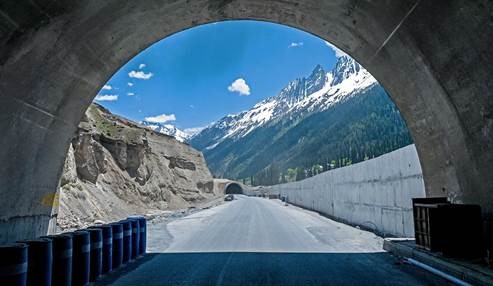
What is Zojila Tunnel Project?
- About: The Zojila Tunnel is an under-construction bi-directional Himalayan road tunnel designed to provide year-round weather-proof connectivity between the Kashmir Valley and the Ladakh region.
- Location: Situated at an altitude of approximately 11,578 feet above sea level, the route spans the geologically fragile Zojila Pass in the Himalayas.
- It directly connects Baltal (near Sonamarg in the Ganderbal district of Jammu and Kashmir) to Minamarg (near Drass in the Kargil district of Ladakh).
- Need: The Zojila Pass acts as a natural divide that shuts down for months annually due to extreme sub-zero temperatures, heavy snowfall, and avalanches. This completely isolates Ladakh from the rest of mainland India.
- Background: First conceptualized in 2005, the Detailed Project Report was prepared by the Border Roads Organization (BRO) in 2013.
- Initial groundwork commenced in 2018, excavation officially picked up pace in 2020 under the newly restructured mandate.
- Agencies: The project is overseen by the National Highways and Infrastructure Development Corporation Limited (NHIDCL), a central public sector undertaking.
- The engineering and excavation are executed by the Hyderabad-based firm Megha Engineering and Infrastructures Limited (MEIL).
- Funding: The tunnel operates as part of a broader infrastructure modernization package of 31 road tunnels across J&K and Ladakh, collectively cost at INR 1400 billion (approximately US $17.5 billion).
- The tunnel has a sanctioned project cost of approximately ₹6,808.69 crore.
- Funding is provided by the Government of India as a centrally financed national highway project.
- Engineering Design: The project entails a 13.15 km long, 9.5 m wide, and 7.57 m high horseshoe-shaped single-tube bi-directional road tunnel.
- Once finished, it will stand as one of the world’s longest and highest altitude bi-directional road tunnels, serving as a critical infrastructure artery.
- Technical Design: The main tunnel is engineered with a smart transport ventilation system.
- Engineers adopted the New Austrian Tunnelling Method (NATM), a technique suited to fragile Himalayan geology.
- It features three vertical ventilation shafts measuring 500 meters, 385 meters, and 220 meters to maintain air quality.
- Associated Infrastructure: Beyond the main tunnel, the project includes approach roads, four bridges (about 910 metres combined length), two Nilgrar tunnels, eight cut-and-cover sections and three major ventilation shafts measuring approximately 480 m, 385 m and 213.5 m.
- Smart Safety System: It integrates responsive ventilation and proactive fire detection with continuous CCTV, safe pedestrian cross-passages, and clear maintenance routes, ensuring optimal protection and operational readiness.
- Operational Scope: Built on National Highway 1 (NH-1), the tunnel spans the lifeline of the Ladakh region.
- It is heavily integrated with the adjacent Z-Morh Tunnel project.
- The project formed part of a larger Sonamarg–Kargil connectivity corridor.
- Zojila serves as a vital lifeline to Ladakh, alongside the Rohtang and Shinku La corridors, collectively securing year-round Himalayan access.
- Completion: On 9 June 2026, engineers completed the final breakthrough by connecting both ends of the tunnel.
- According to project officials, nearly 85% of overall work has been completed, with remaining works focused on systems, finishing and corridor integration.
- The final public commissioning is targeted for February 2028.
Significance of Zojila Tunnel
- National Security: The tunnel ensures 365-day strategic mobility along the sensitive Line of Actual Control (LAC) and Line of Control (LoC).
- It eliminates winter vulnerability, allowing the Indian Armed Forces to rapidly deploy personnel and heavy armor to forward border posts without seasonal interruptions.
- Military Logistics: With over 70,000 Army personnel stationed in Ladakh, the all-weather highway serves as a vital artery.
- It facilitates the uninterrupted transit of heavy artillery, machinery, spare parts, and dry rations, drastically minimizing dependence on weather-vulnerable, expensive airlifts.
- Travel Optimization: The project optimizes regional transit by compressing travel times through the Zojila Pass from 3 to 4 hours down to just 15 to 30 minutes.
- This structural bypass directly slashes transport costs and significantly curtails massive vehicular fuel consumption.
- Economic Integration: By establishing a permanent land bridge on National Highway 1 (NH-1), the tunnel eradicates the traditional 5 to 6-month winter blockade.
- This allows local trades, including Kashmiri handicrafts and Ladakhi agriculture, to sustain business operations seamlessly year-round.
- Tourism Expansion: The structure opens up permanent access to pristine destination hubs like Sonamarg, Drass, Kargil, and Leh.
- It safely extends the conventional summer tourist window into a year-round travel season, heavily expanding hospitality employment.
- Civilian Protection: The modern engineering complex insulates motorists from highly erratic Himalayan weather, shielding them from standing snow up to 6 meters and sudden avalanches.
- Integrated avalanche galleries and deflator dams systematically reduce fatal mountain road accidents.
- The tunnel guarantees uninterrupted emergency medical evacuations and reliable transport for essential life-saving drugs.
- Fiscal Efficiency: A complete restructuring reduced the total projected civil expenditure from an initial estimate of ₹12,000 crore down to a realized capital cost of approximately ₹6,808.69 crore.
- This optimized output saved the exchequer nearly ₹5,000 crore in public development funds.
- Geopolitical Deterrence: The operational corridor fortifies the highway segment targeted during the 1999 Kargil conflict, placing vital infrastructure behind an all-weather shield.
- It secures military logistical supply lines far out of reach from hostile foreign artillery observation posts.
- Employment Generation: The project has successfully logged over 11.25 million man-hours with zero casualties.
- The site employs more than 1,200 personnel, with locals making up approximately 80% of the staff.
Major Infrastructure Projects Transforming Jammu & Kashmir and Ladakh
- Udhampur–Srinagar–Baramulla Rail Link (USBRL) – 1994: The USBRL is India’s most ambitious Himalayan railway project, spanning 272 km from Udhampur to Baramulla.
- Declared a National Project in 2002, it aims to connect the Kashmir Valley with the national railway network through all-weather rail transport.
- The project was completed in 2025 at a cost of about ₹43,780 crore, featuring 36 tunnels (119 km) and 943 bridges.
- Chenab Rail Bridge: The Chenab Rail Bridge is the world’s highest railway arch bridge, standing 359 metres above the riverbed in Reasi district.
- Constructed as part of USBRL, it was inaugurated in 2025 to enable uninterrupted rail connectivity across the Chenab gorge.
- The bridge is designed to withstand extreme winds, seismic activity and difficult Himalayan conditions.
- Anji Khad Rail Bridge – 2017: The Anji Bridge is India’s first cable-stayed railway bridge and forms a critical section of USBRL.
- Located in Reasi district, the bridge spans 473 metres across the Anji River with a 193-metre-high pylon.
- Its objective is to overcome difficult terrain while ensuring safe rail access to Kashmir.
- Z-Morh Tunnel – 2015: The 6.4-km Z-Morh Tunnel near Gagangir in Ganderbal district is designed to provide year-round access to Sonamarg.
- The project eliminates seasonal disruptions caused by avalanches and snowfall on the Srinagar–Leh corridor.
- It serves as an important feeder infrastructure for Ladakh-bound traffic.
- Shinku La Tunnel: The Shinku La Tunnel (Shinkun La) is a 4.1 km, all-weather highway tunnel under construction beneath the 16,580-foot Shinku La pass.
- Located on the Nimu-Padam-Darcha road link, it connects Ladakh’s Zanskar Valley with Himachal’s Lahaul Valley.
- Built by the Border Roads Organisation, it will be the world’s longest and highest tunnel at this altitude.
FAQs:
1. Why is the Zojila Tunnel important for India’s defence?
It enables year-round movement of troops, weapons and supplies to Kargil, Siachen and Ladakh, strengthening military readiness in border regions.
2. Where is the Zojila Tunnel located?
The tunnel lies beneath the Zojila Pass on NH-1, connecting Sonamarg (Jammu & Kashmir) with Minamarg (Ladakh).
3. How will the tunnel improve connectivity?
It will provide all-weather Kashmir–Ladakh connectivity and reduce travel time across Zojila from about 1.5 hours to 15 minutes.
4. What is the strategic significance of the project?
The tunnel secures a critical Himalayan corridor, enhances border logistics, reduces weather-related disruptions, and improves access to India’s northern frontier.
5. When is the Zojila Tunnel expected to be completed?
Following the June 2026 breakthrough, NHIDCL officials expect the tunnel to be opened for public use by February 2028.
| Also Read: Z-Morh Tunnel |