11th-Century Chola Copper Plates
|
General Studies Paper I: Indian Heritage Sites, Indian Architecture, Cultural Diplomacy |
Why in News?
Recently, the Netherlands repatriated 11th-Century Chola Copper Plates to India during Prime Minister Narendra Modi’s visit, highlighting cultural restitution.
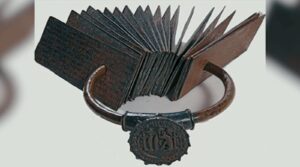
Highlights of 11th-Century Chola Copper Plates
- Historical Identity: The 11th-Century Chola Copper Plates, popularly called the Leiden Plates, are among the most valuable surviving records of the Chola Empire under Rajaraja Chola I and Rajendra Chola I.
- They date to the early 11th century CE and document royal administrative orders.
- Physical Composition: The collection contains 21 large copper plates and 3 smaller plates, weighing nearly 30 kg, bound by a bronze ring carrying the royal Chola seal.
- The inscriptions were engraved for permanent preservation of imperial grants and decrees.
- Script: The plates contain inscriptions in both Tamil and Sanskrit, reflecting the Chola Empire’s multilingual governance system.
- Tamil sections explain administrative details, while Sanskrit portions highlight royal legitimacy and ceremonial traditions.
- Significance: The records formalised the grant of Anaimangalam village to the Chudamani Vihara at Nagapattinam, a Buddhist monastery linked to the Srivijaya Kingdom of Southeast Asia.
- The inscriptions highlight the Cholas’ strong naval and commercial influence across the Bay of Bengal and Southeast Asia.
- Historians consider them key evidence of India’s medieval maritime diplomacy and trans-Asian trade networks.
- Preservation: The plates were taken from Nagapattinam to the Netherlands during the colonial period and remained at Leiden University since the 19th century.
- Florentius Camper, a Dutch missionary/pastor, took these plates with him in the early 18th century when Nagapattinam was under Dutch colonial control.
- These royal documents from the Chola dynasty had been in Dutch custody for over 300 years.
- Repatriation: India officially sought their return from 2012 onward.
- In May 2026, the Netherlands formally returned the artefacts to India during Prime Minister Narendra Modi’s visit.
- These plates will be handed over to the Archaeological Survey of India (ASI) in New Delhi, which will determine their location for public display.
Know About Chola Empire
- Origin: The Chola Empire emerged in the Kaveri Delta of Tamil Nadu and existed from the 3rd century BCE to the 13th century CE.
- The Imperial Chola phase began around 848 CE under Vijayalaya Chola.
- Greatest Rulers: Important rulers included Rajaraja Chola I (985–1014 CE) and Rajendra Chola I (1014–1044 CE).
- They expanded the empire across South India, Sri Lanka, Maldives, and Southeast Asia through powerful military and naval campaigns.
- Administrative System: The empire had a centralised monarchy with efficient bureaucracy.
- Territories were divided into Mandalams, Valanadus, Nadus, and villages. Local governance through Sabha and Ur assemblies reflected advanced democratic practices.
- Electoral System: The famous Kudavolai system used palm-leaf ballots for selecting village committee members.
- It ensured transparency, accountability, and local participation in administration, making Chola governance historically significant.
- Economic Prosperity: The economy depended on agriculture, irrigation, and overseas trade.
- Merchant guilds like Ayyavole and Manigramam dominated Indian Ocean commerce.
- Massive irrigation canals and tanks improved agricultural productivity.
- Temple Architecture: The Cholas perfected Dravidian architecture.
- The Brihadeeswara Temple at Thanjavur, built in 1010 CE, remains a UNESCO-recognised masterpiece of granite engineering and Shaivite devotion.
- Sculptures: Chola artisans mastered lost-wax bronze casting, creating iconic sculptures of Nataraja Shiva.
- Their temple art deeply influenced South and Southeast Asian artistic traditions.
- Cultural Contributions: The empire patronised Tamil literature, Shaivism, Vaishnavism, and Sanskrit learning.
- Chola inscriptions remain vital historical sources for studying medieval South Indian society and economy.
- Decline: By the 13th century, conflicts with Pandyas and Hoysalas weakened Chola authority.
- However, their achievements in governance, naval expansion, temple architecture, and Tamil culture continue shaping India’s civilisational heritage.
India–Netherlands Cooperation in Heritage Preservation
- Diplomatic Framework: India and the Netherlands executed a landmark Strategic Partnership Roadmap (2026–2030).
- This framework codifies institutional timelines for bilateral cultural consultations and policy alignments.
- Both nations deployed UNESCO-backed investigative mechanisms to trace displaced antiquities.
- Systematic verification targets 10,000 colonial-era artifacts earmarked for potential source-nation return.
- Conservation specialists co-manage Dutch-era structures in Nagapattinam and Kochi.
- Maritime Collaboration: The nations signed a dedicated Maritime Heritage MoU in December 2025.
- This links India’s Lothal National Maritime Heritage Complex directly with Amsterdam’s National Maritime Museum.
- Institutional Archiving: Leiden University Library partnered with Indian archives for comprehensive manuscript digitization.
- The process preserves Sanskrit and Tamil inscriptions using advanced photogrammetry.
- Joint initiatives include bilateral art exchanges between national galleries. A prominent upcoming Van Gogh exhibition will debut at India’s National Gallery of Modern Art.
- The Archaeological Survey of India (ASI) integrates Dutch conservation technology. Collaboration centers on 3D laser scanning for structural longevity.
- Community Engagement: The partnership involves the 250,000-strong Indian diaspora in the Netherlands.
- Dedicated diaspora funding drives local civilizational identity preservation projects globally.
|
Repatriation of Antiquities and India’s Cultural Diplomacy Efforts:
|
|
Also Read: US Returns 657 Stolen Artefacts to India |