1st World Yogasana Championship 2026
|
General Studies Paper I: Sports, Indian Art Forms |
Why in News?
India will host the 1st World Yogasana Championship from 04-08 June 2026 in Ahmedabad, Gujarat.
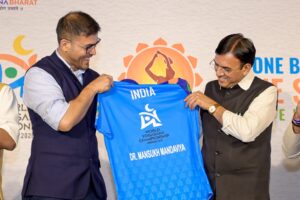
Highlights of World Yogasana Sports Tournament 2026
- Launch: The first-ever World Yogasana Sports Championship 2026 was officially unveiled in New Delhi.
- Union Sports Minister Dr. Mansukh Mandaviya led the launch event to establish yoga as a competitive sport globally.
- Event Timeline: This mega international tournament is scheduled from June 4 to June 8, 2026.
- Venue: The entire athletic competition is being hosted at the world-class Eka Arena, TransStadia Complex in Ahmedabad, Gujarat, India.
- Organizing Bodies: The historic event is organized by Yogasana Bharat and World Yogasana.
- It operates with key administrative support from the Indian Olympic Association (IOA) and the Ministry of Youth Affairs and Sports.
- The championship is supported by the Ministry of AYUSH, Sports Authority of India (SAI), Sports Authority of Gujarat, and Gujarat Tourism.
- Official Mascot: The national organizers introduced an energetic official mascot named “Veer the Lion”.
- The dynamic lion character symbolizes strength, core stability, and the proud sporting heritage of India.
- Participation: Practitioners from over 70 countries are participating in this debut edition.
- Major global contingents include teams from Japan, Netherlands, Kenya, Uganda, Zambia, Nepal, Sri Lanka, Oman, Mauritius, Malaysia, Ghana, Uzbekistan, and the United States.
- The event brings together over 400 international athletes, making it the largest global Yogasana competition ever organized.
- India has fielded a 122-member contingent, one of the largest delegations.
- Age Divisions: Athletes across a massive age bracket spanning from 10 to 55 years are eligible.
- They compete under clearly demarcated sub-junior, junior, and senior performance divisions.
- Competition Categories: Competitions are classified under four main formats: Traditional Yogasana, Artistic Yogasana, Rhythmic Yogasana, and Athletic Yogasana.
- Individual skill rounds focus on specialized posture types including Forward Bend, Back Bend, Twisting Body, Hand Balance, and Leg Balance. Each posture tests core body control.
- Scoring System: The games implement a digitized “Code of Points” system.
- This modern software judges routines transparently based on absolute stillness, strength, and structural alignment.
- For the first time at a global Yogasana event, an electronic scoring system has been introduced.
What is Yogasana?
- About: Yogasana is the practice of physical postures and poses designed to improve bodily control, alignment, and overall well-being.
- The word is derived from two Sanskrit terms: yuj, meaning to unite, and asana, meaning a seat or posture.
- Categories: Broadly organized into four main categories:
- Standing Poses: Poses like the Triangle Pose (Trikonasana) that build initial stamina and full-body activation.
- Sitting Poses: Postures like the Lotus Pose (Padmasana) that serve as grounding frames for breathing and meditation.
- Supine Poses: Reclining postures performed lying flat on your back, such as the Corpse Pose (Shavasana), used for deep relaxation.
- Prone Poses: Postures performed lying flat on your stomach, like the Cobra Pose (Bhujangasana), which strengthen the spine and back.
- Benefits: Regularly executing these positions directly shapes physical and mental resilience:
- Physical Health: Enhances muscle strength, expands joint flexibility, and builds overall physical endurance.
- Internal Systems: Stimulates physiological paths including your respiratory, circulatory, digestive, and nervous systems.
- Mental Clarity: Calms erratic thoughts, lowers baseline stress levels, and develops intense interior focus.
- History: Yogasana has evolved from ancient, indigenous roots in India:
- Pre-Vedic & Vedic Periods (circa 3000–1500 BCE): Origins of yogic postures found in the Indus-Saraswati civilization (e.g., the Pashupati seal). The word “Yoga” is first documented in the Rig Veda, largely used for rituals and spiritual discipline.
- Classical Period (circa 200 BCE): Patanjali compiled the Yoga Sutras, creating the “Eight Limbs of Yoga” where asanas serve as physical preparation for meditation and higher consciousness.
- Post-Classical Period (circa 800–1700 CE): Emergence of Hatha Yoga. Texts like the Hatha Yoga Pradipika document 84 foundational asanas, shifting focus to bodily control as a vehicle for spiritual liberation..
- Modern Era (Late 19th–20th Century): Swami Vivekananda introduced Yoga to the West. In the early 20th century, pioneers like T. Krishnamacharya, B.K.S. Iyengar, and K. Pattabhi Jois systematized and expanded the asanas.
- Contemporary Era (2014–2026): The United Nations declared June 21 as the International Day of Yoga (2014). Recent data shows that approximately 300 million people practice yoga across the globe.
- In 2015, India’s Ministry of Youth Affairs & Sports classified Yoga as a ‘Priority’ sports discipline.
- In 2016, UNESCO inscribed Yoga on the Representative List of the Intangible Cultural Heritage of Humanity.
- The World Health Organization champions Yoga as a crucial, accessible tool to combat Non-Communicable Diseases (NCDs). It is formally integrated into the WHO Global Action Plan for promoting physical and mental well-being worldwide.
- Competition: The first formal āsana competitions are organized in Calcutta by the West Bengal Yoga Federation, founded by the students of Bishnu Charan Ghosh.
- The inaugural global competitive yoga event took place in 1989 in Pondicherry, India. It was organized under the guidance of Yoga Maharishi Dr. Swami Gitananda Giri.
- The Government of India officially recognized Yogasana as a competitive sport on November 27, 2020, pushing it into the Fit India Movement and the Khelo India programs.
- Yogasana was inducted into major multi-sport events like the Khelo India National Games. This platform offered 51 medals across multiple technical categories to mainstream young talent.
|
Government Policies & Initiatives:
|
|
Also Read: Inaugural Khelo India Tribal Games 2026 |