Vivek Doraiswamy Named India Ambassador to China
| General Studies Paper II: Government Policies and Interventions, India’s Neighbourhood |
Why in News?
Recently, the Government of India appointed Vikram K. Doraiswami, as the next Ambassador to the People’s Republic of China.
- He is currently the High Commissioner of India to the United Kingdom and soon will succeed Pradeep Kumar Rawat to manage critical India-China relations.
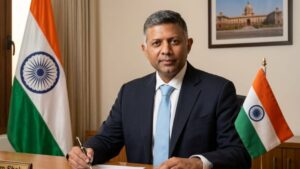
Who is Vikram K. Doraiswami?
- Intro: Vikram K. Doraiswami is a senior Indian Foreign Service (IFS) officer of the 1992 batch, currently appointed as India’s Ambassador to China (2026). He is known for his extensive diplomatic experience and strategic expertise.
- Early Life: Born on 11 July 1969, he comes from a military background, with his father serving in the Indian Air Force. He completed his Master’s degree in History from the University of Delhi, reflecting a strong academic foundation.
- Civil Service: Doraiswami joined the prestigious Indian Foreign Service in 1992. Before this, he briefly worked as a journalist, which helped develop his analytical and communication skills—important for diplomacy.
- Roles: He worked in the Prime Minister’s Office as Private Secretary to leaders like Atal Bihari Vajpayee and Manmohan Singh, and also handled key roles in the Ministry of External Affairs, including BRICS coordination.
- Diplomatic Career: He began his career as a Third Secretary in Hong Kong (1994) and later served in Beijing (1996 to 2000), gaining early exposure to China.
- He has served as Ambassador to Uzbekistan (2014–15) and South Korea (2015–18), and High Commissioner to Bangladesh (2020–22) and the United Kingdom (2022–26), showcasing wide global experience.
Significance of His Appointment
- Diplomatic Reset: The appointment comes amid post-2020 border tensions and gradual normalization efforts like LAC disengagement agreements (2024) and resumption of flights (2025). It reflects India’s intent to stabilize ties with its largest neighbor and strategic rival.
- Expertise in Chinese Language: Doraiswami is a Mandarin-speaking diplomat who studied the language at the New Asia Yale-in-Asia school. To foster rapport, he has even adopted the Chinese name Wei Jiameng. His linguistic proficiency allows for direct engagement without reliance on translators during sensitive high-level negotiations.
- Extensive Field Experience: This assignment marks a return to China for Doraiswami, who served in Hong Kong and Beijing early in his career. Having spent nearly four years in the Beijing mission previously, he possesses a deep understanding of China’s political landscape and administrative machinery.
- Neighbourhood Diplomacy: Having served as High Commissioner to Bangladesh, he played a key role in managing complex regional issues like the Water Treaty. This background is vital for addressing China’s increasing influence in South Asia and the SAARC region.
- Strengthening Economic Relations: Despite border friction, China remains a massive trading partner. Doraiswami’s previous roles in the Americas Division and international organisations equip him to handle the complex trade-related matters that define the contemporary bilateral economic link.
- Multilateral Alignment: His experience at India’s Permanent Mission to the UN in New York provides a global perspective on China’s role in multilateral forums like BRICS and the SCO. He is expected to navigate India’s interests where both collide and coincide with China’s global ambitions.
How Are Ambassadors Appointed in India?
|
Key Indian Ambassadors to China and Their Strategic Contributions
-
- K. M. Panikkar: India’s first Ambassador to China (1950) played a key role during early post-independence diplomacy. He helped shape India’s initial “Hindi-Chini Bhai-Bhai” approach, laying the foundation of bilateral engagement after the establishment of the People’s Republic of China.
- K. R. Narayanan: Served as ambassador at a crucial time after a 15-year diplomatic freeze following the 1962 war. He was instrumental in normalizing diplomatic relations between India and China.
- C. V. Ranganathan: As Ambassador (1987–91), he coordinated Rajiv Gandhi’s historic 1988 China visit, the first after the 1962 war. This led to creation of a Joint Working Group on boundary issues, marking normalization of relations.
- Nirupama Rao: As one of India’s most prominent female diplomats, she initiated the Indian farmers’ training program in Ningxia and handled the high-level response to the 2008 Sichuan earthquake, fostering good relations.
- S. Jaishankar: As Ambassador (2009–13), he handled major crises like the Depsang standoff (2013) and resolved issues such as stapled visas for J&K residents. He also promoted trade, cultural ties, and market access.
- Vijay Keshav Gokhale: During his tenure (2016–17), India and China faced the Doklam standoff (2017). He played a key role in quiet diplomacy, contributing to peaceful disengagement and preventing escalation.
| Also Read: Sergio Gor Nominated as the next U.S. Ambassador to India |