




Nasa Artemis II Mission
|
General Studies Paper III: Space Technology, International Space Agencies |
Why in News?
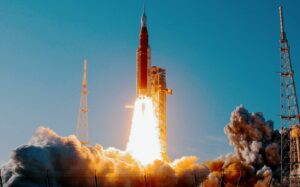
Recently, NASA’s Artemis II mission Successfully launched on 1 April 2026, marking the first crewed lunar mission in over 50 years and testing systems for future human landings.
What is Artemis II Mission?
- About: Artemis II is the first crewed lunar mission after the Apollo era (last in 1972), marking a gap of over 50 years. The mission was launched under NASA’s Artemis Program, to sustain human presence on the Moon and beyond.
- Launch Details: The mission was launched on April 1, 2026, from Launch Complex 39B at NASA’s Kennedy Space Center in Florida.
- Background: The mission builds on Artemis I (2022), an uncrewed test flight that validated systems like the Orion spacecraft. Artemis II represents the second phase, which was officially established in 2017 following Space Policy Directive 1.
- Agencies: This mission is led by NASA (USA) in partnership with the Canadian Space Agency (CSA) and the European Space Agency (ESA).
- The ESA provides the critical European Service Module for Orion, while the CSA provides key robotic technology and a crew member.
- Mission Type: Artemis II is categorized as a crewed lunar flyby mission. It will not land on the Moon; instead, it will perform a “translunar loop” that takes the crew around the far side of the Moon before returning to Earth.
- This type of mission, similar to Apollo 8 and Apollo 13, focuses on testing the spacecraft’s performance during long-duration flight.
- Funding: The Artemis program is a multi-billion dollar initiative, with estimated costs reaching approximately $93 billion through 2025.
- Specific hardware costs include the SLS rocket at roughly $23.8 billion and the Orion capsule at about $20.4 billion.
- Duration: The planned mission duration is approximately 10 days from launch to splashdown. The timeline includes a one-day initial Earth orbit for system checkouts, followed by a four-day outbound journey to the Moon, a lunar flyby, and a four-day return trip to Earth.
- Crew Members: The four-person crew includes Commander Reid Wiseman (NASA), Pilot Victor Glover (NASA), and Mission Specialists Christina Koch (NASA) and Jeremy Hansen (CSA).
- This historic crew features the first woman (Koch), the first person of color (Glover), and the first non-U.S. citizen (Hansen) to travel to the vicinity of the Moon.
- Trajectory: Orion will utilize a hybrid free-return trajectory, which uses the gravity of the Earth and Moon to pull the spacecraft back home naturally.
- The crew will travel roughly 4,700 miles (7,600 km) beyond the far side of the Moon, reaching a maximum distance of over 230,000 miles from Earth—the farthest humans have ever ventured into deep space.
- Launch System: The Space Launch System (SLS) Block 1 is the primary launch vehicle, standing 322 feet tall and producing 8.8 million pounds of thrust.
- It is the most powerful rocket ever built, designed specifically to send the Orion spacecraft, its crew, and cargo directly to the Moon in a single launch.
- Objectives: The primary objective is to validate human-rated deep-space systems, specifically testing the Environmental Control and Life Support System (ECLSS) with a crew on board.
- Other critical goals include testing deep-space communications, navigation, and manual piloting capabilities, as well as verifying the heat shield’s performance during a high-speed reentry of 25,000 mph.
- Features: Artemis II features advanced technologies like the Orion Optical Communications System (O2O), which enables high-bandwidth data downlink speeds of up to 260 Mbps.
-
- The mission uses a “free-return trajectory”, enabling the spacecraft to loop around the Moon and return without engine burns, ensuring fail-safe recovery in emergencies.
- The mission carries multiple CubeSats from countries like Germany, Argentina, South Korea, and Saudi Arabia, enabling global participation in deep-space experiments.
- The European Service Module (ESM) carries a precise inventory of 90 kg of oxygen, 30 kg of nitrogen, and 240 kg of drinking water to sustain four astronauts for 10 days.
- During the mission, astronauts will manually pilot the Orion spacecraft near the jettisoned Interim Cryogenic Propulsion Stage (ICPS) to test handling qualities.
- To safeguard the crew from Solar Particle Events (SPEs), the mission features the Hybrid Electronic Radiation Assessor (HERA) and the AstroRad protective vest.
|
Artemis Program:
|
|
Also Read: Chandrayaan-4 to Land on Mons Mouton Near Moon South Pole |