




INS Aridhaman
|
General Studies Paper III: Indigenization of Technology, Defence Technology |
Why in News?
Recently, the Indian Navy commissioned INS Aridhaman, third indigenously built nuclear-powered ballistic missile submarine, enhancing India’s nuclear triad and second-strike capability.
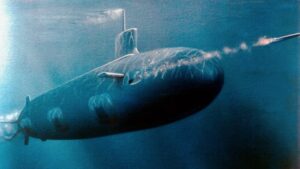
India’s Nuclear Missile Submarine – INS Aridhaman
- Intro: INS Aridhaman is India’s third indigenously built nuclear-powered ballistic missile submarine (SSBN) under the Arihant-class. It is officially designated S4 (SSBN-82) and represents an advanced generation of India’s underwater nuclear fleet.
- Background: The submarine is developed under the highly classified Advanced Technology Vessel (ATV) Project, India’s long-term programme to build nuclear submarines.
-
-
- The submarine was laid down in 2018, launched in November 2021, and completed extensive sea trials by late 2025, before being commissioned in 2026.
-
- Development: INS Aridhaman was constructed at the Ship Building Centre (SBC), Visakhapatnam, a dedicated facility for nuclear submarine production.
-
-
- The development involved collaboration between DRDO, BARC, and the Indian Navy for reactor and platform development.
-
- Features:
- Displacement & Dimensions: It has an estimated displacement of around 7,000 tonnes, making it larger than earlier Arihant-class submarines. Its length is about 130 metres, with a beam of roughly 11 metres, providing space for advanced systems.
- Propulsion System: The submarine is powered by an 83 MW Compact Light Water Reactor (CLWR-B1). This nuclear propulsion gives it virtually unlimited range and endurance, limited only by crew supplies.
- Operational Capability: INS Aridhaman can achieve speeds of about 24 knots underwater and around 12 knots on the surface. It can operate at depths between 300–400 metres, allowing stealthy deep-sea missions.
- Stealth and Acoustic: The upgraded reactor and design provide a lower acoustic signature, making the submarine harder to detect by enemy sonar systems, critical for survivability in underwater operations.
- Launch Capability: A key feature is its eight Vertical Launch System (VLS) tubes, double that of earlier variants. These tubes allow the submarine to carry a significantly higher number of ballistic missiles.
- Missile Types & Payload: The submarine can carry K-15 (750 km range), K-4 (3,500 km range), and potentially K-5 (up to 6,000 km range) ballistic missiles. It can hold up to 24 K-15 missiles or 8 longer-range missiles, depending on configuration.
- Sensors & Combat Systems: It is equipped with advanced indigenous systems such as USHUS sonar and Panchendriya integrated sonar and communication system, ensuring improved underwater detection and combat coordination.
- Indigenous Content: The submarine reportedly has around 90% indigenous content, reflecting India’s progress in metallurgy and submarine design technologies. It is considered one of the most technologically complex defence platforms built in India.
India’s Indigenous Nuclear-Powered Ballistic Missile Submarines
India’s indigenously built nuclear submarines belong to the Arihant-class SSBN (Ship Submersible Ballistic Nuclear) category. These submarines are designed to carry submarine-launched ballistic missiles (SLBMs) and operate as long-duration underwater strategic platforms.
- INS Arihant: INS Arihant (SSBN‑80) is India’s first indigenously built nuclear‑powered ballistic missile submarine.
- It was laid down in 2004, launched in July 2009, and formally commissioned in August 2016 by the Indian Navy, marking the nation’s entry into the small global club of SSBN‑capable powers.
- Arihant displaces approximately 6,000 tonnes (surfaced) and uses an 83 MW CLWR for propulsion.
- The submarine has four VLS tubes capable of carrying up to 12 K‑15 (Sagarika) SLBMs with a range of ~750 km or four K‑4 SLBMs with a range ~3,500 km.
- INS Arihant completed its first official 20-day deterrence patrol in November 2018, marking the full operationalisation of India’s nuclear triad.
- INS Arighaat: INS Arighaat (SSBN‑81) is the second submarine in the Arihant class. After construction and sea trials, it was officially commissioned on 29 August 2024 at Visakhapatnam, reinforcing India’s strategic underwater fleet.
- Arighaat displaces around 6,000 tonnes, uses an 83 MW CLWR, and can remain submerged for months without surfacing, limited only by crew endurance and supplies on board. (
- INS Arighaat carries a similar missile load to Arihant: up to 12 K‑15 SLBMs or four K‑4 SLBMs. This flexibility allows it to perform longer range deterrence patrols in varied mission profiles.
- In November 2024, INS Arighaat successfully test‑fired a long‑range K‑4 SLBM (range ≈ 3,500 km) while submerged in the Bay of Bengal.
Significance of Nuclear Submarines for India
- Strategic Second-Strike Capability: Nuclear-powered ballistic missile submarines (SSBNs) like INS Aridhaman provide a survivable sea-based second-strike capability. This ensures that India can retaliate even if land-based assets are destroyed. It is the most vital leg of the nuclear triad.
- Enhanced Maritime Endurance: Unlike conventional submarines, nuclear vessels can stay submerged for months without surfacing. This stealth makes them nearly impossible for adversaries to detect in the vast Indian Ocean Region.
- Regional Power Balance: India is the only South Asian nation with operational SSBNs. This capability counters the growing presence of the Chinese PLA Navy in the Indo-Pacific. It establishes a strategic balance and prevents regional nuclear coercion.
- Geopolitical Influence: Possessing such advanced technology elevates India into an elite group of six nations. It strengthens India’s role as a net security provider in the region. This status enhances diplomatic leverage and signals technological maturity.
- Economic Self-Reliance: The Advanced Technology Vessel (ATV) project has fostered a massive indigenous defense ecosystem. Over 75% indigenous content in new vessels supports thousands of jobs and hundreds of MSMEs. It reduces long-term import dependency.
- Operational Flexibility: Newer models like the 7,000-tonne Aridhaman carry more K-4 missiles with a 3,500 km range. This allows for Continuous At-Sea Deterrence (CASD). It provides the military with flexible options for power projection and surveillance.
- Security of Sea Lanes: Nuclear attack submarines (SSNs) are essential for protecting critical sea lanes of communication (SLOCs). They safeguard India’s economic lifelines against underwater threats. This ensures freedom of navigation in contested waters.
|
Advanced Technology Vessel (ATV) Project:
|
|
Also Read: Indian Navy Set to Induct Indigenous ASW Ship Mahe |